
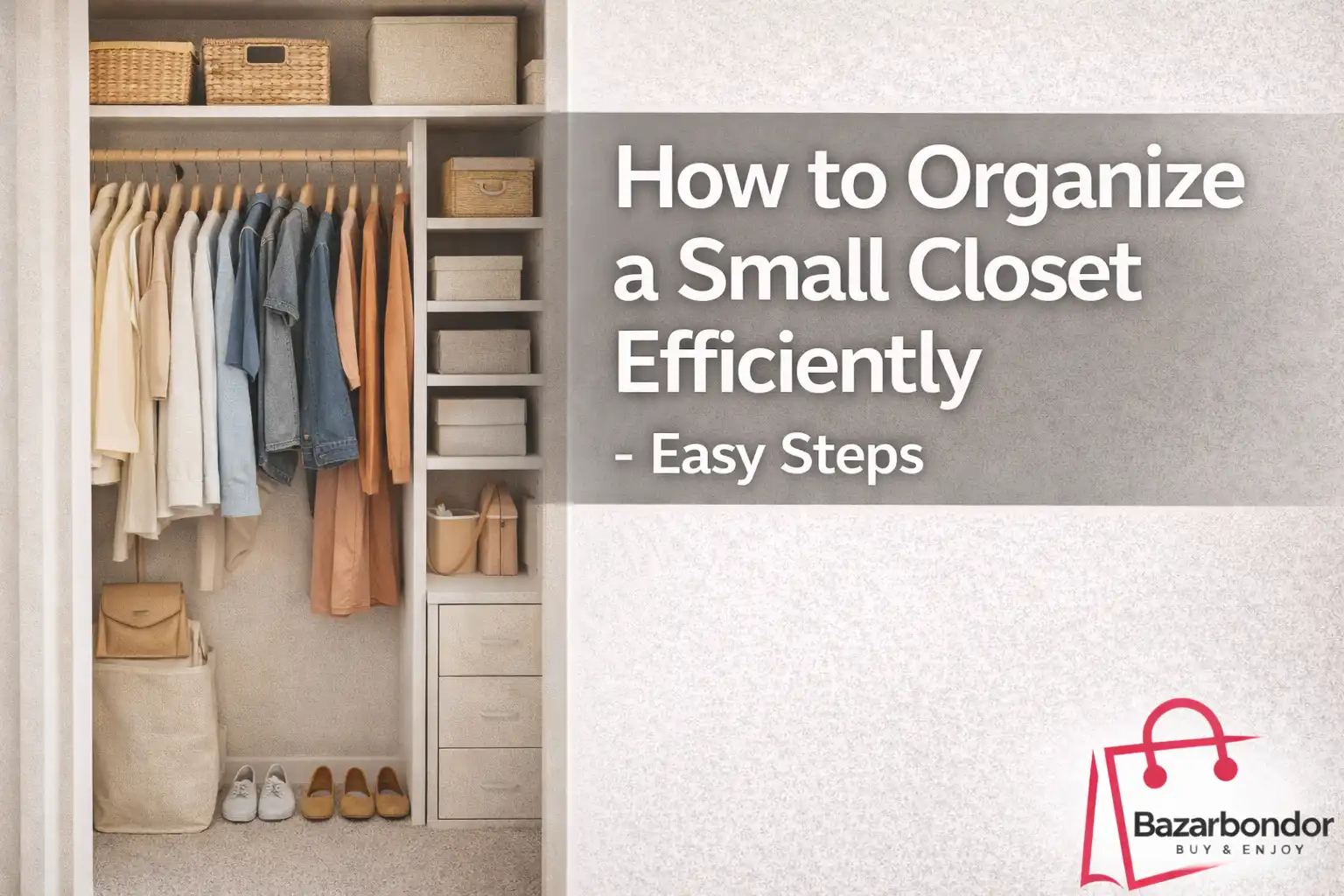
Organizing a small closet efficiently means using every inch of vertical and horizontal space with smart storage like double rods, slim hangers, and door racks. It matters because a clutter-free closet saves you time, reduces stress, and helps you actually see what you own.
I’ve Been Where You Are Right Now
That feeling when you open your closet and something falls out? Yeah, me too. For years, I stuffed jackets next to dresses, lost matching shoes, and bought duplicates of things I already owned because I couldn’t find the original.
I’m a professional organizer who has worked with hundreds of people across the US, UK, Canada, and Australia. And the number one complaint I hear? “My closet is too small.”
But here’s the truth: Most small closets aren’t the problem. The system is.
By the time you finish this article, you’ll know exactly how to organize a small closet efficiently without spending a fortune or needing a renovation. Let’s fix this together.
The Real Struggles (And What Actually Works)
Before we talk about pretty bins and matching hangers, let’s name what’s actually driving you crazy. These are the three biggest pain points I see again and again.
Pain Point #1: “I Can’t See What I Own”
You shove things to the back. You forget about that sweater you love. So you buy another one. Sound familiar?
Why it happens: Most closets are designed as a single rod with a shelf above. That’s a black hole. Deep, dark, and easy to lose things in.
The fix you can use today: Divide your closet into zones. Hang only what truly needs hanging (dresses, dress shirts, coats). Fold everything else. Use slim, velvet hangers – they take up half the space of plastic or wire ones. I switched my entire closet to these for under $20 at Target (US), Wilko (UK), Canadian Tire, or Kmart AU.
Real example: A client in Manchester had a closet so small she called it “the coffin.” We removed the single rod, installed two rods (one at 40 inches, one at 80 inches), and suddenly she had space for tops on top, pants below. No renovation. Just a screwdriver.
Pain Point #2: “I Have Too Much Stuff (But I Wear The Same 5 Things)”
You purge. Then three months later, it’s full again. You feel guilty getting rid of gifts or things you “might need someday.”
Why it happens: We keep clothes for our fantasy self – the person who will wear sequins on a Tuesday or fit into those jeans from 2019. That person doesn’t live here.
The fix you can use today: The Reverse Hanger Trick. Turn all your hangers backwards. Every time you wear something and hang it back up, turn the hanger the correct way. After 30 days, anything still backwards? You haven’t touched it. Donate it (USA/Canada: Goodwill, Salvation Army; UK: British Heart Foundation, Oxfam; Australia: Vinnies, Salvos).
“But what if I need it next season?” Pick one small bin. Label it “Seasonal.” Keep max one bin. If it doesn’t fit, something else has to go.
Pain Point #3: “My Shoes Are Everywhere”
Shoes on the floor. Shoes in a pile. Shoes that get stepped on and misshapen.
Why it happens: Floor space is prime real estate, and shoes are awkwardly shaped. We throw them down because we’re tired.
The fix you can use today: Over-the-door shoe pockets. Not just for shoes – they’re genius for scarves, belts, cleaning supplies, even kids’ art supplies. In the UK and Australia, look for “door hanging organiser” at Argos or Bunnings. In the US, Amazon or The Container Store.
Pro tip from a client in Sydney: She mounted a tension rod at the bottom of her closet (just a few inches off the floor) and hung her heels by the straps. Zero floor space used. Cost: $8.
Your Step-by-Step Small Closet System
Now let’s build a system that works. Set aside two hours this weekend. You can do this.
Step 1: Empty Everything. Yes, Everything.
I know. It looks worse before it looks better. But you cannot organize what you cannot see.
Pull every single item out. Put it on your bed or the floor. You are now forced to deal with it – no shoving things back in.
As you empty, wipe down the shelves, rod, and walls. A clean slate feels different. Trust me.
Step 2: The Four-Box Method
Get four bags or boxes:
- Keep – items you love and wear regularly
- Donate/Sell – good condition, but not for you
- Trash – stained, ripped, stretched out
- Maybe – the “I’m not sure” pile. Limit this to 5 items total.
Ask yourself these three questions for every item:
- Have I worn this in the last 12 months? (In Australia, factor in seasons – if you skipped last summer’s heat wave, you’ll skip next year too.)
- Does it fit me right now?
- If I saw this in a store today, would I buy it again?
If you answer no to any of those, it goes.
“Clutter is not just the stuff on your floor – it’s the decisions you haven’t made. Getting rid of clothes you don’t wear is not wasteful. Keeping them while others could use them is.” – Marie Kondo, Tidying Expert and Author
Step 3: Measure Your Space (Then Measure Again)
This is where people mess up. They buy organizers that almost fit. Don’t be that person.
Measure:
- Width of the closet
- Height from floor to rod
- Depth from back wall to door
- Door height (for over-door racks)
Real-world example: A client in Toronto bought a beautiful 10-shelf shoe rack online. It was two inches too deep. The closet door wouldn’t close. We returned it and used stackable clear bins instead – half the price, double the function.
Now decide on your closet configuration:
| Closet Height | Best Setup |
|---|---|
| Under 60 inches | Single rod + high shelf |
| 60–80 inches | Double rods (one high, one low) |
| Over 80 inches | Single rod + two shelves above |
Step 4: Choose Your Storage Tools
You don’t need fancy. You need functional.
What I actually recommend (by country):
- Slim velvet hangers – available at Walmart/Target (US), Tesco/Argos (UK), Dollarama/Canadian Tire (Canada), Kmart/Big W (Australia)
- Stackable clear bins – label them: “Sweaters,” “Workout,” “Off-season.” Clear means no guessing.
- Tension rod – for scarves, bags, or a lower hanging bar without drilling holes
- Door rack – over-the-door pockets or hooks. In rental flats (common in London and Sydney), use Command hooks – no damage to walls.
- Cascading hangers – these drop down vertically. Great for tanks, camis, or ties.
What to skip: Complicated folding boards, bulky wooden hangers, and anything that claims to “revolutionize” your closet. Simplicity wins every time.
Step 5: Zone Your Closet Like a Pro
Think of your closet like a grocery store. The milk is in the back because you go there every day. Same logic here.
Top shelf (hardest to reach): Seasonal items, luggage, bulky blankets. You only need these a few times a year.
Eye level (prime zone): Everyday items. Shirts, blouses, jackets you wear weekly.
Lower rod or floor: Pants, skirts, folded jeans, shoes.
Back of door: Accessories, bags, belts, scarves, cleaning wipes.
Pro tip: Hang clothes by category, not color. All short sleeves together. All long sleeves together. All pants together. This sounds simple, but you’d be shocked how many people don’t do it. It cuts decision time in half.
“The most efficient small closets have one thing in common: a place for everything and everything in its place – but only after you’ve edited ruthlessly. Storage solutions won’t save you if you’re storing things you don’t need.” – Peter Walsh, Professional Organizer and Author of “It’s All Too Much”
Step 6: The “Out of Sight” Strategy for Non-Clothes
Small closets often become dumping grounds for everything: old photos, gift wrap, electronics, sports gear.
Stop that today. Your closet is for clothes and accessories. Period.
Move non-clothing to:
- A hallway closet
- Under-bed bins (great for UK homes with limited storage)
- A dedicated drawer
- A [INTERNAL LINK: how to organize a small bedroom] if your bedroom has extra space
One exception: A single bin for “sentimental” items (baby clothes, wedding memorabilia). Keep it small. When it fills up, edit it down.
Step 7: Maintain the System (5 Minutes a Day)
Here’s where most people fall off. You organize beautifully, then life happens.
The 5-minute daily reset:
- Put one thing back immediately after trying it on (no “I’ll do it later”)
- Every night before bed, hang or fold anything you wore that day
- Once a week, scan for items that migrated to the wrong zone
The seasonal swap: Twice a year (spring and fall for US/Canada/UK, spring and autumn for Australia), swap out heavy coats for shorts, or vice versa. Move off-season items to a bin on the top shelf. This alone doubles your usable space.
“Organization is not a one-time event. It’s a daily practice. The people who keep their small closets functional aren’t tidier than you – they just have better habits. Start with the two-minute rule: if it takes less than two minutes to put something away, do it immediately.” – Gretchen Rubin, Author of “The Happiness Project”
Real-Life Fixes for Tricky Small Closet Shapes
Not all small closets are created equal. Here’s how to handle the awkward ones.
The Reach-In (Narrow and Shallow)
Common in older US and UK homes. The depth is maybe 18 inches.
Solution: Use a single rod only. Fold everything else. Skip the door rack – it will hit your clothes. Instead, install a DIY closet shelf brackets on the back wall for folded items.
The Slanted Ceiling Closet
Typical in converted lofts (Brooklyn, Toronto, Manchester) and Australian apartments under the roofline.
Solution: Low-profile bins on the short side. Hang shirts on the tall side. Use adhesive hooks on the slanted wall for lightweight bags.

The “No Door” Closet
Open to the room. Looks messy even when it’s tidy.
Solution: A tension rod with a curtain. Buy a cheap blackout curtain or a light linen one (IKEA works in all four countries). Suddenly it’s a closet. Cost: under $30.
The National Association of Productivity and Organizing Professionals (NAPO) has a fantastic free guide called “Organizing Your Closet on a Budget.” They include printable checklists and measurements sheets. You can find it on their official website under the Resources section. Highly recommended.

Frequently Asked Questions on How to Organize a Small Closet
How long does it take to organize a small closet efficiently?
Most people finish in 2–4 hours, depending on how much you purge. The first hour is the hardest because you’re making decisions. After that, it flows faster. Set a timer for 90 minutes and do it in one go.
What’s the cheapest way to organize a small closet?
Use what you already own. Repurpose shoe boxes as drawer dividers. Cut a cardboard tube (from wrapping paper) to keep boots upright. Use soda can tabs to double your hanger space – hook one tab onto another hanger. Free and clever.
Should I use vacuum storage bags for a small closet?
Yes, but only for true off-season items like bulky winter coats or duvets. Vacuum bags save space but make items wrinkly. For everyday sweaters, fold them normally. For US and Canadian winters, vacuum bags are a lifesaver. For Australian winters, you probably don’t need them.
How often should I declutter my small closet?
Do a mini-declutter every season (every 3 months). That takes 15 minutes – pull out anything you didn’t wear that season. Do a full overhaul once a year. Put a reminder on your phone for the first weekend of March and September.
Can I organize a small closet without buying anything new?
Absolutely. The Reverse Hanger Trick costs nothing. Moving your rods costs nothing. Folding instead of hanging costs nothing. I’ve organized closets using only binder clips (to hold scarves) and rubber bands (to keep boots paired). Start with what you have.
Let’s Wrap This Up
Three things I want you to remember:
- Empty, edit, then organize. Never buy bins before you purge. You don’t know what space you actually have until the extra stuff is gone.
- Use vertical space. Double rods, door racks, and stackable bins turn a tiny closet into a functional one. Most people ignore the top 12 inches of their closet. That’s free real estate.
- Maintenance takes five minutes a day. The system only works if you use it. Put things back. Do the reverse hanger trick. You’ve got this.
You don’t need a walk-in closet. You don’t need a renovation. You just need a plan and two hours. I’ve seen people cry happy tears after finishing this process – not because their closet was magazine-perfect, but because for the first time, they could breathe.
Start today. Open that door. Pull everything out. Future you is going to be so grateful.

“I believe your home should tell your story, not your bank account statement.”
Hi, I’m Benjamin Harrison. I grew up in a small town in Ohio, helping my dad refinish old furniture in the garage, and that’s where my love for home decor began. After years of working as a set designer, I realized my real passion was helping everyday people fall in love with their homes again. Here on my blog, I share easy DIY projects, budget-friendly room makeovers, and tips on how to find hidden gems at thrift stores. When I’m not rearranging my own living room for the tenth time, I’m probably drinking coffee on my porch in Charleston with my wife and our golden retriever.