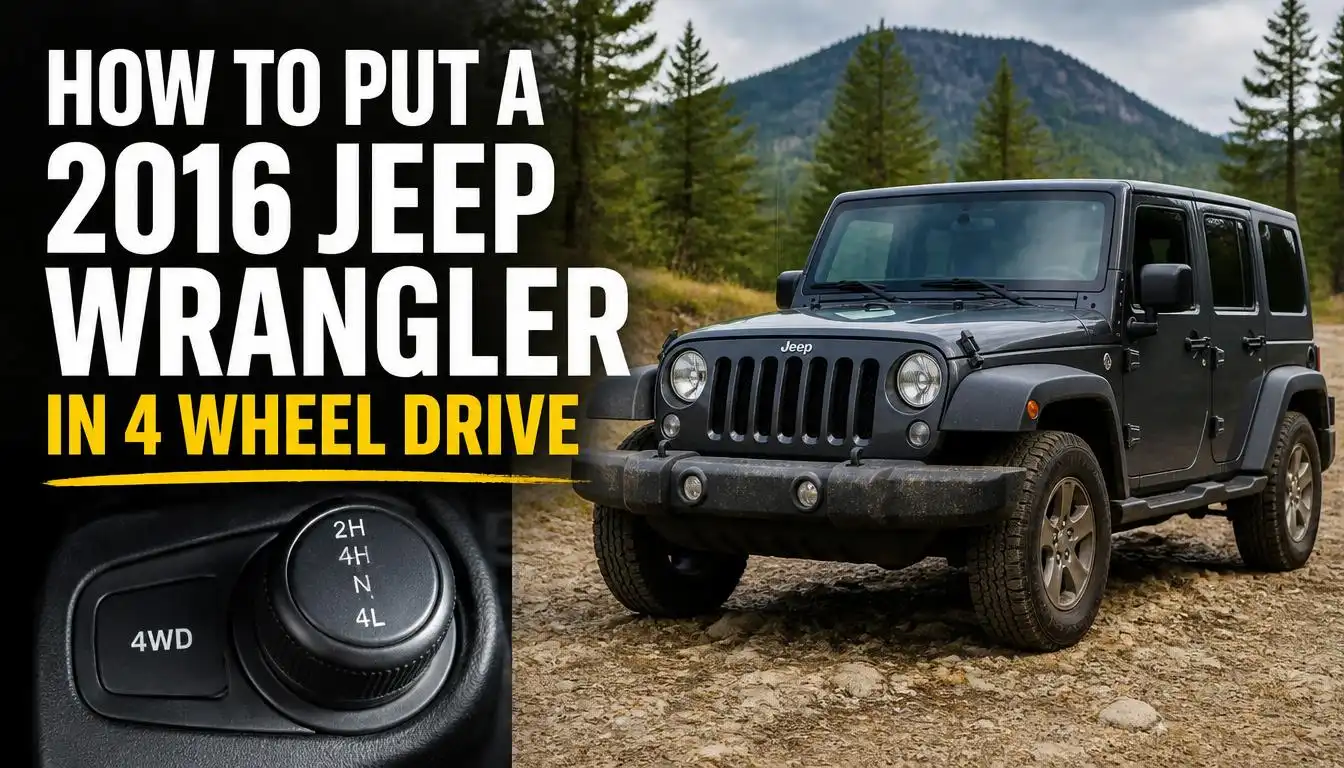
If you need more traction from your 2016 Jeep Wrangler, putting it into four-wheel drive is simple once you understand the transfer case lever.
For normal slippery conditions, move the transfer case lever from 2H to 4H. You can make this shift while the Jeep is stopped or moving. For 4L, slow to about 2–3 mph (3–5 km/h). With an automatic transmission, shift the transmission into Neutral. With a manual transmission, press the clutch. Then move the transfer case lever firmly from 4H through N and into 4L.
The key is choosing the right mode for the conditions. Below, I’ll walk you through exactly how to put a 2016 Jeep Wrangler in 4 wheel drive, when to use 4H or 4L, and what to do if the transfer case does not shift as expected.
Quick Steps To Put a 2016 Jeep Wrangler in 4WD
If you simply want to engage four-wheel drive for snow, mud, gravel, sand, or another loose surface, follow these steps:
- Start your Jeep and locate the smaller transfer case lever beside the main transmission shifter.
- Make sure the transfer case is currently in 2H.
- Move the transfer case lever firmly from 2H to 4H.
- If you are moving, briefly ease off the accelerator after making the shift.
- Check the instrument cluster for the 4WD indicator light.
- Once 4H is fully engaged, continue driving at a speed that suits the road or trail conditions.
That is all you need for most situations where a 2016 Jeep Wrangler needs extra traction.
You do not need to put an automatic transmission into Neutral just to shift from 2H to 4H.
The procedure changes when you want to enter 4L, which we will cover below.
How the 2016 Jeep Wrangler 4WD System Works
The 2016 Jeep Wrangler is part of the JK generation and uses a traditional part-time 4×4 system. Depending on equipment, Jeep refers to the four-wheel-drive system as Command-Trac I or Rock-Trac.
The transfer case gives you four positions:
| Position | Meaning | Best Used For |
|---|---|---|
| 2H | Two-Wheel Drive High Range | Normal roads and highways |
| 4H | Four-Wheel Drive High Range | Snow, mud, gravel, sand, and slippery surfaces |
| N | Transfer Case Neutral | Mainly recreational/flat towing |
| 4L | Four-Wheel Drive Low Range | Deep mud, steep terrain, rocks, and low-speed off-road driving |
Jeep specifies 2H for normal hard-surfaced road driving. The 4H and 4L positions lock the front and rear driveshafts together and are intended for loose or slippery surfaces rather than ordinary dry pavement.
Command-Trac vs Rock-Trac
You may see the names Command-Trac and Rock-Trac while researching your 2016 Jeep Wrangler 4WD system.
Both use the familiar:
2H → 4H → N → 4L
transfer case pattern described in the 2016 Wrangler owner’s manual.
Rock-Trac is designed with more serious low-speed off-road use in mind, but the basic shifting procedure covered in this guide remains the same for the manual transfer-case systems described by Jeep.
What Does 2H Mean?
2H means Two-Wheel Drive High Range.
This should be your normal driving position when travelling on:
- Dry pavement
- City streets
- Motorways or highways
- Normal paved roads
- Other high-traction surfaces
If the weather and road surface are good, there is usually no reason to leave 2H.
What Does 4H Mean?
4H means Four-Wheel Drive High Range.
In this position, the transfer case sends power through the front and rear driveline to give the vehicle better traction on loose or slippery surfaces.
4H is useful for conditions such as:
- Snow-covered roads
- Loose gravel
- Mud
- Sand
- Dirt roads
- Slippery trails
Think of 4H as your normal extra-traction mode.
What Does N Mean?
The N on the transfer case is Neutral, but it is not the same as Neutral on your transmission.
Transfer case Neutral disconnects the driveshafts from the powertrain. Jeep primarily references this position for recreational or flat towing.
For normal driving, you should not leave the transfer case in N.
What Does 4L Mean?
4L means Four-Wheel Drive Low Range.
It gives you additional low-speed pulling power for difficult terrain.
Typical situations include:
- Deep mud
- Steep climbs
- Steep descents
- Rock crawling
- Deep sand
- Difficult off-road obstacles
- Situations requiring slow, controlled movement
4L is not simply a stronger version of 4H for everyday driving. It is a specialized low-range setting.
How To Shift a 2016 Jeep Wrangler From 2H to 4H
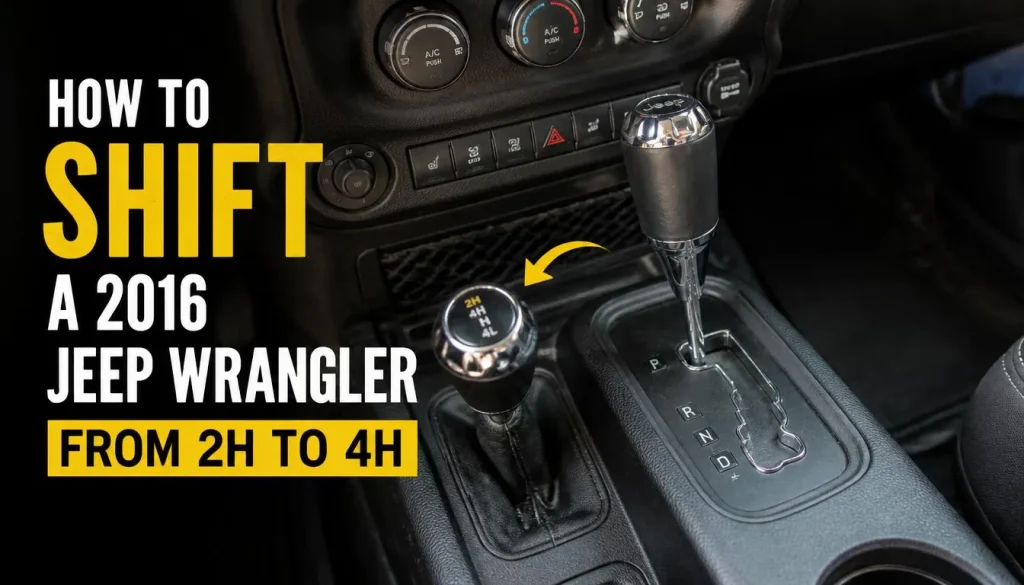
For most owners asking how to engage 4WD on a 2016 Jeep Wrangler, this is the procedure they need.
Step 1: Check the Road Surface
Before engaging 4H, make sure you actually need four-wheel drive.
If you are on normal dry pavement, stay in 2H. If you are entering snow, loose gravel, mud, sand, or another low-traction surface, 4H may be appropriate.
Step 2: Locate the Transfer Case Lever
Look beside your regular gear selector.
The shorter transfer case lever should show the positions:
2H – 4H – N – 4L
Do not confuse this lever with your transmission shifter.
Step 3: Shift From 2H to 4H
Move the transfer case lever firmly from 2H into 4H.
The 2016 Wrangler can be shifted between 2H and 4H with the vehicle either stopped or moving. If the Jeep is moving, Jeep notes that engagement or disengagement can happen more quickly if you briefly release the accelerator after completing the shift.
Do not jerk the lever back and forth. Use steady pressure and make sure it reaches the 4H position.
Step 4: Check the 4WD Indicator Light
Once the transfer case reaches 4H, look at the instrument cluster.
The 4WD indicator light should illuminate, letting you know the four-wheel-drive system is engaged.
If the lever seems to be between positions or the system has not fully engaged, do not simply continue driving as normal. Make sure the transfer case has completed the shift.
Can You Shift a 2016 Jeep Wrangler Into 4H While Driving?
Yes.
The 2016 Jeep Wrangler owner’s manual states that shifting between 2H and 4H can be done while the vehicle is stopped or in motion.
You do not have to stop every time you encounter snow, gravel, or another loose surface.
However, that does not mean you should make an aggressive transfer-case shift while accelerating hard or while the wheels are spinning.
Make the change smoothly and use a sensible speed for the conditions.
Do You Need Neutral To Shift Into 4H?
No.
You do not need to put an automatic transmission into Neutral when shifting normally between 2H and 4H.
Neutral becomes important when shifting between 4H and 4L with an automatic transmission.
How To Put a 2016 Jeep Wrangler in 4L
Putting your Jeep into 4 Low requires a different procedure.
Do not try to shift into 4L the same way you shift from 2H to 4H.
Jeep’s preferred method is to have the vehicle rolling very slowly at approximately 2–3 mph (3–5 km/h).
How To Shift Into 4L With an Automatic Transmission
Follow these steps:
- Make sure the transfer case is in 4H.
- Slow the Wrangler to around 2–3 mph (3–5 km/h).
- Put the automatic transmission into Neutral (N).
- Allow the vehicle to continue coasting slowly.
- Move the transfer case lever firmly from 4H through N and into 4L.
- Do not stop or pause with the transfer case lever in Neutral.
- Make sure 4L is fully engaged.
- Put the automatic transmission back into Drive.
The movement through the transfer case should be firm and deliberate rather than slow and hesitant.
How To Shift Into 4L With a Manual Transmission
If your 2016 Wrangler has a manual transmission:
- Start in 4H.
- Slow to approximately 2–3 mph (3–5 km/h).
- Press the clutch pedal.
- While slowly coasting, move the transfer case lever firmly through N and into 4L.
- Do not pause in transfer case Neutral.
- Confirm that 4L has engaged.
- Release the clutch pedal.
Jeep says it is possible to shift into or out of 4L while completely stopped, but the gears may not line up easily. The preferred method is to have the vehicle rolling at 2–3 mph because this helps the transfer case complete the shift.
How Fast Can You Drive in 4L?
Keep your speed low.
For the 2016 Wrangler, Jeep states that you should not exceed 25 mph (40 km/h) while the transfer case is in 4L. Exceeding that speed can cause an engine overspeed condition and possible engine damage.
In practice, 4L is meant for slow, difficult terrain anyway. If conditions allow you to travel comfortably at normal road speeds, you probably do not need 4L.
When To Use 2H, 4H, and 4L
Choosing the correct drive mode matters just as much as knowing how to move the lever.
When To Use 2H
Use 2H for your normal daily driving.
Examples include:
- Dry city streets
- Paved country roads
- Motorways
- Highways
- Dry parking areas
For most everyday driving, leave the Jeep in 2H.
When To Use 4H
Use 4H when you need additional traction but still need to travel at normal or moderate driving speeds.
Good examples are:
- Snow
- Slippery winter roads
- Loose gravel
- Dirt
- Mud
- Sand
- Slippery off-road trails
Remember that four-wheel drive helps the vehicle find traction, but it cannot eliminate the limits of braking, steering, or tire grip. Drive according to the conditions.
When To Use 4L
Choose 4L when traction alone is not enough and you need more low-speed pulling power and control.
It is useful for:
- Deep mud
- Difficult rocks
- Deep sand
- Very steep climbs
- Controlled steep descents
- Serious low-speed off-road driving
If you are just driving along a snowy paved road, 4H will usually make far more sense than 4L.
Can You Drive a 2016 Jeep Wrangler in 4H on Dry Pavement?
You should avoid it.
The 2016 Wrangler’s 4H and 4L modes are part-time four-wheel-drive settings intended for loose or slippery surfaces. Jeep warns that using these modes on hard-surfaced roads can increase tire wear and damage driveline components.
On normal dry pavement, switch back to 2H.
How To Take a 2016 Jeep Wrangler Out of 4 Wheel Drive
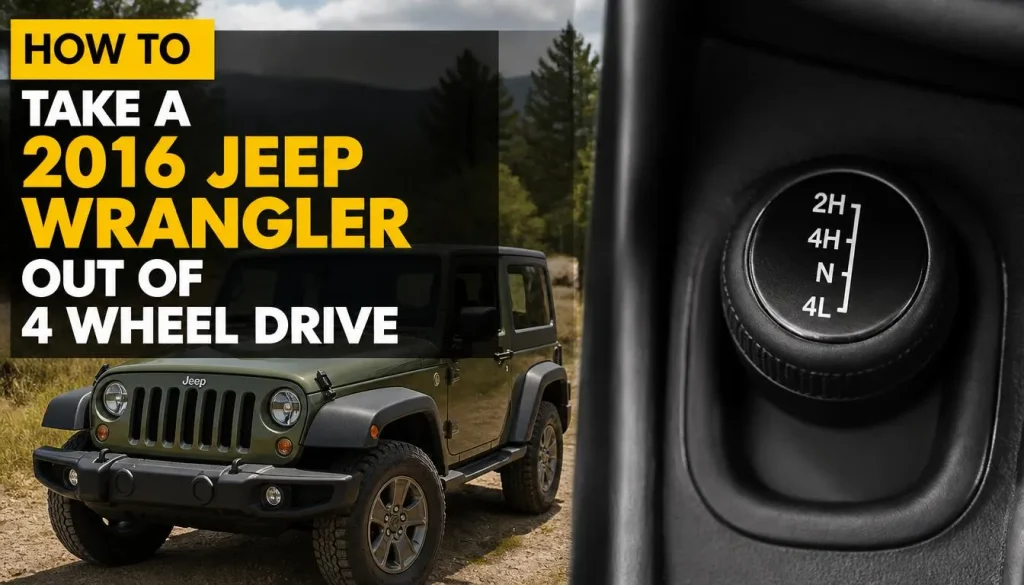
Getting back into normal two-wheel drive is straightforward.
How To Shift From 4H to 2H
To leave 4H:
- Make sure the wheels are not spinning.
- Move the transfer case lever firmly from 4H to 2H.
- If the Jeep is moving, briefly ease off the accelerator after the shift.
- Confirm that the 4WD indicator light goes out.
Like the 2H-to-4H shift, the 4H-to-2H shift can be performed while stopped or moving.
How To Shift From 4L to 4H
Use essentially the reverse of the procedure used to enter 4L.
For an automatic transmission:
- Roll slowly at about 2–3 mph (3–5 km/h).
- Put the transmission into Neutral.
- Firmly move the transfer case lever from 4L through N into 4H.
- Do not pause in transfer case Neutral.
- Return the transmission to Drive once the shift is complete.
For a manual transmission, press the clutch instead of putting an automatic transmission into Neutral.
What To Do If Your 2016 Jeep Wrangler Won’t Shift Into 4WD
A transfer case that does not shift immediately does not always mean something is broken.
Start with the simple things.
It Won’t Shift From 2H to 4H
First, make sure the front or rear wheels are not spinning.
Jeep specifically warns against making a transfer-case shift while the front and rear wheels are rotating at different speeds. Doing so can damage the transfer case.
If you are moving normally, make a firm shift into 4H and briefly ease off the accelerator.
If it still will not engage, stop somewhere safe and try again rather than forcing the lever.
It Won’t Go Into 4L
One common reason 4L feels difficult to engage is trying to shift while completely stopped.
The internal teeth may not be lined up correctly.
Instead, use Jeep’s preferred procedure:
- Roll at 2–3 mph (3–5 km/h)
- Automatic transmission in Neutral, or clutch pressed on a manual
- Firmly move the transfer case into 4L
- Do not pause in transfer case N
A little movement can help the internal parts line up.
The Jeep Is Stuck in 4H
Do not yank or kick the transfer case lever.
Make sure the vehicle is in a safe location, the wheels are not spinning, and there is no heavy load on the drivetrain. Then try a smooth 4H-to-2H shift while briefly easing off the throttle.
If the vehicle still refuses to leave 4H after reasonable attempts, have the transfer case linkage and drivetrain inspected.
The 4WD Light Doesn’t Come On
The 4WD indicator is designed to illuminate when the transfer case is in 4H or 4L.
If the lever has been moved but the indicator does not show four-wheel drive, do not assume the shift is complete.
Stop safely and check the transfer case position again. If the lever will not fully engage or the indicator continues behaving unexpectedly, an inspection may be needed.
The Transfer Case Lever Is Hard To Move
Some resistance is different from a lever that feels completely jammed.
For 4L in particular, gear alignment can make shifting difficult when the Jeep is stationary. Rolling slowly at 2–3 mph while following the correct Neutral or clutch procedure can make the shift easier.
Do not use excessive force.
Check the Tires Too
This is easy to overlook.
Jeep states that proper four-wheel-drive operation depends on all four tires having equal size, type, and circumference. Significant differences can affect shifting and damage the transfer case.
If your Wrangler has mismatched tires or one tire is dramatically different in wear or size, fix that issue before blaming the transfer case.
Common 2016 Jeep Wrangler 4WD Mistakes To Avoid
The Wrangler’s four-wheel-drive system is tough, but it still needs to be used correctly.
Using 4H on dry pavement:
4H is designed for loose or slippery surfaces. Return to 2H when you are back on normal dry roads.
Trying to shift into 4L too fast:
The recommended speed for the 4H-to-4L shift is only about 2–3 mph (3–5 km/h).
Confusing transmission Neutral with transfer case Neutral:
They are two different things. For an automatic 4H-to-4L shift, the transmission goes into Neutral while the transfer case lever moves through its own N position into 4L.
Pausing in transfer case Neutral:
When shifting between 4H and 4L, move firmly through N rather than stopping there.
Driving too fast in 4L:
Do not exceed 25 mph (40 km/h).
Shifting while wheels are spinning:
Front and rear driveshaft speeds need to be compatible for the transfer case to shift correctly. Wait until wheelspin has stopped.
Forcing a stubborn lever:
A difficult 4L shift may simply need slight vehicle movement for the gears to align.
Assuming 4WD makes every situation safe:
Four-wheel drive improves traction. It does not give you unlimited grip for braking or cornering.
Frequently Asked Questions About Put a 2016 Jeep Wrangler in 4 Wheel Drive
Can you put a 2016 Jeep Wrangler in 4WD while driving?
Yes. You can shift between 2H and 4H while the vehicle is stopped or moving. If you are moving, briefly easing off the accelerator after shifting can help the transfer case engage.
Do you have to stop to put a 2016 Jeep Wrangler in 4H?
No. A complete stop is not required for a normal 2H-to-4H shift.
Do you need to be in Neutral to shift into 4H?
No. Putting the transmission into Neutral is not required when shifting between 2H and 4H.
Do you need to be in Neutral to shift into 4L?
With an automatic transmission, yes. Slow to approximately 2–3 mph (3–5 km/h), put the transmission into Neutral, and then move the transfer case lever firmly into 4L. With a manual transmission, press the clutch pedal instead.
What is the difference between 4H and 4L on a Jeep Wrangler?
4H provides additional traction while allowing normal driving speeds appropriate for loose or slippery conditions. 4L provides much greater low-speed pulling power and control for demanding off-road terrain.
How fast can you shift from 2H to 4H?
Jeep’s 2016 Wrangler owner’s manual confirms that the shift can be made with the vehicle stopped or moving, but the manual section does not give a specific numerical maximum shift speed. For that reason, it is better to make the shift smoothly at a sensible speed for the conditions rather than rely on a generic speed limit quoted for a different Jeep model or model year.
How fast can you drive a 2016 Jeep Wrangler in 4L?
Do not exceed 25 mph (40 km/h) in 4L.
Can you drive a Jeep Wrangler in 4H on dry pavement?
You should not use 4H for normal dry-pavement driving. The part-time system locks the front and rear driveline together, and using it on a high-traction surface can increase tire wear and stress driveline components.
How do I know my Jeep Wrangler is actually in 4WD?
Check that the transfer case lever is fully in 4H or 4L and look for the 4WD indicator light in the instrument cluster.
Is the 2016 Jeep Wrangler full-time or part-time 4WD?
The traditional 2H, 4H, N, and 4L system in the 2016 Wrangler is a part-time four-wheel-drive system. For normal dry roads, use 2H. Engage 4H or 4L when the surface provides enough slip to allow the front and rear driveline to work correctly.
Does this process apply to a 2016 Jeep Wrangler Unlimited?
If your 2016 Jeep Wrangler Unlimited is equipped with the manual transfer case showing 2H, 4H, N, and 4L, the shifting procedures described above apply to that system.
Are the 4WD controls different on Sport, Sahara, and Rubicon models?
The exact four-wheel-drive hardware can vary by equipment, including Command-Trac and Rock-Trac systems. However, the 2016 Wrangler owner’s manual describes the basic manual transfer-case positions as 2H, 4H, N, and 4L, with the same core shifting procedure covered in this guide.
Final Thoughts
Putting a 2016 Jeep Wrangler in four-wheel drive becomes easy once you remember one simple difference.
For ordinary extra traction, move the transfer case from 2H to 4H. That shift can be made while stopped or moving.
For serious low-speed off-road traction, slow to 2–3 mph (3–5 km/h), put an automatic transmission in Neutral or press the clutch on a manual, and firmly shift from 4H through N into 4L.
Use 2H on normal dry pavement, save 4H for loose or slippery conditions, and use 4L when the terrain really requires low-speed pulling power.
Most importantly, never force a transfer case that has not fully engaged. A few seconds spent making the shift correctly can save you from unnecessary drivetrain problems later.

“Cars aren’t just machines. They’re freedom, memory, and a little bit of grease under your fingernails.”
I’m Theodore Roosevelt—though my friends just call me “Ted” (and no, I’m not related to the president, though I do share his love for adventure). I grew up in Detroit in the 1970s, back when the city was still the heart of the American auto industry. My first love was a rusted-out 1967 Mustang my father and I rebuilt in our garage when I was fifteen. That project taught me that cars have souls. After spending twenty years as a mechanic and another ten writing for magazines, I started this blog to help everyday drivers and weekend wrenchers feel confident under the hood. Whether you’re restoring a classic or just trying to keep your daily driver alive for one more winter, I’m here to help you get there.