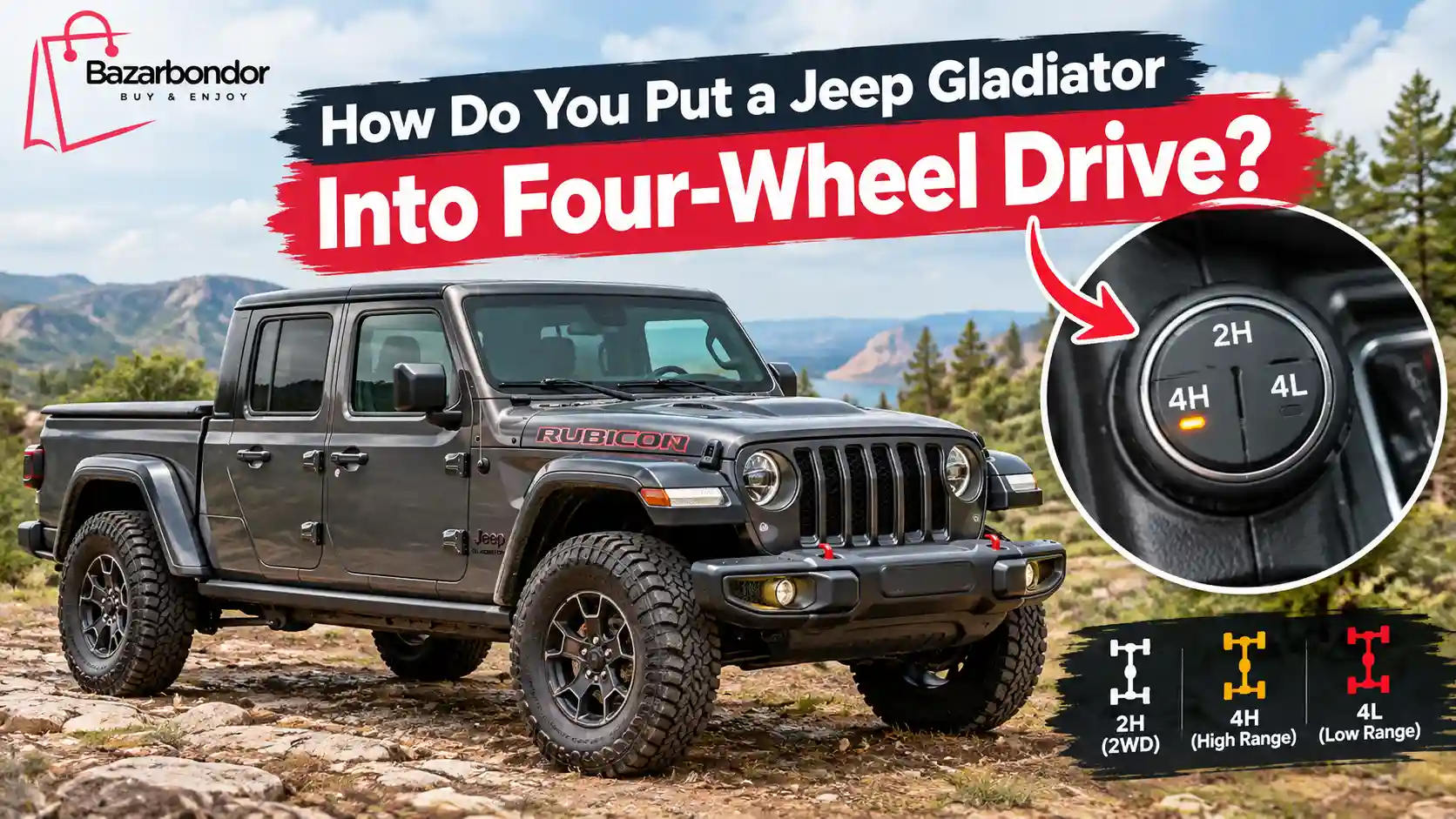
Putting a Jeep Gladiator into four-wheel drive is simple once you understand the transfer-case positions. For most Gladiators with part-time 4WD, move the transfer-case lever from 2H to 4H when you need extra traction on snow, mud, gravel, sand, or another loose or slippery surface. You can normally make the shift while stopped or while moving, but you should ease off the accelerator and follow the speed instructions in the owner’s manual for your specific model year.
Using 4L (4WD Low) requires a different procedure. Slow the Gladiator to a crawl, place an automatic transmission in Neutral, or depress the clutch on a manual-transmission model, and then shift the transfer case into 4L. Jeep recommends making a low-range shift while rolling at about 2–3 mph (3–5 km/h).
The important part is choosing the right four-wheel-drive mode for the conditions. Using 4H or 4L at the wrong time can cause poor handling, tire scrub, or unnecessary stress on drivetrain components.
Check Which 4WD System Your Jeep Gladiator Has
Before moving the transfer-case lever, look at the markings beside it.
Depending on the model, trim, model year, and equipment, the lever may show positions such as:
- 2H
- 4H Part Time
- 4H Auto, if equipped
- N
- 4L
This matters because 4H Part Time and 4H Auto do not work the same way.
A traditional part-time 4WD system mechanically connects the front and rear drivetrains for additional traction. Jeep advises using part-time 4WD on loose, wet, or slippery surfaces rather than normal dry pavement. A full-time system can allow different front and rear wheel speeds and is suitable for a wider range of surfaces.
Jeep also offers a Rock-Trac full-time 4×4 system that adds a 4H Auto setting, which automatically manages four-wheel-drive engagement as traction conditions change.
If the labels on your transfer-case lever differ from the examples in this guide, follow the owner’s manual for your exact Gladiator.
How to Put a Jeep Gladiator Into 4H Part Time
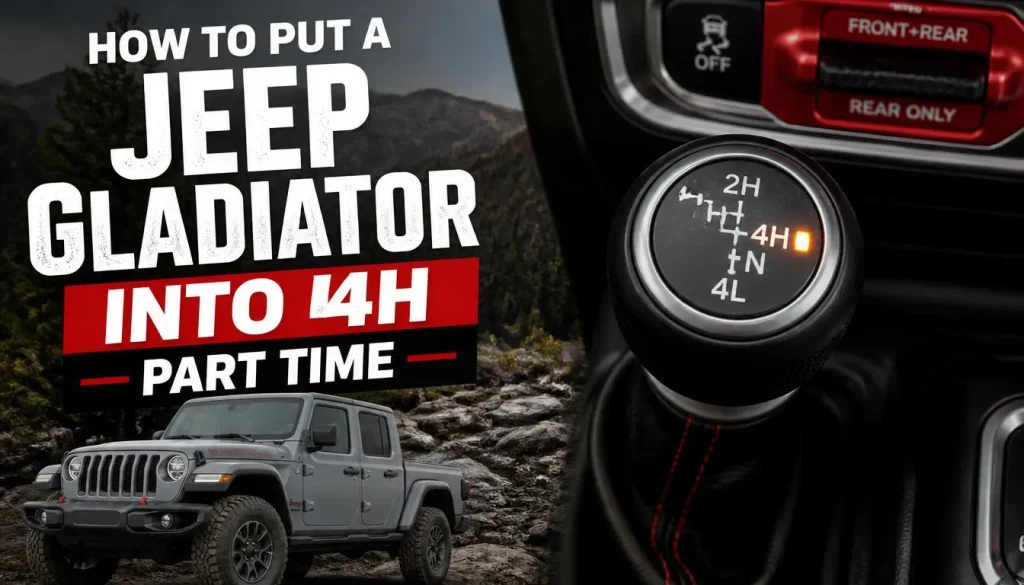
For most everyday situations where you suddenly need more traction, 4H Part Time is the mode you will use.
Here is the basic process.
1. Check the Road Surface
Use 4H Part Time when the tires have some ability to slip.
Good examples include:
- Snow-covered roads
- Mud
- Loose gravel
- Sand
- Dirt trails
- Slippery or uneven terrain
Jeep describes high-range 4WD as suitable for conditions such as gravel, mud, and sand.
2. Reduce Your Speed
You do not normally need to come to a complete stop to shift from 2H into 4H. However, reducing speed makes the shift smoother and gives you more control.
The exact maximum shift speed can vary by transfer case and model year, so use your Gladiator owner’s manual as the final reference rather than assuming one speed applies to every model.
3. Ease Off the Accelerator
Take pressure off the accelerator pedal while making the shift.
You do not need to floor the accelerator or force the system to engage. A light throttle or momentary release of the accelerator helps remove load from the drivetrain.
4. Move the Transfer-Case Lever From 2H to 4H Part Time
Move the lever firmly into the 4H Part Time position.
Do not stop the lever halfway between positions.
5. Confirm 4WD Has Engaged
Check the instrument cluster for the appropriate four-wheel-drive indicator.
Once the transfer case is fully engaged, you can continue driving while adjusting your speed to the surface conditions.
Remember that four-wheel drive improves your ability to move through poor-traction conditions, but it does not give you unlimited braking or cornering grip.
How to Put a Jeep Gladiator Into 4H Auto
If your Gladiator has 4H Auto, it works differently from 4H Part Time.
Move the transfer-case lever from 2H into 4H Auto when you want a four-wheel-drive mode that can automatically respond to changing traction conditions.
A full-time 4WD system allows differences in front and rear wheel speed, which means it can be used on surfaces where traditional part-time 4WD would be inappropriate.
4H Auto can be especially useful when road conditions change repeatedly—for example, when you are moving between dry pavement and patches of snow, ice, or wet roadway.
Do not assume your Gladiator has this feature simply because another Gladiator does. Check the transfer-case selector. If there is no 4H Auto position, your vehicle is not equipped with that transfer-case mode.
Jeep Gladiator 4H Auto vs 4H Part Time
The difference is important.
| Mode | Best Use | Dry Pavement |
|---|---|---|
| 2H | Normal everyday driving | Yes |
| 4H Auto | Changing traction conditions, if equipped | Generally suitable |
| 4H Part Time | Snow, mud, sand, gravel, loose surfaces | Avoid during normal dry driving |
| 4L | Slow, difficult off-road terrain | No normal road use |
4H Auto can manage power between the axles as traction changes.
4H Part Time locks the front and rear drivetrains together more directly. This provides strong traction on loose surfaces, but it does not allow the same difference in axle speed that is needed during normal turns on dry pavement. Jeep warns that prolonged part-time 4WD use on dry pavement can cause binding and driveline stress.
How to Put a Jeep Gladiator Into 4L
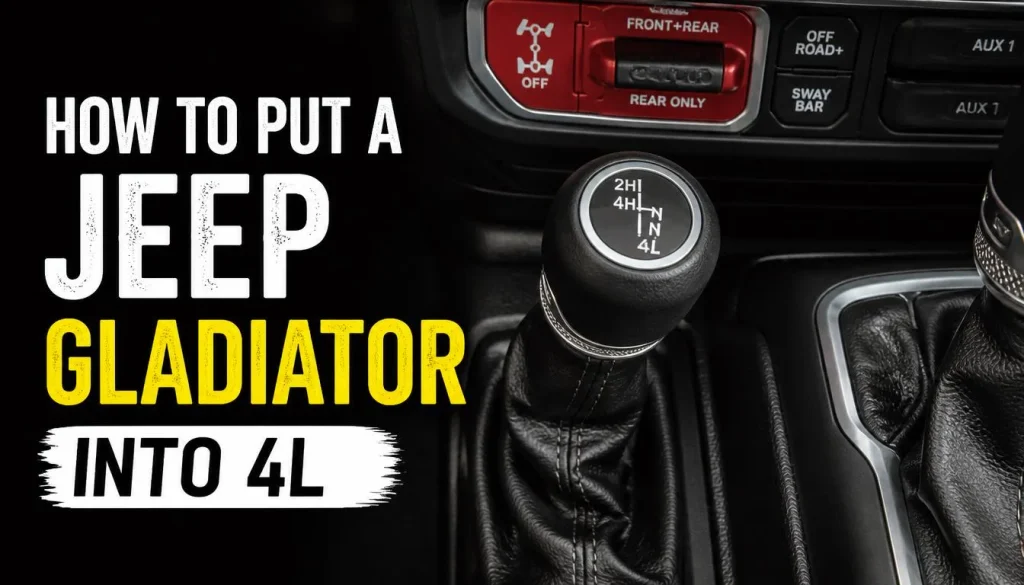
4L is not simply a stronger version of 4H that you should use whenever the road gets slippery. It is a low-range gear setting designed for slow driving when you need greater torque and control.
Jeep recommends this procedure for shifting into low range.
Step 1: Slow to About 2–3 MPH
Slow the Gladiator until it is barely rolling—about 2–3 mph (3–5 km/h).
A slow roll is actually preferred over being completely stopped because the transfer-case gears may align more easily.
Step 2: Put the Transmission in Neutral
If you have an automatic transmission, move the transmission selector into Neutral.
If you have an older or applicable manual-transmission Gladiator, depress the clutch pedal fully.
Step 3: Move the Transfer-Case Lever Into 4L
Move the transfer-case lever firmly through its required path into 4L.
Do not pause in transfer-case Neutral longer than necessary, and do not force the lever if the gears do not immediately engage.
Step 4: Confirm 4L Is Engaged
Look for the corresponding indicator on the instrument panel.
Step 5: Select the Driving Gear
After 4L is fully engaged, place the automatic transmission back into Drive or select the appropriate gear on a manual transmission.
Jeep advises not exceeding 25 mph (40 km/h) while operating in low range, although difficult off-road terrain will often require speeds far below that limit.
When Should You Use 4H on a Jeep Gladiator?
Use 4H when you need extra traction but still need to drive at normal or moderate speeds.
Typical situations include:
- Snow-covered roads
- Loose gravel
- Mud
- Sand
- Dirt roads
- Wet or slippery trails
- Moderate off-road terrain
Jeep specifically describes high-range 4WD as useful when driving over surfaces such as snow, ice, and rocky roads where more speed is needed than low range allows.
The key is traction. If you have a part-time system, 4H is not a mode that should simply remain engaged all year.
When Should You Use 4L on a Jeep Gladiator?
Use 4L when speed is less important than control and low-speed torque.
Good situations include:
- Rock crawling
- Very steep climbs
- Steep off-road descents
- Deep mud
- Soft sand
- Crossing difficult obstacles
- Pulling through a difficult off-road section
- Getting out of a low-speed situation where high range is not enough
Low range changes the gearing so the Gladiator can move slowly while providing more torque at the wheels. Jeep recommends low range for extreme off-road situations, including steep climbs and difficult terrain.
Do not use 4L simply because it is raining or because the highway is wet.
Can You Shift a Jeep Gladiator Into 4WD While Driving?
Yes, you can normally shift a Jeep Gladiator from 2H into 4H while the vehicle is moving.
Jeep’s general guidance says high-range four-wheel drive can be engaged while stopped or moving.
However, that does not mean you should make the shift at any speed. Transfer-case specifications can vary by model year and equipment.
For the smoothest shift:
- Travel in a straight line when possible.
- Reduce your speed.
- Ease off the accelerator.
- Move the transfer-case lever firmly into 4H.
- Confirm the four-wheel-drive indicator.
Shifting into 4L is different. Slow to approximately 2–3 mph, put an automatic transmission in Neutral—or depress the clutch on a manual—and then make the low-range shift.
Do You Have to Stop to Put a Jeep Gladiator in 4WD?
Not for 4H.
A Jeep Gladiator can generally shift between 2H and 4H while moving, provided the vehicle is within the operating limits specified for its transfer case.
For 4L, stopping completely is possible in some situations, but Jeep says it is not the preferred method because the gear teeth may not line up correctly. A slow roll of roughly 2–3 mph is preferred.
That is why a driver may find the 4L lever easier to move when the Jeep is creeping slowly rather than sitting completely still.
Can You Drive a Jeep Gladiator in 4WD on Dry Pavement?
It depends on which four-wheel-drive mode you are using.
If your Gladiator is in 4H Part Time, avoid normal driving on dry pavement.
Part-time 4WD locks the front and rear axles together. During a turn, the front and rear wheels need to travel slightly different distances. On a loose surface, the tires can slip enough to release this difference. Dry pavement offers much more grip, so stress can build inside the drivetrain.
If your Gladiator has 4H Auto/full-time capability, that system is designed differently and can accommodate differences in wheel speed.
When normal road conditions return and you are using 4H Part Time, shift back into 2H.
What Is Drivetrain Binding or Crow Hop?
Crow hop can happen when a part-time four-wheel-drive system is used on a high-traction surface such as dry pavement.
You may notice:
- The Jeep feels reluctant to turn
- The tires scrub or skip
- The vehicle shudders
- You hear a bang or driveline noise
- The steering feels unusually heavy
Jeep explains that crow hop occurs because the front and rear axles follow different paths during a turn while the part-time system is forcing them to rotate together.
If you experience these symptoms while driving in 4H Part Time on dry pavement, return to 2H when it is safe to do so.
How to Take a Jeep Gladiator Out of Four-Wheel Drive
Getting back to normal two-wheel drive is straightforward.
From 4H Part Time to 2H
Reduce your speed if necessary, ease off the accelerator, and move the transfer-case lever from 4H Part Time to 2H.
Confirm the 4WD indicator changes or turns off as appropriate.
From 4H Auto to 2H
If your Gladiator has 4H Auto, move the selector from 4H Auto to 2H when you no longer need automatic four-wheel-drive operation.
From 4L to 4H
Treat this like a low-range shift.
Slow to approximately 2–3 mph (3–5 km/h). Put an automatic transmission in Neutral or depress the clutch on an applicable manual-transmission model. Shift the transfer case from 4L into 4H, then return the transmission to your desired gear. Jeep gives the same low-speed guidance when engaging or disengaging low range.
You can then move from 4H to 2H when conditions allow.
Why Is My Jeep Gladiator Hard to Shift Into or Out of 4WD?
A transfer-case lever can sometimes feel firm, especially when the drivetrain is loaded.
Do not immediately assume something is broken.
First try these steps:
- Reduce pressure on the accelerator.
- Keep the vehicle moving slowly and straight.
- Avoid forcing the lever.
- For a 4L shift, make sure an automatic transmission is in Neutral.
- If attempting 4L while stopped, allow the Jeep to roll slightly so the gears can align.
- Check that all four tires are properly inflated and reasonably matched.
Low-range engagement can be difficult while completely stopped because the internal gear teeth may not be aligned. Jeep therefore recommends making the shift while moving very slowly.
If the transfer-case lever repeatedly refuses to move, the 4WD warning remains on, you hear grinding, or the vehicle does not properly engage the selected mode, have the system inspected.
Transfer-Case Neutral Is Not the Same as Transmission Neutral
This causes confusion for many new Jeep owners.
The N position on the transfer case and the Neutral position on the transmission have different jobs.
Transmission Neutral disconnects engine power through the transmission.
Transfer-case Neutral disconnects the driveline relationship handled by the transfer case. Jeep notes that transfer-case Neutral is also associated with certain towing procedures and low-range operation.
So when instructions tell you to put the transmission in Neutral before shifting into 4L, that does not mean you should leave the transfer-case lever in its N position.
2H vs 4H vs 4L: Which Mode Should You Use?
Here is the easiest way to remember the different modes.
| Drive Mode | Best For | Typical Situation |
|---|---|---|
| 2H | Everyday driving | Dry pavement, normal streets and highways |
| 4H Auto | Changing traction, if equipped | Mixed dry, wet, snowy, or slippery conditions |
| 4H Part Time | Extra traction | Snow, gravel, mud, sand, dirt |
| 4L | Maximum low-speed control | Rocks, steep hills, deep mud, difficult trails |
| Transfer Case N | Special procedures | Certain towing or transfer-case operations |
Think of it this way:
2H is for normal roads.
4H is for traction.
4L is for slow, difficult terrain.
Common Jeep Gladiator 4WD Mistakes to Avoid
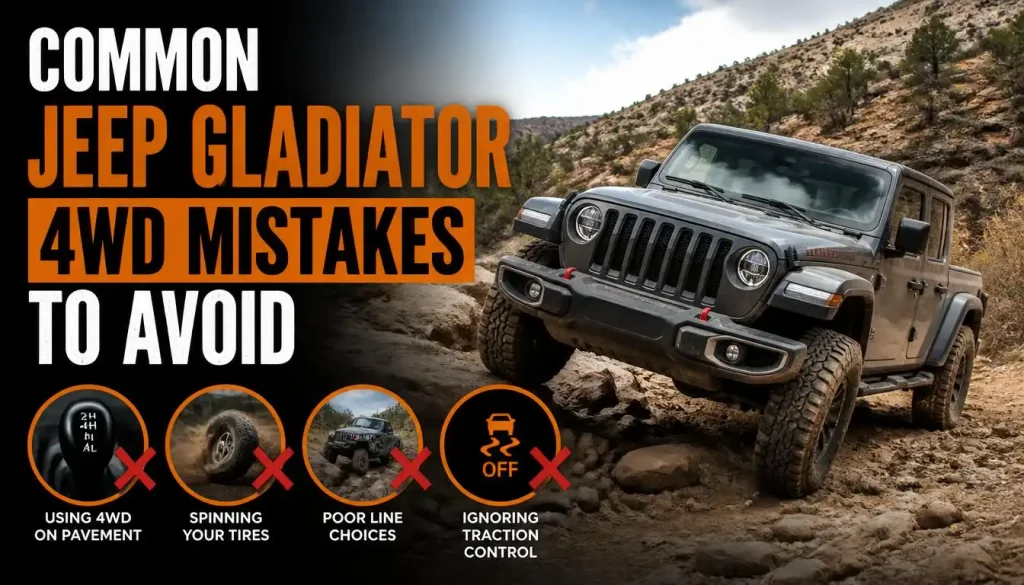
A capable four-wheel-drive system still needs to be used correctly.
Avoid these common mistakes:
- Using 4H Part Time for extended driving on dry pavement
- Shifting into 4L at normal road speed
- Forgetting to put the transmission in Neutral for a low-range shift
- Driving fast in 4L
- Forcing a transfer-case lever that will not engage
- Assuming 4WD gives the Jeep more braking grip
- Confusing transmission Neutral with transfer-case Neutral
- Waiting until the Jeep is deeply stuck before thinking about traction
- Continuing to spin the wheels after traction has been lost
Jeep advises stopping excessive wheelspin when traction has been lost because spinning can dig the vehicle deeper into snow or mud.
It is generally better to select the appropriate 4WD mode before the terrain becomes difficult.
Frequently Asked Questions About How Do You Put a Jeep Gladiator Into Four-Wheel Drive?
Is a Jeep Gladiator Always in Four-Wheel Drive?
Not necessarily. A Gladiator with a traditional part-time transfer case normally uses 2H for regular driving, with the driver selecting 4H or 4L when needed.
A Gladiator equipped with a full-time-capable system may also provide a 4H Auto setting.
Can I Switch From 2H to 4H While Driving?
Yes. High-range four-wheel drive can generally be selected while stopped or moving. Always stay within the operating limits specified in the owner’s manual for your exact Gladiator.
Do I Need to Put My Jeep Gladiator in Neutral for 4H?
Normally, no. Shifting between 2H and 4H does not require putting the transmission into Neutral.
Neutral becomes important when shifting into or out of 4L.
Do I Need Neutral to Shift Into 4L?
Yes, when using an automatic transmission, Jeep’s low-range procedure calls for placing the transmission in Neutral while the vehicle rolls at approximately 2–3 mph. For applicable manual-transmission vehicles, depress the clutch pedal.
Can I Shift Into 4L While Completely Stopped?
It may be possible, but Jeep does not recommend it as the preferred method. The transfer-case gear teeth may not be aligned correctly. A slow roll of about 2–3 mph usually helps the system engage.
How Fast Can You Drive a Jeep Gladiator in 4L?
Jeep’s general low-range guidance says do not exceed 25 mph (40 km/h). In serious off-road conditions, a much lower speed is usually appropriate.
How Fast Can You Drive in 4H?
There is no reason to treat 4H as permission to drive quickly in poor conditions. Jeep says your speed in high-range four-wheel drive should be limited by the road and traction conditions.
Remember that the maximum speed for shifting into 4H and the safe speed for driving in 4H are two different things.
Can You Use 4H on the Highway?
If the road is covered with snow or another loose/slippery surface, part-time 4H may be appropriate.
On normal dry pavement, use 2H rather than 4H Part Time.
If your Gladiator has a full-time 4H Auto setting, that mode is designed to handle a broader range of road surfaces.
Should I Use 4H in the Rain?
For ordinary rain on a paved road, 4H Part Time is usually unnecessary. If conditions become extremely slippery or you are on a loose surface, extra traction may be useful.
A 4H Auto-equipped system is better suited to roads where traction changes frequently.
Should I Use 4H or 4L in Snow?
For most snow-covered roads, 4H is the better choice because it gives you additional traction without the very low gearing of 4L.
Use 4L when you are moving slowly through extreme conditions where additional low-speed torque and control are required. Jeep describes high range as appropriate for surfaces such as snow and ice, while low range is intended for demanding low-speed situations.
Is 4H or 4L Better for Sand?
Start with 4H for many sand-driving situations because maintaining momentum can be important. Jeep notes that high-range 4WD can be useful in sand, although low range may become necessary depending on the conditions.
Why Is My Jeep Gladiator Shuddering in 4H?
If you are using 4H Part Time on dry pavement, drivetrain binding or crow hop may be the cause. Shift back to 2H when safe and see whether the problem disappears.
If shuddering continues in the correct drive mode, have the vehicle inspected.
Final Thoughts
So, how do you put a Jeep Gladiator into four-wheel drive?
For normal slippery or loose conditions, move the transfer case from 2H to 4H. Use 4H Part Time for surfaces such as snow, gravel, mud, and sand. If your Gladiator has 4H Auto, that setting can manage changing traction conditions more automatically.
For serious low-speed off-roading, slow to approximately 2–3 mph, place an automatic transmission in Neutral, and shift the transfer case into 4L.
The simplest rule is easy to remember: 2H for everyday roads, 4H when you need traction, and 4L when you need slow-speed control and torque.
Because transfer cases and available modes can vary by Gladiator model year and equipment, always check the markings on your vehicle and follow the owner’s manual if its instructions differ from general guidance.

“Cars aren’t just machines. They’re freedom, memory, and a little bit of grease under your fingernails.”
I’m Theodore Roosevelt—though my friends just call me “Ted” (and no, I’m not related to the president, though I do share his love for adventure). I grew up in Detroit in the 1970s, back when the city was still the heart of the American auto industry. My first love was a rusted-out 1967 Mustang my father and I rebuilt in our garage when I was fifteen. That project taught me that cars have souls. After spending twenty years as a mechanic and another ten writing for magazines, I started this blog to help everyday drivers and weekend wrenchers feel confident under the hood. Whether you’re restoring a classic or just trying to keep your daily driver alive for one more winter, I’m here to help you get there.