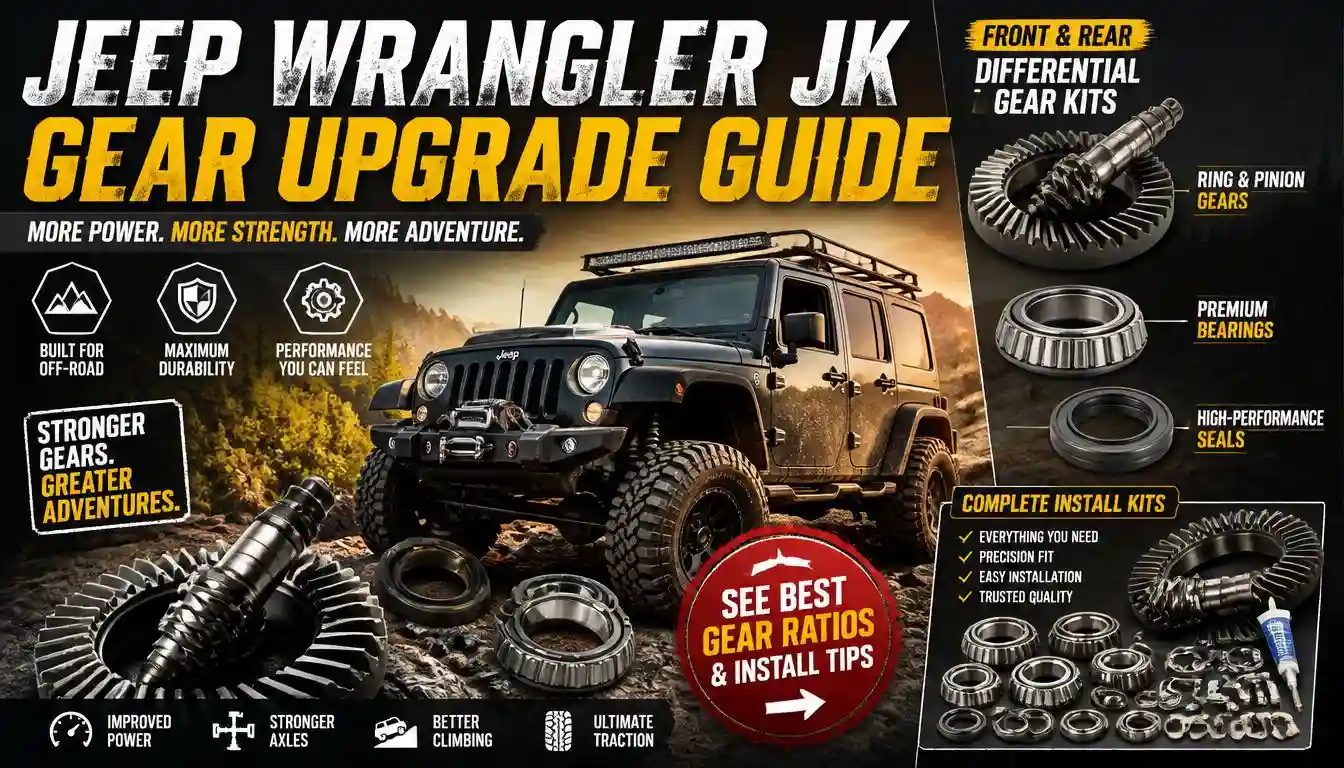
A Jeep Wrangler JK gear and install kit package is a front and rear differential upgrade that changes your axle gear ratio and includes the small parts needed for setup. It matters because the right ratio helps your JK feel stronger with larger tires, tow better, crawl slower off-road, and avoid drivetrain strain.
If your JK feels lazy after 33s, 35s, or 37s, the problem may not be the engine. It is often the axle gearing.
I have seen plenty of Wrangler JK owners spend money on intake parts, exhaust parts, or tuners, then still complain that the automatic hunts for gears on hills. The smarter fix is often a matched front and rear regear with the right install kit.
This Jeep Wrangler JK Gear And Install Kit Package Front Rear Upgrade Guide will show you how to choose the ratio, what parts should come in the package, what installation really costs, and where DIY stops being smart.
Pain Points Wrangler JK Owners Face Before Regearing
Problem 1: Bigger Tires Make the JK Feel Heavy
A stock JK may drive fine on factory tires. Add 35-inch mud tyres, steel bumpers, a winch, roof rack, and camping gear, and the same Jeep can feel tired.
That happens because taller tires change the effective gearing. Your engine has to work through a longer final drive, so the Jeep feels slow from a stop and weak on grades.
“A change of tire size changes your overall gear ratio.” — Jim Allen, Author of Jeep 4×4 Performance Handbook
The fix is to choose a new axle ratio based on tire size, transmission, weight, and driving style. For many 2012–2018 automatic JKs on 35s, 4.56 or 4.88 is a common range. For 37s, many owners look at 4.88 or 5.13, depending on axle strength and road use.
Problem 2: Front and Rear Ratios Do Not Match
A 4WD Wrangler must have the same ratio in the front and rear axles. If the front is 4.88 and the rear is 4.56, the drivetrain will bind in 4WD.
This is why a front rear package makes sense. It helps you buy the correct ring and pinion sets, bearings, seals, shims, crush sleeves or preload parts, and marking compound together.
I once looked at a used 2015 Wrangler Unlimited on 35s that had a “fresh regear” in the ad. The owner had receipts for the rear axle only. That Jeep was fine in 2WD, but using 4WD would have risked transfer case and axle damage. Always confirm both axles were done.
Problem 3: Cheap Quotes Leave Out the Hard Parts
A low regear quote can look tempting. Then the shop adds carrier bearings, axle seals, fluid, labor for seized bolts, and speedometer calibration.
A proper Jeep Wrangler JK gear and install kit package front rear upgrade should be priced as a full job, not a bag of gears alone. Ask what is included before you order.
In the USA, a front and rear regear often lands around $1,800–$3,500 USD parts and labor. UK owners may see about £1,600–£3,200. In Canada, expect roughly CAD $2,400–$4,800. In Australia, AUD $2,800–$5,500 is realistic at 4×4 shops, especially if engineering or roadworthy checks are involved.
Choosing the Right Jeep Wrangler JK Gear Ratio
Know Your Axles First
Most non-Rubicon JK models use a Dana 30 front axle and Dana 44 rear axle. Rubicon JK models use Dana 44 front and rear axles. Some trims, years, and markets vary, so confirm your axle tags, build sheet, or differential cover shape before buying.
This matters because a Dana 30 front ring and pinion will not fit a Dana 44 front. A Rubicon locker also changes what parts may fit.
If you bought your JK used, do not trust the seller’s memory. Check the axle tag, count driveshaft turns, scan the build sheet, or ask a Jeep shop to verify it during a vehicle inspection.
Ratio Guide by Tire Size
Use this as a practical starting point, not a final rule:
| Tire Size | Daily Road Use | Mixed Trail Use | Heavy Build / Crawling |
|---|---|---|---|
| 33 inch | 4.10–4.56 | 4.56 | 4.56–4.88 |
| 35 inch | 4.56 | 4.88 | 4.88–5.13 |
| 37 inch | 4.88 | 5.13 | 5.13, if axle setup supports it |
Manual JKs and automatic JKs do not always feel the same with the same ratio. A 2011 3.8L automatic on 35s may need a deeper ratio than a 2016 3.6L manual used mostly on the highway.
If you drive long UK motorway miles, a slightly milder ratio may feel calmer. If you crawl Utah slickrock, Canadian forest trails, or Australian outback tracks with a loaded JKU, deeper gearing may make the Jeep easier to control at low speed.
Match Ratio to Real Use
Ask yourself three questions before ordering:
- What tire size will I run for the next three years?
- Do I drive more highway miles or trail miles?
- Am I adding more weight soon?
A two-door JK on 35s and alloy wheels does not need the same setup as a four-door JKU on 37s with steel armor and camping drawers.
“We’ve seen what works and what doesn’t for every common 4×4 vehicle!” — Jon Tirrell, Mount Zion Offroad Staff Writer
That line sums up why a good 4×4 shop matters. The math matters, but so does real use.
What Should Be in a Front Rear Gear and Install Kit Package?
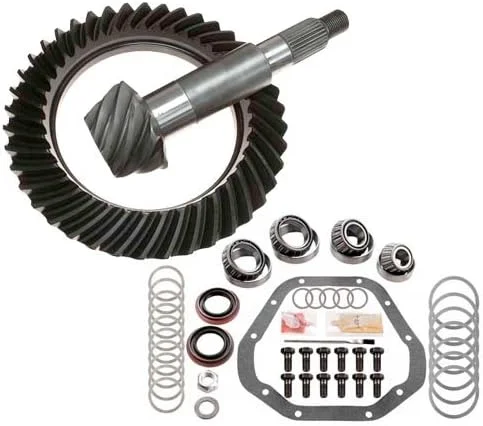
Ring and Pinion Sets
The ring gear bolts to the carrier. The pinion gear connects to the driveshaft side. Together, they create the axle ratio.
For a JK package, you need one matched ring and pinion set for the front axle and one for the rear. Both must be the same ratio.
Common upgrade ratios include 4.10, 4.56, 4.88, and 5.13. Some packages list 4.11 instead of 4.10, depending on axle and gear brand.
Credit: Amazon
Master Install Kit Parts
A master install kit usually includes more than a basic install kit. For a full front rear regear, I prefer master kits unless the axles were recently rebuilt.
Look for:
- Carrier bearings and races
- Pinion bearings and races
- Pinion seals
- Shims
- Crush sleeves or preload spacers
- Ring gear bolts
- Pinion nuts
- Marking compound
- Cover gaskets or sealant
Some cheaper kits leave out bearings. That can be fine for a low-mile axle if the shop approves, but I do not like reusing tired bearings on a high-mile 2007–2013 JK.
Fluids, Additives, and Small Extras
Do not forget gear oil. Many JK Dana axles use 75W-90 or 75W-140 depending on use, climate, and axle type. Check your manual and gear maker guidance.
If your rear differential has a clutch-style limited slip, it may need friction modifier. Rubicon lockers do not use the same logic as a standard limited slip, so confirm before pouring in additives.
A good parts list may also include:
- Brake cleaner
- RTV or reusable covers
- Axle shaft seals if needed
- New diff cover bolts
- Speedometer calibration tool
- OBD diagnostics scan after setup
DIY vs Professional Installation
What a Skilled DIY Owner Can Handle
You can remove diff covers, drain fluid, inspect teeth, and identify axle type at home. You can also replace covers, service fluid, and check for metal flakes.
If you have strong mechanical skills, a dial indicator, torque tools, bearing pullers, a press, setup bearings, and patience, you may be able to set gears. I still do not suggest this as a first major Jeep repair.
A bad gear pattern can whine, overheat, chip teeth, or fail early. This is not like replacing a bumper.
Why Gear Setup Is Usually a Shop Job
A correct regear depends on pinion depth, backlash, bearing preload, and contact pattern. Backlash is the tiny amount of movement between gear teeth. Pinion depth controls how the pinion sits against the ring gear.
If those settings are off by a small amount, the axle can howl at 45 mph or fail after the break-in period.
For a daily-driven JK, I would pay a trusted axle shop. In the USA or Canada, ask if they warranty gear noise. In the UK, ask whether the regear affects MOT concerns, insurance disclosure, or speedometer accuracy. In Australia, ask if the job needs paperwork for your state road authority or a roadworthy certificate after related lift and tyre changes.
Break-In Matters
New gears need a break-in. Most shops recommend short heat cycles first, then fluid change after 500 miles or about 800 km. Avoid towing, high-speed long drives, and hard trail use during the first stage.
I have seen a fresh 4.88 JK regear fail early because the owner drove three hours home at highway speed, then hit a trail weekend with no cool-down periods. The parts were not the only problem. The break-in was poor.
Cost Breakdown and Money-Saving Tips
Parts Cost
A front rear Jeep Wrangler JK gear and install kit package commonly costs:
| Item | USA | UK | Canada | Australia |
| Front/rear gear package | $700–$1,300 | £600–£1,100 | CAD $950–$1,800 | AUD $1,100–$2,000 |
| Fluids and extras | $80–$180 | £70–£160 | CAD $110–$250 | AUD $130–$300 |
| Calibration tool/service | $100–$350 | £90–£300 | CAD $140–$475 | AUD $160–$550 |
Prices change by brand, ratio, axle type, and local labor rates. Rubicon Dana 44 front setups can cost more than non-Rubicon Dana 30 setups.
Labor Cost
Labor is the big line item. A careful shop may spend 8–14 hours on both axles, sometimes more if rust fights back.
In snow-belt areas like Ontario, New York, Michigan, or Scotland, rusty brackets and seized bolts can slow the job. In Australia, remote 4×4 shops may charge more because parts supply is tighter.
Do not pick the cheapest installer by default. A noisy axle can cost more to fix than doing the job right the first time.
Smart Ways to Save
You can save money without buying weak parts.
- Buy the full package once, not front and rear parts from random listings
- Confirm axle type before purchase
- Replace worn axle seals during the same job
- Regear before buying a tuner or engine add-ons
- Ask for written warranty terms
- Keep the receipt for resale value and service history
A clean invoice helps the next buyer trust the Jeep. On AutoTrader UK, CarGurus USA, Carsales AU, or Kijiji Autos CA, a well-documented regear can make a modified JK look cared for instead of hacked together.
Safety, Legal, and Insurance Checks
Speedometer and Stability
Changing tire size and gear ratio can affect speedometer readings, shift behavior, and traction control logic. After a regear, calibrate tire size and axle ratio with a proper tool.
If your speedometer is wrong, you can drive faster than you think. That can create ticket risk and safety risk.
Large tires, lifts, and extra weight also affect handling. Vehicle safety researchers have warned that “the physical characteristics of the vehicle are known to have great impact on the vehicle’s ability to resist rollover.” — Micky Gilbert and Brad Stolz, Authors, Canadian Association of Road Safety Professionals Study
This does not mean every lifted JK is unsafe. It means you should treat gearing, tyres, brakes, steering, and suspension as one system.
Country-Specific Notes
In the USA, inspection rules vary by state. Some states care most about emissions and safety items, while others have limited inspection rules. Check open recalls through the NHTSA recall lookup before buying or modifying any used Wrangler JK.
In the UK, MOT testers can fail unsafe steering, suspension, tyres, brakes, leaks, and warning lights. Tell your insurer about gearing, tyre, suspension, and drivetrain changes.
In Canada, rules vary by province. Ontario buyers should think about MTO safety standards, tyre condition, lighting, braking, and steering wear during transfer or sale checks.
In Australia, lift, tyre, and driveline changes can trigger state compliance rules. A roadworthy certificate may not be enough if the vehicle needs engineering approval for other related changes.
Common Myths About JK Regear Packages
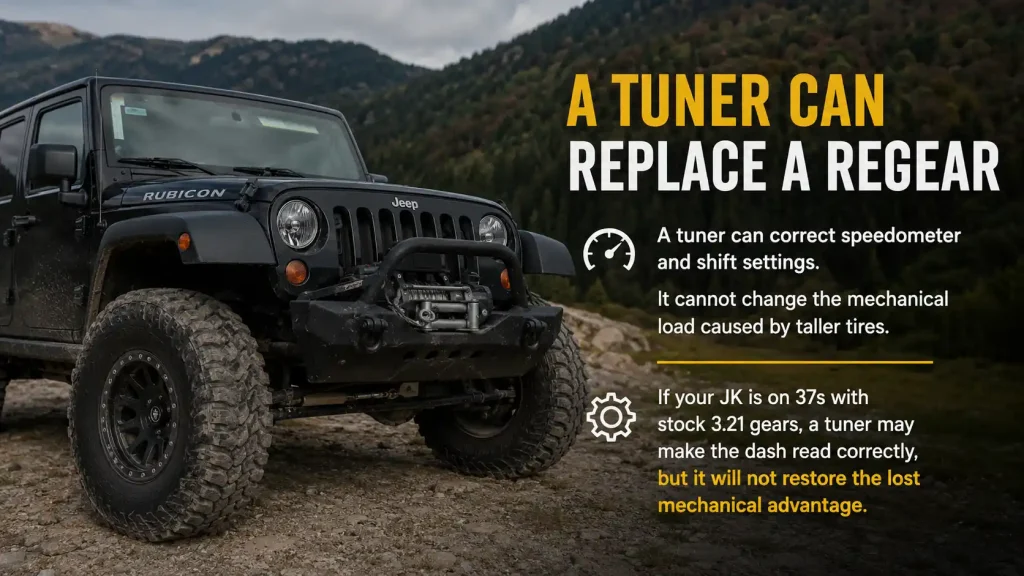
Myth 1: A Tuner Can Replace a Regear
A tuner can correct speedometer and shift settings. It cannot change the mechanical load caused by taller tires.
If your JK is on 37s with stock 3.21 gears, a tuner may make the dash read correctly, but it will not restore the lost mechanical advantage.
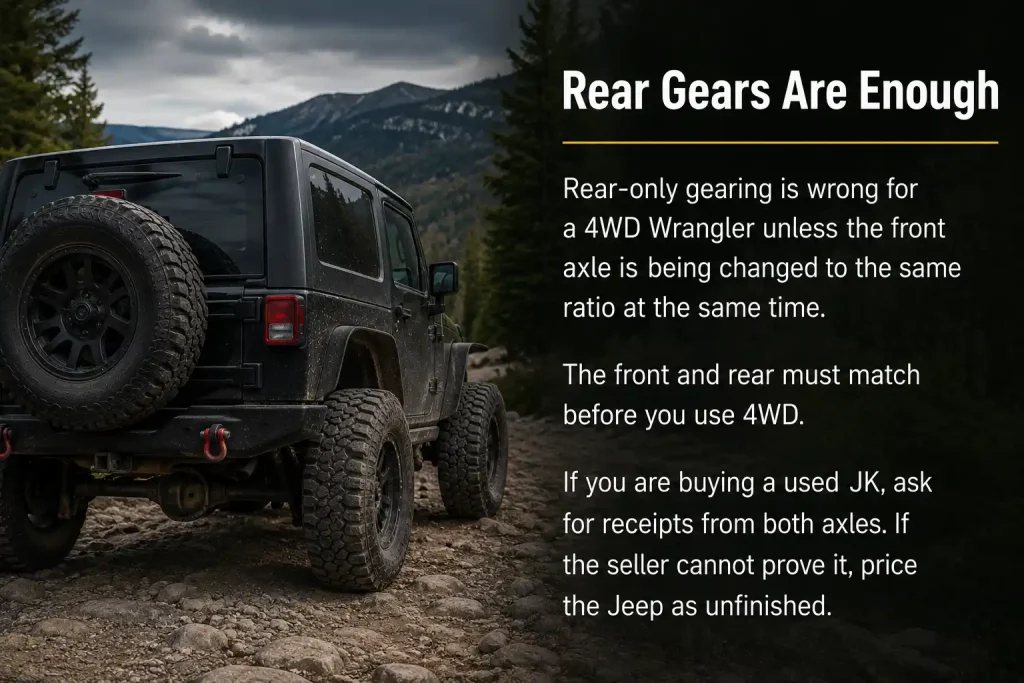
Myth 2: Rear Gears Are Enough
Rear-only gearing is wrong for a 4WD Wrangler unless the front axle is being changed to the same ratio at the same time. The front and rear must match before you use 4WD.
If you are buying a used JK, ask for receipts from both axles. If the seller cannot prove it, price the Jeep as unfinished.
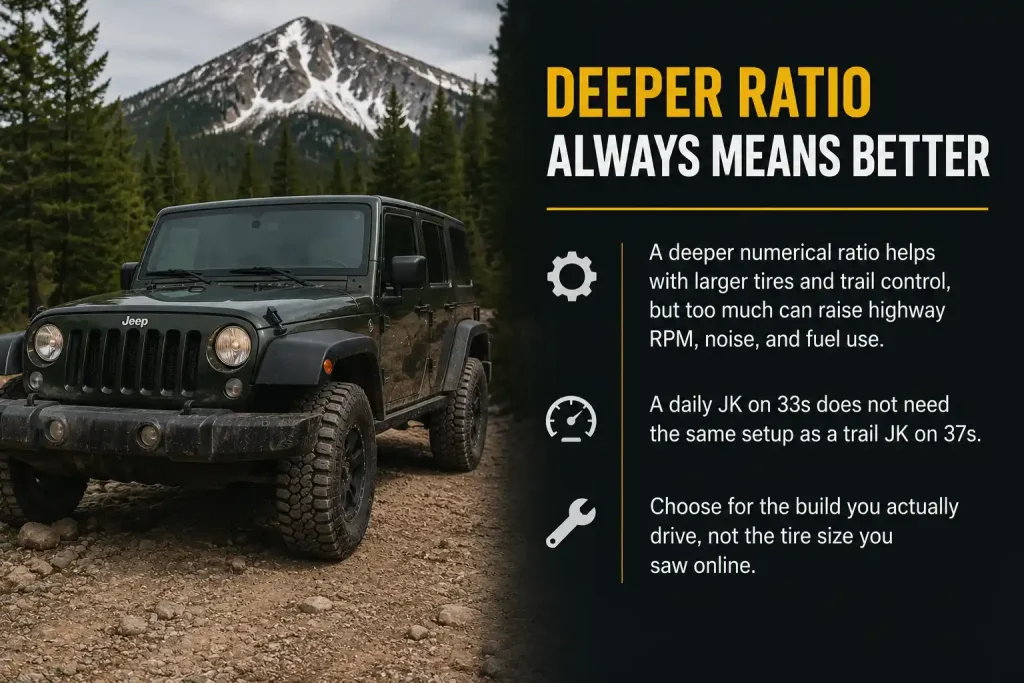
Myth 3: Deeper Ratio Always Means Better
A deeper numerical ratio helps with larger tires and trail control, but too much can raise highway RPM, noise, and fuel use. A daily JK on 33s does not need the same setup as a trail JK on 37s.
Choose for the build you actually drive, not the tire size you saw online.
Long-Term Maintenance After the Upgrade
After installation, listen for whine, clunking, vibration, or heat. A slight gear hum during break-in may happen, but loud howl is not normal.
Check for leaks around pinion seals and differential covers. After the break-in fluid change, keep the diff service on your engine maintenance calendar.
For trail JKs, inspect gear oil after water crossings. Milky oil means water got inside. That can ruin bearings and gears.
Keep all records. A documented regear helps resale value, especially when paired with a clean VIN check, service history, and a proper used car checklist.
Frequently Asked Questions on Jeep Wrangler JK Gear Install Kit Upgrade Guide
What gear ratio is best for a Jeep Wrangler JK on 35s?
For many 2012–2018 JKs on 35-inch tires, 4.56 or 4.88 is a common choice. I lean toward 4.88 for heavier four-door builds, trail use, or automatic transmissions. A lighter two-door manual used mostly on the road may feel fine with 4.56.
Do I need front and rear gears for a Jeep JK?
Yes, if you plan to use 4WD. The front and rear axle ratios must match. Buying a front rear package helps reduce fitment mistakes and makes the job easier for the installer.
Can I install a Jeep JK gear kit at home?
You can inspect and service differentials at home, but setting ring and pinion gears is a precision job. It requires measuring backlash, pinion depth, bearing preload, and gear contact pattern. For a daily driver, I suggest a trained axle shop.
How long does a Jeep Wrangler JK regear take?
Most shops need one to two full working days for both axles. Rust, damaged bearings, locker issues, or missing parts can stretch the job. Ask the shop for a break-in plan before you pick up the Jeep.
Will regearing improve fuel efficiency?
It can help a JK return to a better working range after larger tires, but it may not always raise MPG. If your Jeep was lugging badly, proper gearing may help drivability and reduce constant downshifts. Deep ratios, heavy tires, roof gear, and aggressive tread can still reduce fuel efficiency.
Final Takeaway
A Jeep Wrangler JK gear and install kit package front rear upgrade is one of the most useful changes after larger tires. Get the axle type right, choose the ratio for your real tire size and driving style, and pay for proper setup.
The three things I would not gamble on are matching front and rear ratios, master install kit quality, and installer skill.
Do it once, document it well, and your JK will feel more honest on the road and more controlled on the trail.

“Cars aren’t just machines. They’re freedom, memory, and a little bit of grease under your fingernails.”
I’m Theodore Roosevelt—though my friends just call me “Ted” (and no, I’m not related to the president, though I do share his love for adventure). I grew up in Detroit in the 1970s, back when the city was still the heart of the American auto industry. My first love was a rusted-out 1967 Mustang my father and I rebuilt in our garage when I was fifteen. That project taught me that cars have souls. After spending twenty years as a mechanic and another ten writing for magazines, I started this blog to help everyday drivers and weekend wrenchers feel confident under the hood. Whether you’re restoring a classic or just trying to keep your daily driver alive for one more winter, I’m here to help you get there.