A Jeep Wrangler Tire Pressure Monitoring System warning can appear because of low air pressure, a leaking tire, a damaged sensor, incompatible aftermarket wheels, or a communication fault. The correct solution depends on whether the dashboard light stays solid, flashes before remaining on, or appears with a “Service Tire Pressure System” message.
Do not assume that every TPMS warning means the sensor needs replacement. Start by inspecting the tires and checking their cold pressure with an accurate gauge. If the pressures are correct but the warning remains, the system may need sensor testing, programming, relearning, or further diagnosis.
For Jeep owners in San Diego, a qualified Jeep or Chrysler Dodge Jeep Ram service center can inspect the tires, scan each sensor, identify communication problems, and complete any necessary repair or programming.
Quick Answer: What Does the Jeep Wrangler TPMS Warning Mean?
A solid TPMS warning light usually means that one or more road tires may be below the vehicle’s recommended cold inflation pressure.
A light that flashes for approximately 75 seconds and then stays solid generally indicates a TPMS system fault. Recent Wrangler models may also display “Service Tire Pressure System” and show dashes instead of a pressure value for a sensor that is not being received.
Check the tires immediately if:
- A tire looks visibly low or flat.
- The Wrangler pulls to one side.
- Steering feels unstable.
- You notice sudden vibration.
- Pressure continues to drop after inflation.
- The warning appears with a tire-related handling problem.
If there is no visible damage, check every road tire with a pressure gauge and compare the readings with the label inside the driver-side door opening.
Jeep Wrangler TPMS Warning Light Meanings
The warning pattern provides an important clue about the cause.
| Dashboard symptom | Possible meaning | Recommended first step |
|---|---|---|
| TPMS light stays solid | One or more tires may be underinflated | Check all tires when cold |
| Light flashes, then stays solid | Sensor or system communication fault | Scan each TPMS sensor |
| “Tire Low” message | A road tire is below the warning threshold | Inflate to the door-placard pressure |
| “Inflate to XX” message | The vehicle is showing its target pressure | Inflate the indicated tire |
| “Service Tire Pressure System” | The system detected a fault | Arrange professional diagnosis |
| Dashes instead of a PSI reading | A sensor signal is not being received | Test sensor operation and compatibility |
| Warning returns after inflation | Leak, incorrect pressure, or sensor issue | Recheck pressure and inspect the tire |
| Warning appears after new wheels | Missing, damaged, or incompatible sensor | Verify sensor and wheel compatibility |
On recent Wranglers, a system fault may trigger a warning-light flash, a chime, a service message, and dashes in place of the missing pressure reading.
How the Jeep Wrangler Tire Pressure Monitoring System Works
The Jeep Wrangler uses a direct tire pressure monitoring system. Electronic sensors mounted inside the wheel assemblies measure tire pressure and transmit readings wirelessly to the vehicle’s receiver module.
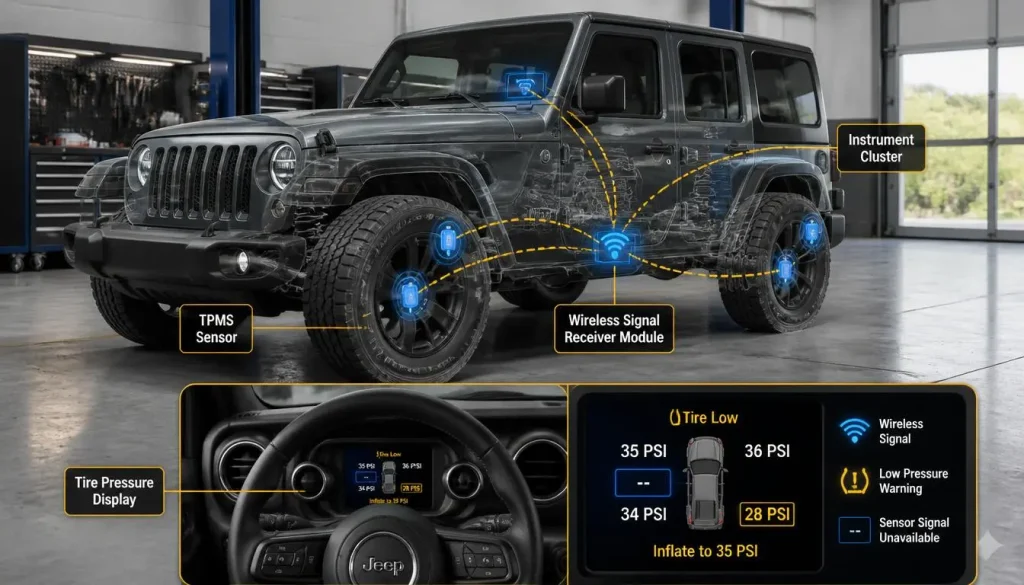
The instrument cluster can then display:
- Individual tire-pressure readings
- A low-pressure warning light
- A “Tire Low” notification
- An “Inflate to XX” instruction
- A system-fault message
- Dashes when a sensor signal is unavailable
Recent Wrangler documentation identifies the receiver module, four active road-tire sensors, dashboard messages, and the TPMS warning light as the primary parts of the system.
TPMS is an important warning system, but it does not replace routine tire maintenance. A tire can be incorrectly inflated without being low enough to trigger a dashboard warning. You should still inspect your tires and check their pressure regularly with an accurate gauge.
What Tire Pressure Should a Jeep Wrangler Have?
There is no single correct pressure for every Jeep Wrangler.
The required pressure can vary according to:
- Model year
- Trim level
- Original tire size
- Front and rear axle requirements
- Vehicle loading
- Factory wheel-and-tire configuration
Use the cold tire pressure printed on the vehicle certification or tire-information label inside the driver-side door area. Do not use the maximum pressure molded into the tire sidewall as your normal operating target.
The sidewall figure is a maximum tire specification, not necessarily the pressure Jeep recommends for your vehicle.
Check the Pressure When the Tires Are Cold
Cold pressure normally means the vehicle has been parked for at least three hours or has traveled less than approximately one mile after sitting for that period.
Tire pressure rises as the tires warm while driving. That increase is normal, so do not release air solely because a warm reading is higher than the cold specification.
Jeep’s recent Wrangler guide states that pressure can change by approximately 1 PSI for every 12°F change in temperature. It also instructs owners to set pressure according to the cold placard value.
Why the TPMS Light Appears in Cold Weather
Cold air can lower the measured pressure enough to trigger the warning even when no tire is punctured.
This is why a Wrangler’s tire-pressure light may appear:
- Early in the morning
- After an overnight temperature drop
- During seasonal weather changes
- When traveling from a warmer area to a colder region
Driving may warm the tires and increase the pressure reading, but that does not necessarily correct the original cold-pressure condition. Check and adjust the tires according to the placard instead of waiting for the warning to disappear.
Common Reasons a Jeep Wrangler TPMS Light Comes On
Low Tire Pressure
Normal air loss, weather changes, and delayed maintenance can cause one or more tires to fall below the warning threshold.
Check all four road tires rather than inflating only the tire shown on the display. More than one tire may be low.
A Slow Tire Leak
A nail, screw, leaking valve, damaged wheel, or poor bead seal can cause gradual pressure loss.
A slow leak may allow the warning to disappear temporarily after inflation and return hours or days later. Repeatedly adding air is not a permanent repair.
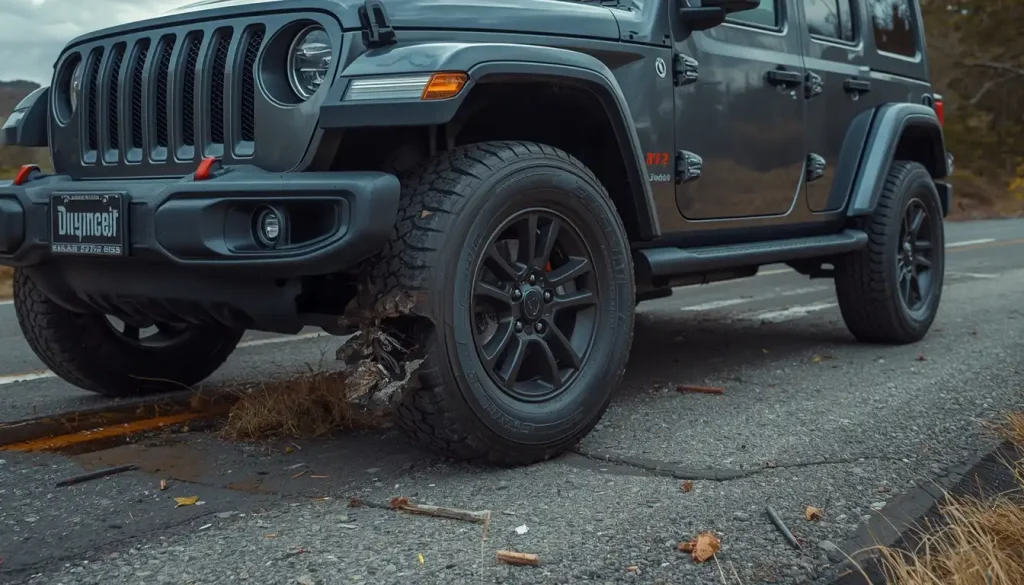
A Puncture or Tire Damage
A fast pressure loss may be caused by:
- Road debris
- Sidewall damage
- A bent or cracked wheel
- A damaged valve stem
- Tire separation
- An impact with a curb or pothole
Do not continue driving on a visibly flat or seriously damaged tire.
A Failed TPMS Sensor
Each sensor contains electronics and an internal power source. A sensor may stop transmitting because of age, physical damage, corrosion, moisture, or an internal failure.
Common symptoms include:
- One tire showing dashes
- Intermittent pressure readings
- A flashing warning light
- A sensor that cannot be activated by a scan tool
- A service message after every startup
Sensor Damage During Tire Service
A TPMS sensor can be damaged when a tire is removed or installed if the technician does not account for the sensor’s location.
Problems may appear immediately after:
- New tire installation
- Tire repair
- Wheel replacement
- Valve-stem service
- Seasonal tire changes
Aftermarket Wheels
Some aftermarket wheels may not properly accommodate the original sensor or valve design. A sensor can also be damaged during installation, positioned incorrectly, or transferred without the correct service components.
Jeep warns that replacement wheels and tires differing from the original size, type, or style may cause undesirable TPMS operation or sensor damage. The current Wrangler guide also cautions that some aftermarket wheels may contribute to poor system performance.
Incorrect or Incompatible Sensors
TPMS sensor compatibility varies by model year, vehicle market, and build configuration.
A sensor may physically fit the wheel but still be incompatible with the Wrangler’s receiver. The sensor must use the appropriate protocol, frequency, and identification process for the specific vehicle.
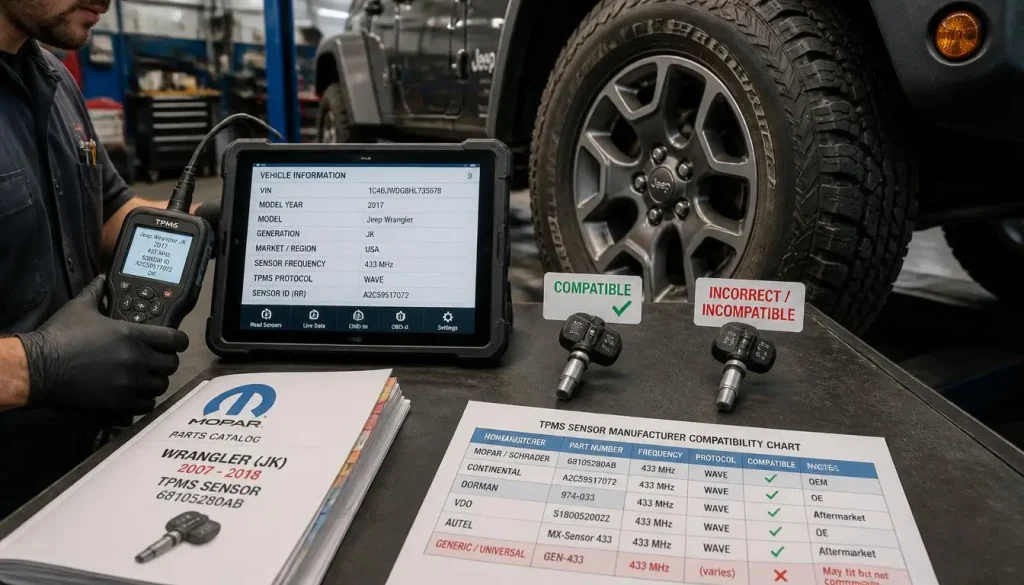
Do not purchase a sensor based only on its appearance or a broad “fits Jeep” description. Verify compatibility using:
- Vehicle identification number
- Model year
- Wrangler generation
- Market or country
- Existing sensor information
- Current Mopar or sensor-manufacturer catalog data
New Sensors Were Not Programmed or Relearned
A replacement sensor may need to be programmed before installation, followed by a vehicle relearn process.
Programming configures a universal sensor to imitate the correct original-equipment sensor. Relearning allows the vehicle to recognize the installed sensor IDs.
TPMS tool manufacturer ATEQ lists direct sensing, auto-relearn procedures, and OBD-based relearning for various 2007–2020 Wrangler applications. It also recommends verifying the exact procedure by vehicle year.
Electronic Interference
A sensor may be temporarily blocked by another source using a similar radio frequency.
Recent Wrangler documentation lists possible interference from:
- Nearby electronic devices
- Facilities transmitting similar frequencies
- Certain types of aftermarket window tint
- Heavy snow or ice around the wheels
- Tire chains
- Wheels without TPMS sensors
These conditions may cause a warning even when the sensors themselves are not permanently damaged.
Aftermarket Tire Sealant
Some emergency sealants can interfere with or damage an internal TPMS sensor.
Jeep recommends having the sensor function checked after an aftermarket sealant has been used.
How to Troubleshoot a Jeep Wrangler TPMS Warning
Follow these steps in order so you do not replace a sensor unnecessarily.
Step 1: Stop and Inspect the Tires
Park in a safe location and visually inspect all four road tires.
Look for:
- A visibly low tire
- A nail or screw
- Sidewall cuts
- Bulges
- Wheel damage
- A leaking valve
- Unusual tread damage
Do not rely only on appearance. A radial tire can be significantly underinflated without looking completely flat.
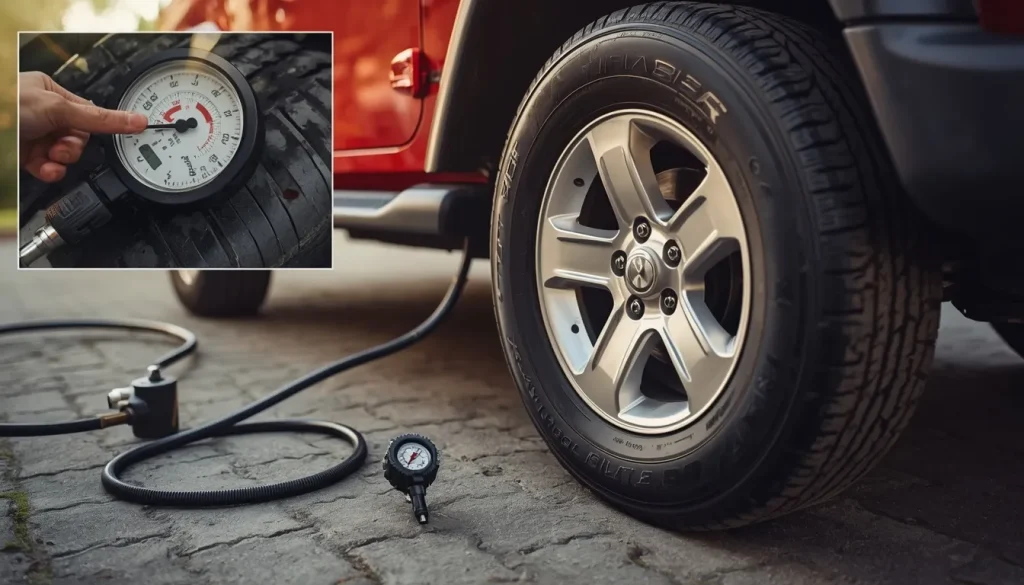
Step 2: Check Every Tire With a Gauge
Use a reliable handheld tire-pressure gauge.
Check the pressure when the tires are cold and compare each reading with the label inside the driver-side door area.
Do not use the maximum sidewall pressure as the vehicle target.
Step 3: Inflate to the Placard Pressure
Inflate any low tire to the specified cold pressure.
Recent Wranglers may display an “Inflate to XX” message identifying the target pressure. The warning should clear after the system receives corrected readings, provided no other fault exists.
Step 4: Watch for Pressure Loss
Check the tires again after several hours or the following morning.
A tire that loses pressure again may have:
- A puncture
- A leaking bead
- A valve-stem problem
- Wheel damage
- An improper repair
Arrange a leak inspection instead of repeatedly refilling it.
Step 5: Allow the System to Update
Many Wranglers update automatically after the tire pressure is corrected.
For recent models, Jeep states that the vehicle may need to be driven for up to 20 minutes at more than 15 mph for the system to receive the new readings.
This is not permission to drive on a dangerously low or damaged tire. Correct the pressure and confirm that the tire is safe first.
Step 6: Scan Each Sensor
If the warning flashes, a reading is missing, or the service message remains, a technician should activate and scan each sensor.
A professional TPMS tool may reveal:
- Sensor identification number
- Measured pressure
- Sensor frequency
- Battery status
- Communication response
- Whether a sensor is missing or duplicated
Step 7: Diagnose the Vehicle Side of the System
If all sensors respond to the scan tool but the dashboard still shows a fault, the problem may involve:
- Incorrectly registered sensor IDs
- A relearn failure
- Receiver-module communication
- Antenna or wiring problems
- Radio-frequency interference
- A vehicle software issue
Replacing all sensors without testing these possibilities may not solve the problem.
How to Reset the Jeep Wrangler TPMS Light
Most Jeep Wranglers do not need a simple dashboard-button reset after ordinary pressure correction. The system usually clears the warning after the tires are inflated correctly and the vehicle receives updated sensor readings.
Use this general procedure:
- Park the Wrangler and let the tires cool.
- Read the recommended pressure on the driver-door placard.
- Check all four road tires with a gauge.
- Inflate low tires to the placard specification.
- Inspect for punctures or visible damage.
- Start the vehicle and check the dashboard readings.
- Drive only after confirming the tires are safe.
- Allow sufficient driving time for the readings to update.
- Arrange a sensor scan if the light flashes or remains on.
Do not attempt to hide a genuine low-pressure warning by disconnecting the battery, clearing fault codes, or using an unofficial bypass.
Jeep Wrangler JK Reset Considerations
The JK generation covers a wide range of model years and TPMS configurations. Some models display only a warning light, while others provide more detailed information.
Sensor frequency and relearn procedures also vary across JK production years. ATEQ’s Wrangler application information, for example, lists different frequencies and OBD or automatic relearn methods across 2007–2020 vehicles.
Before replacing or programming a JK sensor, verify the procedure using the exact year and VIN.
Jeep Wrangler JL, JLU, and 4xe Reset Considerations
Later Wrangler models commonly provide individual tire readings and can automatically update after pressure correction.
If the display shows a valid pressure for every tire and the light is solid, begin with cold-pressure correction.
If one position shows dashes or the warning flashes before remaining solid, treat it as a system or sensor fault rather than an ordinary low-pressure reset.
Features and procedures can differ by trim and equipment, including on Wrangler 4xe models. Consult the manual for the exact vehicle rather than assuming every JL, JLU, or 4xe behaves identically.
TPMS Reset vs Relearn vs Programming
These terms are often used interchangeably, but they describe different tasks.
TPMS Reset
A reset clears a warning after the underlying problem has been corrected. On many Wranglers, this occurs automatically after correct inflation and a successful drive cycle.
TPMS Relearn
A relearn teaches the vehicle which sensors are installed or allows it to recognize their identification numbers.
Relearning may be required after:
- Sensor replacement
- Wheel replacement
- A seasonal wheel swap
- Installation of a complete wheel-and-tire package
- A failed automatic recognition process
TPMS Programming
Programming normally applies to a programmable aftermarket sensor. A TPMS tool configures the new sensor with the correct protocol before the vehicle can use it.
A sensor can be programmed correctly but still require a vehicle relearn. Similarly, attempting a relearn will not correct a sensor that was programmed with the wrong application.
Which TPMS Sensor Fits a Jeep Wrangler?
The correct sensor depends on more than the Wrangler name.
Confirm:
- Exact model year
- JK, JL, JLU, or 4xe application
- Country or sales market
- Factory wheel specification
- Sensor frequency
- Sensor protocol
- Valve-stem type
- Whether the sensor is direct-fit or programmable
- Current part-number supersessions
Older Wrangler applications have used different sensor frequencies across production years. ATEQ’s 2007–2020 application guide, for example, lists 315 MHz for some earlier models, 433 MHz for later vehicles, and mixed applications in certain years.
That information should not be applied blindly to newer models. Always check a current vehicle-specific catalog or scan the existing sensor before ordering a replacement.
Jeep Wrangler TPMS After Tire Rotation
A normal four-tire rotation does not automatically mean that a sensor has failed.
However, problems can appear after rotation if:
- A sensor was damaged
- A wheel without a sensor was installed
- The vehicle does not update tire positions correctly
- A relearn procedure was missed
- One tire was left below the placard pressure
- A spare wheel has a different sensor configuration
If the pressure values appear at the wrong positions, ask the technician whether the specific Wrangler automatically learns wheel location or requires a position relearn.
How TPMS Works With a Full-Size Spare
On a recent Wrangler equipped with a matching full-size spare, the spare may contain a TPMS sensor and can be monitored after being installed as an active road wheel.
The warning may remain on during the next ignition cycle after the spare is installed. According to Jeep’s current guide, driving for up to 20 minutes above 15 mph may allow the system to update, provided none of the active road tires remains below the warning threshold.
The spare is not always continuously displayed while mounted on the rear of the vehicle. Operation varies by configuration, so verify the manual for your year.
How to Identify a Bad Jeep Wrangler TPMS Sensor
A professional scan is the most reliable way to determine which sensor has failed.
Possible signs include:
- One tire consistently showing dashes
- A reading disappearing intermittently
- A flashing warning at startup
- A sensor that does not respond to activation
- A battery-status warning on the diagnostic tool
- A damaged or corroded valve stem
- A warning that started immediately after tire installation
A technician can activate each wheel sensor individually and compare the result with the dashboard.
Can the Sensor Battery Be Replaced?
The battery is normally sealed inside the sensor. In most automotive repair settings, the complete sensor is replaced rather than opened for battery repair.
The valve hardware or service kit may be replaceable separately, depending on the sensor design.
Should You Replace One Sensor or All of Them?
One confirmed failed sensor can usually be replaced individually.
Replacing every sensor may be worth considering when:
- The sensors are the same age.
- Several show weak batteries.
- Multiple valve stems are corroded.
- The tires are already being removed.
- The customer wants to reduce the chance of repeated labor.
Do not recommend a complete set based only on vehicle age. Test the sensors first.
TPMS With Oversized Tires and Aftermarket Wheels
Lifted Wranglers and modified wheel-and-tire packages require additional attention.
Potential problems include:
- Incorrect sensor compatibility
- Sensor interference with the wheel design
- Damage during installation
- Missing sensors
- Incorrect valve hardware
- A warning threshold that no longer matches the owner’s preferred off-road setup
- Poor reception from an unsuitable sensor position
Installing 35-inch or 37-inch tires does not automatically change the sensor’s pressure reading. The sensor still reports the pressure inside the tire.
However, the vehicle’s factory TPMS warning strategy is based on the original configuration and placard pressure. Do not attempt to change safety thresholds through unsupported software or unofficial modifications.
Airing Down for Off-Road Driving
Reducing tire pressure for off-road use may intentionally place the tires below the factory TPMS threshold, causing a warning.
Because safe off-road pressure depends on tire construction, wheel type, load, terrain, and speed, there is no universal pressure suitable for every Wrangler.
Before returning to paved or highway driving:
- Inspect the tires and wheels.
- Reinflate to an appropriate road pressure.
- Confirm all beads are seated.
- Check for damage.
- Verify the dashboard readings.
Jeep Wrangler TPMS With Winter Wheels
Some owners install winter wheel assemblies without sensors, particularly in markets where seasonal tire changes are common.
Recent Wrangler documentation describes a TPMS deactivation process on vehicles equipped with that capability when all four road-wheel assemblies are replaced with assemblies that do not contain sensors. The system can later reactivate after sensor-equipped wheels are reinstalled and the vehicle completes the required drive cycle. This feature is specifically marked “if equipped.”
Do not assume your Wrangler supports this function. Regulations and inspection requirements also differ between the United States, Canada, the United Kingdom, and Australia.
How to Use Jeep Tire Fill Alert
Some newer Wranglers include Tire Fill Alert.
When enabled, the system can provide feedback while one tire is being inflated or deflated. On the current Wrangler system:
- One horn chirp indicates that the target pressure has been reached.
- Three chirps can indicate overinflation.
- The feature may be enabled through Uconnect.
- Only one tire should be filled at a time.
- The feature may be unavailable during an active TPMS fault or deactivation mode.
The ignition and transmission must also be in the required positions for the feature to operate. Equipment availability varies by vehicle.
Tire Fill Alert is convenient, but a pressure gauge is still useful for confirming the final result.
2024–2025 Jeep Wrangler TPMS Recall 25V527 / 56C
Certain 2024 and 2025 Jeep Wranglers were included in NHTSA recall 25V527, identified by the manufacturer as recall 56C.
The recall concerns a remote-start antenna cable that may have been pinched under the left rear seat-belt retractor bracket. The condition may interfere with the TPMS system’s ability to detect low tire pressure correctly.
The NHTSA filing lists 78,989 potentially involved vehicles, although the recall does not mean every 2024 or 2025 Wrangler contains the defect. Eligibility must be confirmed by VIN.
The documented remedy is to inspect the remote-start antenna cable and replace it when necessary.
Owners of an affected model should:
- Check the VIN through an official recall lookup.
- Contact an authorized Jeep service department.
- Ask whether recall 25V527 or 56C is open.
- Schedule the inspection if the vehicle is eligible.
- Continue checking tire pressure manually until the issue is resolved.
A TPMS recall is different from an ordinary dead wheel sensor. The repair may involve the vehicle’s antenna cable rather than replacing the tire sensors.
Is It Safe to Drive With the TPMS Light On?
A TPMS warning should never be ignored.
Stop and inspect the vehicle as soon as it is safe if:
- A tire appears flat.
- The Wrangler pulls or wanders.
- Steering response changes.
- The vehicle begins vibrating.
- You hear a tire-related noise.
- Pressure is dropping quickly.
- A tire or wheel has visible damage.
A solid warning caused by a small pressure difference may not indicate immediate tire failure, but you still need to check the tires promptly.
A flashing light followed by a solid warning means the monitoring system itself may not be functioning correctly. In that situation, manually check the pressure because the vehicle may not reliably alert you to a future low tire.
Jeep warns that significantly underinflated tires can overheat, affect handling and stopping, reduce tread life, and contribute to tire failure.
Jeep Wrangler TPMS Sensor Replacement Process
Professional replacement usually includes:
- Confirming the model year, VIN, and sensor application
- Scanning all existing sensors
- Identifying the failed or incompatible sensor
- Removing the tire from the wheel
- Installing the replacement sensor and service hardware
- Reinstalling the tire
- Inflating it to the correct pressure
- Balancing the wheel when necessary
- Programming the sensor if required
- Completing the applicable relearn
- Clearing related faults
- Confirming all readings during a road test
The technician should also inspect the tire, valve area, and wheel so that an air leak is not misdiagnosed as an electronic fault.
How Much Does Jeep Wrangler TPMS Service Cost in San Diego?
The cost depends on the actual cause of the warning.
Important price factors include:
- Diagnostic or inspection charge
- Number of failed sensors
- OEM or aftermarket sensor selection
- Sensor programming
- Vehicle relearn
- Tire removal and installation
- Wheel balancing
- Valve-stem damage
- Tire puncture repair
- Wheel damage
- Receiver, antenna, or wiring diagnosis
- Recall eligibility
Ask for an estimate that separates the sensor price, tire labor, programming, and diagnostic charges.
A low-cost sensor is not a good value if it is incompatible with the vehicle or cannot be programmed correctly.
Jeep Dealership vs Independent Tire Shop
Both may be suitable, depending on the problem.
A Jeep or Chrysler Dodge Jeep Ram Service Department May Be Better For:
- An open factory recall
- Receiver or antenna diagnosis
- Complex electrical faults
- Vehicle software concerns
- A repeated relearn failure
- VIN-specific OEM part confirmation
- Warranty-related service
An Independent Tire Shop May Be Suitable For:
- Pressure checks
- Puncture repair
- Valve-stem service
- Tire mounting
- Wheel balancing
- Basic sensor testing
- Compatible sensor replacement
Choose a shop with an up-to-date TPMS scan and programming tool. Owning a tire changer alone does not guarantee that the shop can diagnose every Wrangler TPMS problem.
Jeep Wrangler TPMS Service in San Diego
Drivers looking for Jeep Wrangler TPMS service in San Diego should choose a repair facility that can diagnose the entire system rather than replacing parts by guesswork.
A complete TPMS appointment may include:
- Cold tire-pressure inspection
- Tire and wheel damage check
- Leak detection
- Valve-stem inspection
- Individual sensor activation
- Sensor battery-status testing
- Compatibility verification
- Programming
- Relearn service
- Receiver and antenna diagnosis
- Recall eligibility check
- Final road test
When scheduling, describe exactly what the dashboard is doing.
For example:
“The TPMS light flashes for about a minute, stays on, and the right-rear tire shows dashes.”
That information helps the service advisor distinguish a likely sensor fault from an ordinary low-pressure warning.
For a persistent “Service Tire Pressure System” message, book a diagnostic visit with a qualified Jeep Dodge Ram service provider in San Diego rather than continuing to clear the warning.
Frequently Asked Questions
Why is my Jeep Wrangler TPMS light on when the tires look fine?
A tire may be low without appearing visibly flat. Check all four road tires with an accurate gauge when cold. If they match the door-placard pressure, the warning may involve a slow leak, sensor fault, temperature change, or communication problem.
Why does the TPMS light flash and then stay solid?
That pattern generally indicates a system fault rather than an ordinary low-pressure condition. One or more sensors may not be communicating, or the receiver may be affected by interference or another fault.
How do I turn off the tire-pressure light on a Jeep Wrangler?
Correct the cold tire pressure, check for leaks, and allow the vehicle to receive updated readings. Recent models may need to be driven for up to 20 minutes above 15 mph after the tires are safely inflated.
Does the Jeep Wrangler TPMS reset automatically?
Many Wrangler systems update automatically after pressure correction and a drive cycle. Sensor replacement may still require programming, activation, or a vehicle-specific relearn.
Does a Jeep Wrangler have a TPMS reset button?
Many models do not use a dedicated reset button for ordinary pressure correction. The correct procedure depends on model year and equipment.
What does “Service Tire Pressure System” mean?
It means the vehicle detected a system fault. A sensor may not be transmitting, an incompatible wheel may be installed, or the receiving system may have a communication problem.
Why does one tire show dashes instead of a pressure reading?
The receiver is not getting a valid signal for that wheel position. The sensor may be damaged, asleep, incompatible, incorrectly programmed, or affected by interference.
Can a tire shop test a TPMS sensor without removing the tire?
Yes. A compatible TPMS activation tool can often test whether the installed sensor transmits. Tire removal may still be necessary to inspect or replace the sensor.
Do new Jeep Wrangler TPMS sensors program themselves?
Some direct-fit sensors are already configured for the application, while universal sensors must be programmed. The vehicle may also require an automatic or tool-assisted relearn after installation.
What frequency sensor does my Jeep Wrangler use?
It depends on the year and market. Do not order a sensor solely by make and model. Confirm the application with the VIN, existing sensor, or an up-to-date TPMS database.
Does tire rotation require a TPMS relearn?
It depends on the Wrangler’s year and system. Some vehicles recognize the sensors automatically, while others may require a relearn to display the correct wheel positions.
Does the Wrangler spare tire have a TPMS sensor?
A matching full-size spare may contain a sensor and become monitored when installed as an active road wheel. Equipment varies by model and configuration.
Can aftermarket wheels cause a TPMS warning?
Yes. The wheel may lack a sensor, use the wrong valve design, interfere with installation, or contain an incompatible or damaged sensor.
Can tire sealant damage a TPMS sensor?
Some aftermarket sealants may make the sensor inoperative. Have the sensor checked after using a sealant.
Can I drive with a failed TPMS sensor?
The vehicle may remain drivable if the tires are properly inflated and undamaged, but you will not have reliable pressure monitoring. Check the pressure manually and arrange repair promptly.
How long do Jeep Wrangler TPMS sensors last?
There is no exact lifespan that applies to every sensor. Battery life and sensor condition depend on age, use, temperature, damage, and design. Test the sensors instead of replacing them based only on age.
Can a lifted Jeep Wrangler use the factory TPMS?
Usually, a lift kit itself does not remove TPMS operation. Problems are more likely to involve replacement wheels, tire changes, sensor compatibility, or damage during installation.
Is my 2024 or 2025 Jeep Wrangler included in the TPMS recall?
Only certain vehicles are affected. Check the VIN for NHTSA recall 25V527 or manufacturer recall 56C rather than relying on the model year alone.
Where can I get Jeep Wrangler TPMS service in San Diego?
A Jeep dealership, Chrysler Dodge Jeep Ram service department, or properly equipped tire shop may perform TPMS diagnosis. Confirm that the facility can scan, program, and relearn Wrangler sensors before booking.
Final Thoughts
A Jeep Wrangler TPMS warning can be caused by something as simple as cold-weather pressure loss or as complex as a sensor, receiver, antenna, or programming fault.
Begin by checking every tire against the cold pressure on the driver-door placard. If the light flashes, the display shows dashes, or the “Service Tire Pressure System” message remains after pressure correction, arrange a complete TPMS scan.
Jeep owners in San Diego should choose a service provider that can inspect tire leaks, test every sensor, verify compatibility, perform programming and relearning, and check applicable recalls. Accurate diagnosis is safer and usually less expensive than replacing sensors without confirming the cause.

“Cars aren’t just machines. They’re freedom, memory, and a little bit of grease under your fingernails.”
I’m Theodore Roosevelt—though my friends just call me “Ted” (and no, I’m not related to the president, though I do share his love for adventure). I grew up in Detroit in the 1970s, back when the city was still the heart of the American auto industry. My first love was a rusted-out 1967 Mustang my father and I rebuilt in our garage when I was fifteen. That project taught me that cars have souls. After spending twenty years as a mechanic and another ten writing for magazines, I started this blog to help everyday drivers and weekend wrenchers feel confident under the hood. Whether you’re restoring a classic or just trying to keep your daily driver alive for one more winter, I’m here to help you get there.