
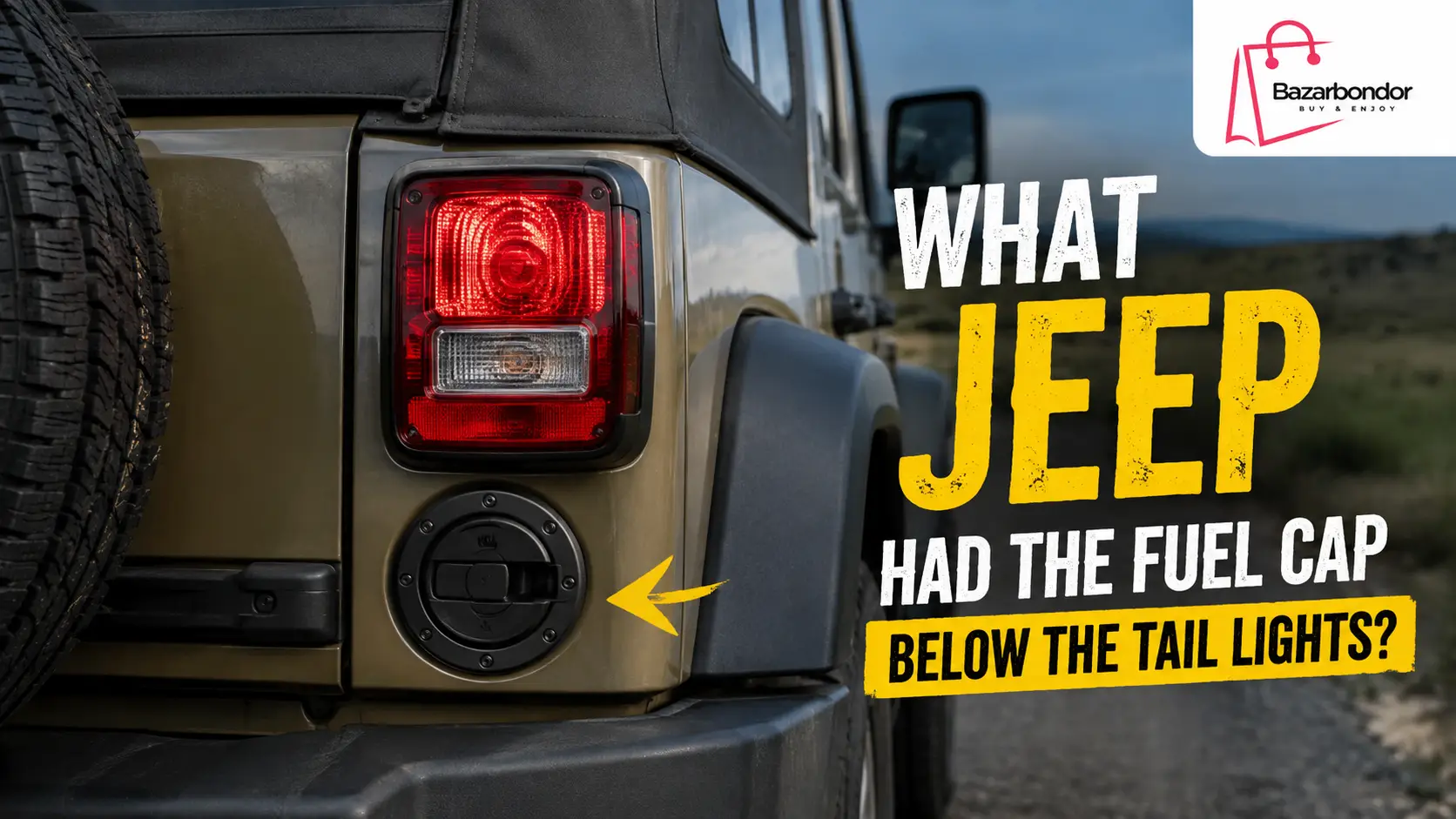
If you have ever seen an older Jeep with a fuel cap mounted low on the rear body and wondered, “What Jeep had the fuel cap below the tail lights?”, you were most likely looking at a classic Jeep from the CJ family.
The Jeep CJ-5 is the model most commonly associated with this unusual fuel filler location, particularly on later versions equipped with a rear-mounted fuel tank. Certain Jeep CJ-7 configurations also used a similar rear fuel filler arrangement.
However, the exact location can vary by model year because Jeep changed fuel tank sizes, filler necks, hoses, and body layouts during the long production life of the CJ series.
For anyone trying to identify an old Jeep from a photograph, restoration project, or vehicle seen on the road, the location of the gas cap can be a surprisingly useful clue.
Here is how the design worked, which Jeeps used it, and what you should check before identifying a specific model.
Quick Answer: What Jeep Had the Gas Cap Below the Tail Light?
The classic Jeep CJ-5, especially later models with a rear-mounted fuel tank, is strongly associated with a gas cap positioned below the rear tail light. Some Jeep CJ-7 models used a similar rear fuel filler arrangement as well.
The location is often described as being near or below the passenger-side rear tail light on applicable CJ models.
That does not mean every CJ-5 or CJ-7 had exactly the same setup. Jeep produced the CJ series for many years, and the fuel system changed several times during that period.
If you are identifying a Jeep based only on the fuel cap location, treat the rear filler as an important clue rather than absolute proof of the model.
Was It the Jeep CJ-5?
Yes. The Jeep CJ-5 gas cap location is one of the strongest matches for this description.
Later CJ-5 models with a rear-mounted fuel tank could have the fuel filler positioned on the rear corner of the body near the tail light. When viewed from behind, the cap appears unusually low compared with the side-mounted fuel doors found on most modern vehicles.
This arrangement is one reason people searching for an unidentified classic Jeep often use phrases such as:
- Jeep gas cap below tail light
- Jeep gas cap under tail light
- Jeep CJ5 gas cap location
- Jeep CJ5 fuel filler location
- old Jeep rear gas cap
The CJ-5 was produced over several decades, though, so an early CJ-5 may not have the same fuel tank arrangement as a later one.
Did the Jeep CJ-7 Have the Same Fuel Filler Location?
The Jeep CJ-7 also used a rear-mounted fuel system on applicable model years, and its fuel filler was located toward the rear body area.
The CJ-7 arrived later than the CJ-5 and featured a longer wheelbase and several changes intended to make the Jeep more practical for everyday driving. Even so, it retained much of the traditional CJ appearance.
Because the CJ-5 and CJ-7 shared many visual features, a rear fuel cap alone may not tell you which model you are looking at.
Other details, including the door opening, wheelbase, body proportions, dashboard, model badges, and VIN, can help confirm the identification.
Where Was the Fuel Cap Located on a Jeep CJ?
On relevant Jeep CJ models, the fuel filler was positioned toward the rear corner of the body rather than farther forward on the rear quarter panel as it is on many newer vehicles.
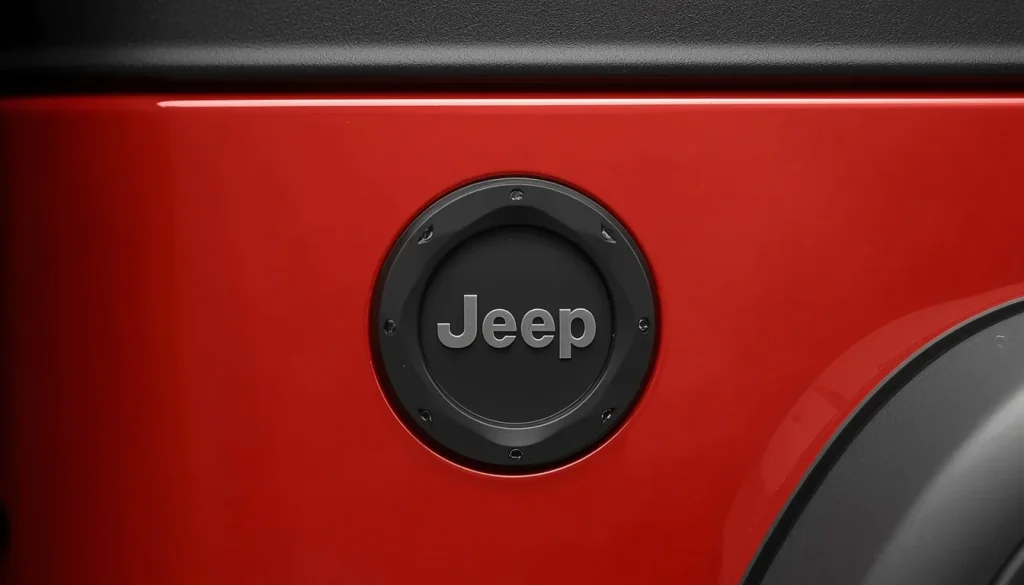
A typical rear fuel filler system includes several parts:
- Fuel cap
- Fuel filler bezel or surround
- Fuel filler neck
- Filler hose
- Vent hose
- Rear fuel tank
The filler opening connects through the filler neck and hose to the fuel tank mounted underneath the rear portion of the vehicle.
From behind the Jeep, the cap can appear directly below or close to the rear tail lamp depending on the model year, body configuration, and viewing angle.
This is the distinctive appearance people usually mean when asking which Jeep had a gas cap under the tail light.
Which Jeep CJ Model Years Used This Fuel Filler Design?
This is where identifying the vehicle becomes more complicated.
The Jeep CJ line existed for decades, and its fuel tank design was not identical throughout production. Earlier Jeeps could use different tank locations from later models, while later CJs adopted rear-mounted fuel tanks and different filler components.
Early Jeep CJ-5 and CJ-6 Models
Early CJ models should not automatically be grouped together with later CJ-5s.
Many older Jeep configurations used a fuel tank located beneath the seat rather than the later rear-mounted arrangement. That means an early CJ-5 may have a filler location that looks very different from the classic rear filler people usually recognize.
This distinction matters when restoring or identifying an older Jeep.
If someone simply says, “All CJ-5 Jeeps had the gas cap below the tail light,” that would be too broad.
The correct answer depends on the production year and fuel system fitted to the vehicle.
1970s Jeep CJ Fuel Filler Changes
During the 1970s, Jeep’s CJ fuel system evolved considerably.
Later CJ-5 vehicles moved toward the rear-mounted fuel tank arrangement associated with the familiar rear fuel filler.
The CJ-7 was also introduced during this period, bringing another configuration into the CJ lineup.
Because filler hoses, filler necks, tanks, and related components differ across particular years, owners buying replacement parts should always verify the exact year and model rather than ordering parts based only on appearance.
1980s Jeep CJ Fuel Cap Placement
By the 1980s, the rear-mounted tank layout was well established on the relevant CJ models.
This period includes later CJ-5s, CJ-7s, and the CJ-8 Scrambler.
If the vehicle you are trying to identify looks like a traditional open-body Jeep and has a fuel filler positioned low near the rear tail lamp, a late CJ-5 or CJ-7 should be among the first models you investigate.
Why Was the Jeep Fuel Cap Below the Tail Light?
The unusual location was closely related to the layout of the Jeep’s fuel system.
Once the fuel tank was mounted beneath the rear section of the vehicle, the filler neck needed a practical route from the exterior body to the tank.
Placing the fuel filler toward the rear corner allowed the filler neck and hoses to connect relatively directly to the rear-mounted tank while working within the compact CJ body.
This made sense for a short, utility-focused vehicle where available body space was limited.
It is better to think of the location primarily as a result of vehicle packaging and fuel-system design, rather than simply a styling choice.
Modern vehicles often hide the filler behind a flush-mounted door on the side of the body. Classic utility vehicles were generally more straightforward about exposing components such as filler caps, hinges, latches, and spare tire mounts.
That simplicity is part of the visual character of an old Jeep CJ.
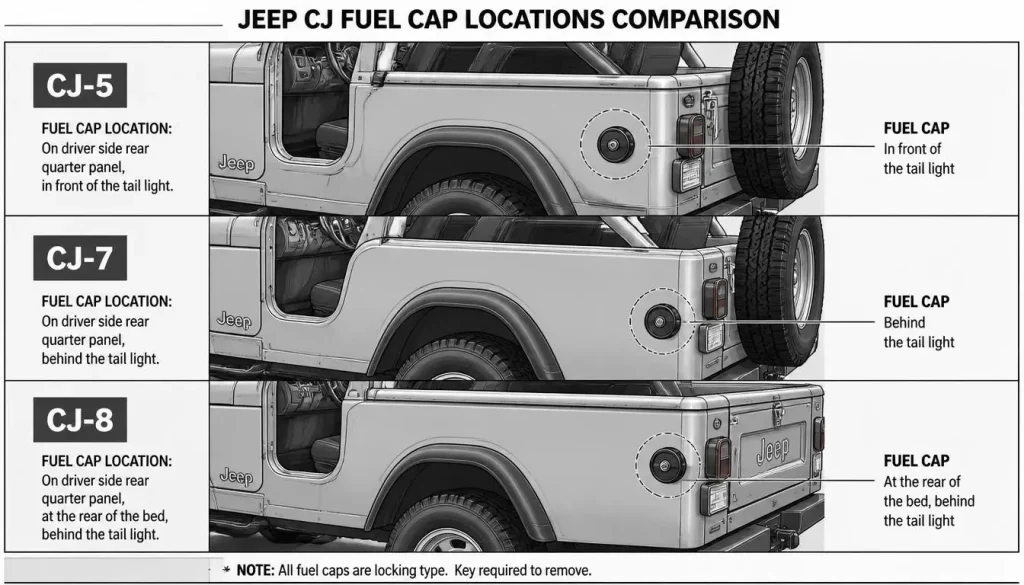
Jeep CJ-5 vs CJ-7 vs CJ-8 Fuel Cap Location
Several Jeep CJ models can appear similar at first glance, so comparing them helps narrow down the possibilities.
| Model | Fuel Filler Context | Identification Importance |
|---|---|---|
| Jeep CJ-5 | Later versions can use the recognizable rear filler near the tail light | Strongest match |
| Jeep CJ-7 | Rear fuel filler used on relevant production years | Important alternative |
| Jeep CJ-8 Scrambler | Shares many later CJ fuel-system components | Possible related model |
| Jeep Wrangler YJ | Later Jeep design with related CJ heritage | Useful comparison |
Jeep CJ-5
The CJ-5 is usually the first model worth checking when someone remembers an old Jeep with the gas cap below the tail light.
Its short body and classic rear layout make the filler particularly noticeable.
Jeep CJ-7
The CJ-7 has a longer wheelbase and a different body opening around the doors. Its rear fuel system can still resemble the later CJ-5 arrangement.
If a Jeep looks slightly longer or more spacious than a traditional CJ-5, it may be a CJ-7.
Jeep CJ-8 Scrambler
The CJ-8, commonly called the Scrambler, has a much longer body with a pickup-style rear cargo section.
Some fuel filler components overlap with later CJ applications, but visually the CJ-8 is much easier to distinguish because of its extended wheelbase and body.
Was the Jeep Gas Cap Behind the Tail Light or Below It?
This distinction causes a lot of confusion.
Some classic American cars are famous for having hidden fuel fillers behind a tail light or other rear trim panel.
The Jeep CJ arrangement is different.
On applicable Jeep CJ models, the filler cap is below, underneath, or near the tail light, rather than being concealed behind the tail light assembly itself.
So these two descriptions should not be treated as the same thing:
Gas cap behind the tail light:
The tail lamp or trim panel moves to reveal the fuel filler.
Gas cap below the tail light:
The filler cap is visibly mounted on the body underneath or close to the tail lamp.
If you remember seeing an exposed round fuel cap below a Jeep’s rear lamp, the CJ family is a much stronger possibility than a vehicle known for a hidden fuel filler.
How to Identify a Jeep With the Rear Fuel Cap
The fuel filler position is useful, but you should examine several details before deciding which Jeep you have found.
Look at the Rear Tail Lights
Check the shape and position of the rear lamps.
Then look directly below and around them for a round filler cap, bezel, or opening.
A rear-mounted filler near the tail lamp is a useful clue that you may be looking at a classic CJ.
Check the Fuel Filler Bezel and Cap
Older fuel fillers are usually much more visible than modern fuel doors.
You may see:
- A round exposed gas cap
- A black or painted filler bezel
- Mounting screws
- A recessed opening
- A filler neck behind the body panel
Restored Jeeps may have reproduction components that look nearly identical to the original parts.
Look for CJ-5, CJ-7 or Scrambler Badging
Badges can immediately narrow down the model.
However, badges are easy to remove, replace, or reproduce, so they should not be your only evidence.
Check the Wheelbase and Body Shape
The CJ-5 is shorter and has distinctive compact proportions.
The CJ-7 is noticeably longer and has different door openings.
The CJ-8 Scrambler is significantly longer and has a pickup-style appearance.
These structural differences are usually more reliable than a single trim feature.
Confirm the Model Year With the VIN
If you have physical access to the Jeep, the VIN is a much better way to confirm its identity.
Model year matters because Jeep changed:
- Fuel tank capacities
- Filler hoses
- Filler necks
- Vent systems
- Body tubs
- Emissions equipment
Two Jeeps that look almost identical from several feet away may use different fuel-system parts.
Check for Modifications
Classic Jeeps are frequently modified.
A previous owner may have installed:
- An aftermarket fuel tank
- A replacement body tub
- A custom fuel cell
- A relocated filler
- A different filler neck
- Modified rear body panels
Because of this, the current gas cap location does not always show how the Jeep originally left the factory.
Did Older Jeep CJ Models Have the Same Gas Cap Location?
No.
This is one of the most important details to understand when researching the old Jeep gas cap location.
Earlier CJ models could use fuel tanks located under the seat. Later vehicles moved toward rear-mounted fuel tanks.
That change affects where the filler opening needs to be positioned.
So if you are researching an early CJ-5 restoration, do not automatically assume that replacement parts listed for a late-1970s or 1980s CJ-5 will fit.
The model name may be the same, but the fuel system can be different.
Did the Wrangler YJ Use the Same Fuel Filler Design?
The Jeep Wrangler YJ replaced the CJ line and carried forward many elements of Jeep’s traditional utility-vehicle design.
However, the YJ should not automatically be described as having exactly the same fuel filler arrangement as every CJ.
The YJ had a different body design, rectangular headlights, revised interior features, and numerous mechanical changes.
Some later CJ and early Wrangler fuel filler components may appear similar or overlap in aftermarket parts catalogs, but that does not mean every component or location is interchangeable.
If you are identifying a Jeep visually, rectangular headlights are one of the easiest signs that you are looking at a YJ rather than a CJ-5 or CJ-7.
Common Jeep Fuel Filler Parts Explained
If you are restoring one of these Jeeps, understanding the terminology can make finding the correct parts much easier.
Fuel Cap
The fuel cap seals the filler opening.
Older Jeep caps are often exposed rather than hidden behind a modern-style fuel door.
Fuel Filler Neck
The fuel filler neck creates the passage between the external filler opening and the hose leading toward the tank.
Rust, damage, or incorrect replacement parts can cause fitment problems on older vehicles.
Fuel Filler Hose
The filler hose connects the filler neck to the fuel tank.
Because CJ fuel systems changed through the years, hose dimensions and shapes are not necessarily identical across every CJ-5 or CJ-7.
Vent Hose
The vent system allows air and fuel vapors to move as the tank is filled.
A cracked or incorrectly routed vent hose can contribute to fuel odors or filling problems.
Fuel Filler Bezel
The bezel surrounds the filler opening and gives the assembly a finished appearance.
It can also help identify where the original filler was mounted if you are examining an old or partially restored Jeep body.
Why the Fuel Cap Location Is Useful When Identifying a Classic Jeep
Classic Jeeps can be surprisingly difficult to identify from a single photograph.
Paint colors change. Wheels are replaced. Doors can be removed. Tops are swapped. Grilles, bumpers, lights, and even complete body tubs may be replaced.
The fuel filler position is useful because it relates directly to the body and fuel-system layout.
Combined with other visual clues, it can help separate:
- Early CJ models
- Later CJ-5 models
- CJ-7 models
- CJ-8 Scramblers
- Wrangler YJs
- Heavily modified Jeeps
It should still be treated as one clue among several rather than a guaranteed model identifier.
Frequently Asked Questions
What Jeep had the gas cap below the tail light?
The Jeep CJ series is best known for this layout, particularly later Jeep CJ-5 models. Certain CJ-7 configurations also used a rear fuel filler positioned near the tail light.
Which Jeep had the gas cap under the passenger-side tail light?
Later Jeep CJ-5 configurations are commonly associated with an exposed rear fuel cap located below or close to the passenger-side tail lamp.
Where is the gas cap on a Jeep CJ-5?
It depends on the year. Earlier CJ-5s could use a different tank arrangement, while later models with rear-mounted tanks could have the filler located near the rear tail light.
Where is the fuel filler on a Jeep CJ-7?
On applicable CJ-7 models, the fuel filler is located toward the rear side or rear corner of the body and connects to the rear-mounted fuel tank.
What year Jeep CJ had a rear-mounted fuel tank?
Rear fuel-tank arrangements appeared on later CJ applications, but exact configurations changed by production year. Always check the specific Jeep year before buying restoration parts.
Did the Jeep CJ-8 Scrambler have a rear fuel filler?
Yes, the CJ-8 used a rear fuel system related to other later CJ models. However, its longer pickup-style body makes it easy to distinguish from a CJ-5 or CJ-7.
Was the Jeep gas cap hidden behind the tail light?
Generally, no. The CJ design people are referring to had the fuel cap below or near the tail light rather than concealed behind the tail lamp assembly.
Did early CJ-5 Jeeps have under-seat fuel tanks?
Many early CJ-5 configurations used an under-seat fuel tank arrangement, which is why their fuel filler location can differ substantially from later CJ-5s.
Is the CJ-5 fuel cap location the same on every model year?
No. Jeep CJ-5 production covered many years, and its fuel system changed during that time. Tank location, capacity, filler neck, hoses, and related components can vary.
Final Answer: Which Jeep Had the Fuel Cap Below the Tail Light?
If you are trying to identify what Jeep had the fuel cap below the tail lights, the Jeep CJ-5 is the strongest answer, particularly later models equipped with a rear-mounted fuel tank. Certain Jeep CJ-7 models also used a similar rear fuel filler setup, and related CJ vehicles such as the CJ-8 Scrambler shared elements of the later fuel-system design.
The key detail is the model year. Not every CJ-5 used the same tank or filler arrangement, and decades of modifications can make identification even harder.
If you see a classic short-wheelbase Jeep with an exposed round gas cap mounted low near the rear tail light, start by checking whether it is a Jeep CJ-5 or CJ-7. Then confirm the body style, wheelbase, VIN, and production year before making a final identification.

“Cars aren’t just machines. They’re freedom, memory, and a little bit of grease under your fingernails.”
I’m Theodore Roosevelt—though my friends just call me “Ted” (and no, I’m not related to the president, though I do share his love for adventure). I grew up in Detroit in the 1970s, back when the city was still the heart of the American auto industry. My first love was a rusted-out 1967 Mustang my father and I rebuilt in our garage when I was fifteen. That project taught me that cars have souls. After spending twenty years as a mechanic and another ten writing for magazines, I started this blog to help everyday drivers and weekend wrenchers feel confident under the hood. Whether you’re restoring a classic or just trying to keep your daily driver alive for one more winter, I’m here to help you get there.