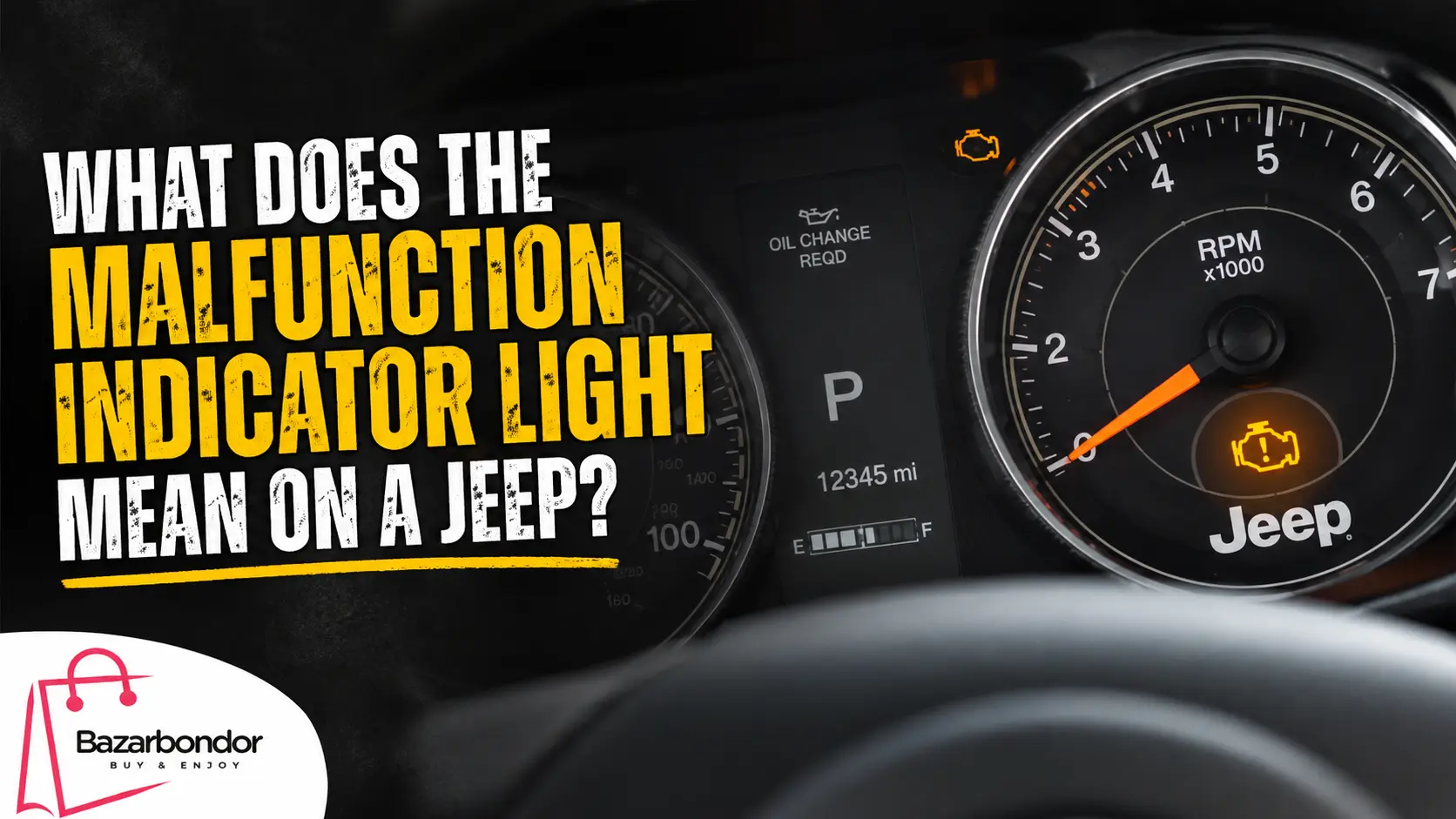
The Malfunction Indicator Light on a Jeep means the vehicle’s onboard diagnostic system has detected a problem involving the engine, emissions system, fuel system, ignition system, automatic transmission, or another monitored powertrain component.
It is commonly called the Check Engine Light, Service Engine Soon Light, Engine Management Light, or simply the MIL.
A solid yellow or amber light usually means the Jeep has detected a fault that should be diagnosed soon. A flashing light is more serious and may indicate an active engine misfire that can quickly damage the catalytic converter.
If the light is flashing, the engine is shaking, or the Jeep is losing power, reduce your speed and stop in a safe location. Continuing to drive under those conditions could turn a manageable problem into an expensive repair.
What Is the Malfunction Indicator Light on a Jeep?
The Malfunction Indicator Light is part of the Jeep’s onboard diagnostics system. This system continuously monitors components that affect engine operation, fuel delivery, emissions, and powertrain performance.
When the system detects a reading or operating condition outside its expected range, it may:
- Turn on the Malfunction Indicator Light
- Store a Diagnostic Trouble Code
- Save operating data from when the problem occurred
- Limit engine or transmission performance
- Disable certain convenience features
- Place the vehicle into a reduced-power or limp mode
The warning usually appears as a yellow or amber engine-shaped symbol. Depending on the Jeep model, market, and model year, the instrument panel may also display a written message.
Jeep owner information explains that the MIL monitors engine and automatic-transmission control systems. It may illuminate because of conditions such as a loose fuel cap, poor-quality fuel, or a more significant engine or transmission fault.
Is the MIL the Same as the Check Engine Light?
Yes. On most Jeep vehicles, the following names refer to the same basic warning:
- Malfunction Indicator Light
- Check Engine Light
- Service Engine Soon Light
- Engine Management Light
- EML
- Engine-shaped warning light
The exact name may differ between the USA, UK, Canada, and Australia, but the purpose is generally the same: the vehicle has detected a fault within an OBD-monitored system.
The MIL should not be confused with the oil-pressure light, temperature warning, Electronic Throttle Control light, battery light, Service 4WD warning, or hybrid charging-system warning.
Why Does the Jeep MIL Come On at Startup?
It is normally not a problem when the Malfunction Indicator Light comes on briefly after you switch the ignition to the ON or RUN position.
The light illuminates during startup so the vehicle can confirm that the warning lamp and monitoring system are functioning. It should normally go out after the engine starts if no relevant fault is present.
Official Jeep guidance states that the MIL illuminates with the ignition in the ON/RUN position before engine startup as part of a normal system check.
You may need further investigation when:
- The light stays on after the engine starts
- The light begins flashing
- The light never comes on during the startup check
- The Jeep runs roughly after startup
- Other warning lights appear at the same time
A light that never illuminates during the startup check could indicate a cluster, warning-lamp, electrical, or communication problem.
What Does a Solid Malfunction Indicator Light Mean on a Jeep?
A solid Malfunction Indicator Light means the Jeep has detected a confirmed fault, but the condition may not yet be severe enough to make the light flash.
Possible causes include:
- A loose or damaged fuel cap
- An EVAP-system leak
- A faulty oxygen sensor
- Worn spark plugs
- A weak ignition coil
- Incorrect fuel-mixture readings
- An engine-temperature problem
- A catalytic-converter efficiency fault
- A sensor or wiring problem
- A transmission-control fault
A steady light does not automatically mean the engine is about to fail. The Jeep may continue to start, accelerate, and drive normally. However, the fault should still be diagnosed instead of ignored.
Driving for an extended period with the MIL on may lead to:
- Increased fuel consumption
- Higher exhaust emissions
- Reduced engine performance
- Failed emissions inspections
- Hard starting or stalling
- Catalytic-converter damage
- More expensive repairs
What Does a Flashing Malfunction Indicator Light Mean on a Jeep?
A flashing Malfunction Indicator Light is more urgent than a steady light.
It frequently indicates an active engine misfire. During a serious misfire, some fuel may pass through the engine without burning properly. That unburned fuel can enter the exhaust system and cause the catalytic converter to overheat.
Official Jeep guidance warns that a flashing MIL may be associated with immediate loss of power or severe catalytic-converter damage and requires prompt service.
Take these steps when the light flashes:
- Release the accelerator.
- Avoid hard acceleration and high engine speed.
- Turn off heavy loads when practical.
- Move away from fast-moving traffic.
- Stop in a safe location.
- Turn off the engine if it is shaking, overheating, smoking, or losing power.
- Arrange professional diagnosis or roadside assistance.
Do not continue driving simply because the Jeep still moves. A flashing light can indicate a fault that becomes substantially more expensive within a short distance.
Jeep MIL Light Guide
| Light condition | Possible meaning | Recommended action |
|---|---|---|
| Light appears briefly at startup | Normal system check | No action if it goes out |
| Solid yellow or amber MIL | Confirmed engine, emissions, or powertrain fault | Drive cautiously and arrange diagnosis |
| Flashing MIL | Active misfire or potentially damaging fault | Reduce speed and stop safely |
| MIL with engine shaking | Serious misfire or mechanical problem | Stop driving and seek assistance |
| MIL after refueling | Fuel-cap, filler-seal, fuel-quality, or EVAP issue | Inspect the fuel-filler system |
| MIL with overheating | Cooling-system or engine problem | Stop and allow the engine to cool safely |
| MIL with red oil light | Possible loss of oil pressure | Shut off the engine as soon as safely possible |
Common Reasons the Jeep Malfunction Indicator Light Comes On
A trouble code is necessary to narrow down the cause, but several problems commonly trigger a Jeep MIL.
Loose, Missing, or Damaged Fuel Cap
A loose fuel cap can prevent the evaporative-emissions system from maintaining the expected pressure or vacuum.
Check whether:
- The cap is installed
- It has been tightened correctly
- Its rubber seal is cracked
- The filler neck is damaged
- Dirt is preventing a proper seal
Some newer Jeeps use a capless fuel-filler system. In that case, inspect the filler door and sealing area for dirt, obstruction, or damage.
After correcting the problem, the light may not turn off immediately. The vehicle may need to complete several self-tests during normal driving.
MIL After Refueling
When the light appears shortly after filling the tank, possible causes include:
- A loose fuel cap
- A damaged cap seal
- A capless filler that did not seal
- Overfilling the fuel tank
- Poor-quality or contaminated fuel
- An unrelated EVAP-system leak
- A purge valve that is stuck open
Do not continue adding fuel after the pump automatically stops. Overfilling can allow liquid fuel to enter parts of the evaporative-emissions system that are designed to handle vapor.
Faulty Oxygen Sensor
Oxygen sensors measure oxygen levels in the exhaust so the engine computer can adjust fuel delivery and evaluate catalytic-converter operation.
A failing sensor may cause:
- Poor fuel economy
- Rough running
- Slow acceleration
- Increased emissions
- Rich or lean trouble codes
- Catalytic-converter efficiency codes
An oxygen-sensor code does not always prove the sensor itself has failed. Exhaust leaks, wiring faults, fuel-pressure problems, vacuum leaks, and engine misfires may produce similar readings.
Worn Spark Plugs or Faulty Ignition Coils
Spark plugs and ignition coils help ignite the air-fuel mixture inside gasoline engines.
Problems can cause:
- Rough idle
- Engine shaking
- Hesitation
- Hard starting
- Reduced power
- Poor fuel economy
- A flashing MIL
A cylinder-specific misfire code can help identify the affected cylinder, but further testing is needed to determine whether the cause is a plug, coil, injector, wiring problem, compression loss, or another fault.
EVAP-System Leak
The evaporative-emissions system prevents fuel vapor from escaping into the atmosphere.
An EVAP fault may involve:
- Fuel-cap leakage
- Cracked vapor hoses
- A faulty purge valve
- A faulty vent valve
- A damaged charcoal canister
- A leak-detection pump
- Wiring or connector damage
EVAP faults frequently cause no noticeable driving symptoms. The Jeep may run normally even though the light remains on.
Catalytic-Converter Efficiency Problem
The catalytic converter helps reduce harmful exhaust emissions.
Possible symptoms of a converter-related problem include:
- Reduced power
- Poor fuel economy
- Excessive heat beneath the vehicle
- A sulfur-like smell
- Failed emissions testing
- A P0420-type trouble code
Do not replace the catalytic converter based only on one code. Misfires, exhaust leaks, fuel-mixture faults, and oxygen-sensor problems can produce a catalyst-efficiency code.
MAP, MAF, or Intake Sensor Problem
Depending on the engine, a Jeep may use a manifold absolute pressure sensor, mass airflow sensor, intake-air temperature sensor, or a combination of sensors to calculate engine load.
Incorrect data may lead to:
- Unstable idle
- Stalling
- Hesitation
- Poor acceleration
- Rich or lean operation
- Increased fuel use
- Hard starting
The intake system should also be inspected for loose clamps, damaged hoses, vacuum leaks, and contaminated connectors.
Fuel-Injector or Fuel-Delivery Problem
A dirty, leaking, restricted, or electrically faulty injector can trigger a misfire or fuel-mixture code.
Other fuel-related causes include:
- Low fuel pressure
- A failing fuel pump
- A restricted fuel filter where separately serviceable
- Contaminated fuel
- Incorrect fuel
- Damaged injector wiring
Fuel delivery should be tested before replacing injectors or other expensive parts.
Engine-Temperature or Thermostat Problem
A thermostat that remains open can prevent the engine from reaching its expected operating temperature. This may trigger a code such as P0128.
Possible symptoms include:
- Slow cabin heating
- Reduced fuel economy
- A temperature gauge that stays unusually low
- The MIL remaining on
- Increased emissions
An overheating engine is a different and more urgent condition. Stop driving if the temperature warning appears or the gauge moves into the hot zone.
Transmission or Powertrain-Control Fault
The Jeep MIL can also illuminate for certain automatic-transmission or powertrain-control faults.
Possible symptoms include:
- Harsh shifting
- Delayed engagement
- Transmission slipping
- Refusal to shift
- Reduced engine power
- Limp mode
- A warning message in the instrument cluster
A basic engine-code reader may not display all transmission, body, four-wheel-drive, hybrid, or communication-module codes. A Jeep-compatible diagnostic scanner may be required.
Battery, Charging, Wiring, or Communication Problems
Low system voltage and unstable electrical connections can affect multiple control modules.
Possible causes include:
- A weak 12-volt battery
- A failing alternator
- Corroded battery terminals
- Loose ground connections
- Damaged sensor wiring
- Water intrusion
- Rodent damage
- Loose electrical connectors
- Control-module communication faults
Multiple warning lights appearing at the same time can point to a voltage, ground, or network communication issue rather than several unrelated component failures.
Why Is the Jeep MIL On but the Vehicle Runs Normally?
Many faults do not immediately change how the Jeep feels from the driver’s seat.
For example, an EVAP leak, a slow oxygen sensor, a thermostat-performance problem, or an intermittent electrical fault may turn on the MIL without causing obvious symptoms.
The absence of symptoms does not mean the warning is false. The system may have detected a problem before it became noticeable.
Have the codes scanned even when:
- The engine sounds normal
- Fuel economy has not changed
- Acceleration feels normal
- There are no unusual smells
- The light is steady rather than flashing
Early diagnosis is usually easier and less expensive than waiting for additional symptoms.
Why Did the Jeep MIL Turn Off by Itself?
The light may turn off when the fault does not return during a required number of self-tests.
However, the computer may still retain:
- A stored trouble code
- A pending code
- A permanent emissions-related code
- Freeze-frame information
- A fault history in another control module
The original problem may have been intermittent. Loose wiring, changing temperatures, moisture, fuel-vapor conditions, and sensor faults can cause the light to turn on and off.
A light that has gone out should still be investigated when it was accompanied by:
- Engine shaking
- Stalling
- Loss of power
- A fuel smell
- Hard starting
- Transmission problems
- Repeated warning messages
Why Is the Jeep MIL On but the Scanner Shows No Codes?
A Check Engine Light with no visible code can happen for several reasons.
The scanner may:
- Read only generic engine codes
- Be connected incorrectly
- Be incompatible with the Jeep
- Miss manufacturer-specific codes
- Miss transmission or hybrid-module codes
- Fail to display pending codes
- Have a software or communication problem
The warning may also be coming from a different system. For example, the Electronic Stability Control Malfunction Indicator Light and the engine MIL are separate warnings, even though both may include the word “malfunction.”
Use a scanner capable of reading all relevant Jeep modules when a basic code reader finds nothing.
How Is the Jeep MIL Different From Other Dashboard Lights?
Correctly identifying the warning symbol is essential because some lights require faster action than a steady Check Engine Light.
MIL vs. Electronic Throttle Control Light
The Electronic Throttle Control warning often appears as a red lightning bolt between two curved lines.
It may indicate a problem with:
- The throttle body
- Accelerator-pedal sensors
- Throttle-position sensors
- Wiring
- Power or ground supply
The throttle warning and engine MIL can appear together, but they are not the same light.
MIL vs. Oil-Pressure Light
The oil-pressure warning usually looks like a red oil can.
A red oil-pressure light may mean the engine is not receiving adequate oil pressure. Stop the engine as soon as it is safe to do so. Continuing to drive with low oil pressure can cause severe engine damage.
Checking the oil level is useful, but a normal level does not prove that oil pressure is adequate.
MIL vs. Temperature Warning
A temperature warning or a gauge in the hot zone indicates overheating.
Stop safely, turn off the engine, and allow it to cool. Never remove a pressurized coolant cap from a hot engine.
MIL vs. Service 4WD Light
The Service 4WD warning relates to the four-wheel-drive system. It may involve a transfer case, actuator, sensor, wiring, or control-module problem.
It is separate from the Check Engine Light, although both may illuminate if a fault affects more than one system.
MIL vs. Hybrid or Charging Warning
On Jeep 4xe models, charging, plug-status, high-voltage battery, and hybrid-system warnings may be separate from the engine MIL.
Do not attempt DIY repairs on high-voltage components. Use a qualified technician with the correct hybrid diagnostic and safety equipment.
What Should You Do When the Jeep MIL Comes On?
Follow this order instead of immediately replacing a sensor or clearing the code.
1. Determine Whether the Light Is Solid or Flashing
A flashing light requires more urgent action. A steady light usually allows time to assess the vehicle, provided there are no serious symptoms.
2. Check Other Warning Lights
Look for:
- Oil-pressure warnings
- High-temperature warnings
- Battery warnings
- Electronic Throttle Control warnings
- Service 4WD messages
- Hybrid-system warnings
A red warning light may be more urgent than the amber MIL.
3. Notice How the Jeep Is Running
Pay attention to:
- Shaking
- Rough idle
- Reduced power
- Unusual exhaust smoke
- Fuel or burning smells
- Knocking sounds
- Stalling
- Hard shifting
- Overheating
Stop driving if any severe symptom is present.
4. Check the Fuel-Filler System
If the light is steady and the Jeep runs normally, inspect the fuel cap or capless filler.
Tighten the cap properly and inspect the seal. Do not clear the code immediately. Allow the vehicle to run its normal self-tests.
5. Scan the Diagnostic Codes
Connect an OBD-II scanner and record:
- Stored codes
- Pending codes
- Permanent codes
- Freeze-frame data
- Module names
- Relevant live data
Do this before disconnecting the battery or clearing codes.
6. Diagnose the System
Use the code as a starting point. Inspect the related wiring, connectors, hoses, mechanical components, and operating data.
7. Repair the Actual Cause
Replace a component only after testing shows that it is faulty.
8. Clear the Code and Confirm the Repair
After the repair, clear the code when appropriate and verify that:
- The light stays off
- The symptoms do not return
- No pending codes reappear
- Relevant readiness monitors complete
How to Read Jeep Codes With an OBD-II Scanner
The diagnostic port is commonly located beneath the dashboard on the driver’s side.
To read the codes:
- Park the Jeep safely.
- Apply the parking brake.
- Turn off unnecessary accessories.
- Connect the scanner to the OBD-II port.
- Switch the ignition to ON as instructed by the scanner.
- Select the correct vehicle or automatic identification option.
- Read stored, pending, and permanent codes.
- Save the freeze-frame data.
- Scan additional modules when supported.
- Research the code together with the symptoms and test results.
The EPA describes the MIL as the Check Engine Light used by the OBD system to warn about monitored engine or emissions-control problems.
Common Jeep OBD-II Codes
| Code | General meaning | Areas to inspect |
|---|---|---|
| P0300 | Random or multiple-cylinder misfire | Plugs, coils, injectors, fuel pressure, vacuum leaks, compression |
| P0301–P0306 | Misfire on a specific cylinder | Cylinder-specific ignition, fuel, wiring, or mechanical condition |
| P0420 | Catalyst efficiency below threshold | Exhaust leaks, oxygen sensors, fuel mixture, misfires, converter |
| P0440 | General EVAP-system fault | Fuel cap, hoses, purge valve, vent valve, leak-detection system |
| P0455 | Large EVAP leak detected | Missing cap, disconnected hose, major leak |
| P0456 | Small EVAP leak detected | Cap seal, small hose leak, valve or pump issue |
| P0171 | System too lean | Vacuum leak, low fuel pressure, sensor error, exhaust leak |
| P0172 | System too rich | Injector leak, excessive fuel pressure, sensor error, restricted airflow |
| P0128 | Coolant temperature below expected range | Thermostat, coolant-temperature sensor, wiring |
| P0106 | MAP sensor range or performance issue | Sensor, vacuum leak, intake problem, wiring |
Code definitions can vary by model, engine, and manufacturer-specific application. Always verify the definition for the exact Jeep model and model year.
Does a Trouble Code Identify the Failed Part?
No. A trouble code identifies the system, circuit, condition, or operating result that the vehicle detected. It does not always identify the component that must be replaced.
For example:
- P0301 does not automatically mean the spark plug is bad.
- P0420 does not automatically mean the catalytic converter has failed.
- An oxygen-sensor code does not always mean the sensor is defective.
- An EVAP code does not always mean the fuel cap is loose.
A correct diagnosis may require:
- Visual inspection
- Wiring tests
- Voltage and ground tests
- Vacuum or smoke testing
- Fuel-pressure testing
- Compression or leak-down testing
- Live-data analysis
- Component activation tests
Generic vs. Jeep-Specific Codes
Diagnostic codes generally begin with a letter:
- P: Powertrain
- B: Body
- C: Chassis
- U: Network communication
A code beginning with P0 is often a generic powertrain code. Codes beginning with P1 may be manufacturer-specific, although the exact classification depends on the code.
A basic scanner may read generic powertrain codes but miss:
- Transmission codes
- Four-wheel-drive codes
- Body-control codes
- Anti-lock braking codes
- Network communication codes
- Hybrid-system codes
- Manufacturer-specific information
Is It Safe to Drive a Jeep With the MIL On?
Driving may be possible for a short distance when:
- The light is solid
- The engine runs smoothly
- There is no overheating
- There is no red oil-pressure warning
- There is no smoke
- There is no strong fuel or burning smell
- The Jeep is not losing power
- The transmission operates normally
Drive gently and arrange a diagnostic scan as soon as practical.
When Should You Stop Driving?
Stop driving when:
- The MIL is flashing
- The engine is shaking
- The Jeep is losing power
- The engine is overheating
- A red oil-pressure light appears
- Smoke is coming from the engine or exhaust
- You smell burning material or strong fuel vapor
- The engine makes loud knocking sounds
- The vehicle stalls repeatedly
- The transmission cannot shift safely
How Many Miles Can You Drive With the Jeep MIL On?
There is no universal safe mileage.
A driver may be able to travel a short distance with a steady light and no symptoms, while another Jeep may require immediate shutdown even though the destination is only a few miles away.
Base the decision on:
- Whether the light is solid or flashing
- Engine temperature
- Oil-pressure warnings
- Engine smoothness
- Available power
- Smells, smoke, or unusual sounds
- Transmission operation
Do not rely on an arbitrary mileage number.
How to Reset the Malfunction Indicator Light on a Jeep
The proper way to reset the MIL is to diagnose and repair the fault first.
After the repair, the light may:
- Turn off automatically after successful self-tests
- Be cleared with a compatible scanner
- Remain off while a permanent code clears later
- Return if the fault is still present
Resetting With an OBD-II Scanner
Before clearing the codes:
- Record every code.
- Save freeze-frame data.
- Check pending codes.
- Diagnose the cause.
- Complete the required repair.
- Clear the codes.
- Test-drive the Jeep safely.
- Scan it again.
Clearing codes without fixing the problem may only turn off the light temporarily.
Should You Disconnect the Battery?
Disconnecting the battery is not a substitute for diagnosis.
It may:
- Erase useful fault information
- Reset learned engine or transmission values
- Reset the clock and other preferences
- Clear emissions readiness monitors
- Cause the light to return later
Some Jeep systems may also require relearning procedures after power loss.
Why Does the Light Return After Resetting?
The light usually returns because:
- The original fault was not repaired
- The wrong component was replaced
- A wiring fault is intermittent
- More than one problem exists
- The vehicle has completed the monitor that detects the fault
- A leak or misfire occurs only under certain conditions
Can a Jeep Pass an Emissions Test or MOT With the MIL On?
An illuminated engine MIL can cause an emissions-inspection problem, depending on local rules.
In the UK MOT process, the engine MIL is inspected to confirm that it illuminates appropriately and goes out when the engine is started. An illuminated malfunction indication can be treated as a defect under applicable testing criteria.
In the USA and parts of Canada, OBD-based inspection programs may check:
- MIL status
- Stored emissions codes
- Readiness-monitor status
- Communication with the vehicle
Rules differ by state, province, territory, vehicle age, fuel type, and inspection program.
Do not clear the codes immediately before an inspection. Clearing codes or disconnecting the battery can reset readiness monitors to “not ready.” The monitors must then run their self-tests under the required driving conditions. EPA material confirms that clearing codes can return monitors to a not-ready state until the relevant diagnostic tests are completed.
Does the MIL Mean the Same Thing on Every Jeep?
The basic purpose is similar, but the systems and possible causes vary by model, engine, model year, and powertrain.
| Jeep type | Important considerations |
|---|---|
| Wrangler and Gladiator | Ignition, EVAP, sensor, wiring, and off-road exposure |
| Grand Cherokee and Wagoneer | Engine, transmission, emissions, and advanced electronic systems |
| Cherokee, Compass, and Renegade | Engine, emissions, sensor, and model-specific transmission faults |
| Diesel Jeep models | Diesel emissions, EGR, DPF, DEF, boost, and fuel-system faults |
| Wrangler 4xe and Grand Cherokee 4xe | Combustion-engine, emissions, charging, communication, and hybrid faults |
Gasoline Jeep Models
Common areas include:
- Spark plugs
- Ignition coils
- Fuel injectors
- EVAP systems
- Oxygen sensors
- Catalytic converters
- Airflow and pressure sensors
Diesel Jeep Models
Diesel models may have faults involving:
- Exhaust-gas recirculation
- Diesel particulate filters
- Diesel exhaust fluid systems
- Turbocharger boost control
- Fuel pressure
- Glow-plug systems
- Diesel-specific emissions sensors
A DPF or DEF warning may be separate from the main MIL. Read the exact message displayed by the vehicle.
Jeep 4xe Models
On a Wrangler 4xe or Grand Cherokee 4xe, the MIL may relate to the internal-combustion engine, emissions controls, or a fault that affects powertrain operation.
Charging-system, plug-status, and high-voltage-system warnings may use separate lights or messages. Official Jeep 4xe documentation includes dedicated warnings for plug-status and electrified-powertrain conditions.
High-voltage hybrid components should be inspected only by properly trained personnel.
Can the Check Engine Light Disable Jeep Remote Start?
On some Jeep models, an active engine or powertrain fault may prevent remote start from operating.
However, remote start can also be disabled by:
- An open hood
- A weak battery
- Low fuel
- An active security-system condition
- A door or liftgate condition
- Incorrect start attempts
- Other stored faults
Do not assume the remote-start system itself has failed when the MIL is also on. Diagnose the engine or powertrain fault first.
Is a Jeep MIL Expensive to Fix?
The repair cost depends entirely on the cause.
Relatively simple possibilities include:
- Tightening or replacing a fuel cap
- Repairing a loose connector
- Replacing a damaged hose
- Installing new spark plugs
Moderate repairs may include:
- Ignition coils
- Oxygen sensors
- Purge valves
- Thermostats
- Fuel injectors
- Wiring repairs
More expensive repairs may involve:
- Catalytic converters
- Internal engine damage
- Major transmission faults
- Turbocharger systems
- Hybrid components
- Control modules
The diagnostic fee, local labor rate, Jeep model, engine type, parts availability, and use of OEM or aftermarket components all affect the final price.
The cheapest repair is not always the least expensive part. Correct testing prevents unnecessary replacement of multiple components.
How to Help Prevent the MIL From Returning
You cannot prevent every warning light, but regular care can reduce avoidable faults.
- Follow the maintenance schedule for your exact Jeep.
- Use the correct fuel and engine oil.
- Replace spark plugs at the recommended interval.
- Tighten the fuel cap after refueling.
- Avoid overfilling the fuel tank.
- Repair misfires promptly.
- Keep the battery terminals clean and secure.
- Address coolant leaks and overheating.
- Inspect wiring after heavy off-road or water exposure.
- Do not ignore intermittent warning lights.
- Use quality replacement parts.
- Diagnose trouble codes instead of guessing.
Frequently Asked Questions
What does the yellow engine-shaped light mean on a Jeep?
It is usually the Malfunction Indicator Light or Check Engine Light. It means the onboard diagnostic system has detected an engine, emissions, fuel, transmission, or powertrain-related fault.
Is a solid Jeep Check Engine Light serious?
A solid light is usually less urgent than a flashing light, but it should still be diagnosed. A minor EVAP leak and a developing catalytic-converter problem can both produce a steady light.
Is a flashing Jeep Check Engine Light serious?
Yes. It may indicate an active misfire that can damage the catalytic converter. Reduce speed and stop safely, especially when the engine is shaking or losing power.
Can a loose fuel cap turn on the Jeep MIL?
Yes. A loose, missing, or damaged cap can cause an EVAP-system leak. A damaged capless filler seal can create a similar problem.
Why is my Jeep Check Engine Light on but running fine?
Some emissions, sensor, thermostat, and EVAP faults do not immediately produce noticeable symptoms. Scan the codes even when the Jeep appears to run normally.
Why is my Jeep shaking while the MIL flashes?
The engine may have a severe misfire. Stop driving as soon as it is safe and have the vehicle diagnosed.
Can poor-quality fuel trigger the Jeep MIL?
Yes. Poor-quality or contaminated fuel may affect combustion, fuel-mixture readings, or engine performance. Jeep owner information identifies poor-quality fuel as one possible reason the MIL may illuminate.
Can low oil cause the Jeep MIL to come on?
Low oil level normally has a separate oil warning, but oil-related engine-timing, pressure, or performance problems may also trigger engine codes. A red oil-pressure warning requires immediate attention.
Can low coolant cause a Jeep Check Engine Light?
Low coolant may contribute to overheating or incorrect temperature readings. Those conditions can trigger engine-related codes, although the vehicle may also display a separate temperature warning.
Can a weak battery trigger the Jeep MIL?
Yes. Low or unstable voltage can cause sensor, module, or communication faults. Test the battery and charging system before assuming multiple control modules have failed.
Will the Jeep MIL reset itself?
It may turn off after the fault stops occurring and the Jeep completes enough successful self-tests. Stored or permanent codes may remain even after the light goes out.
Will disconnecting the battery clear the MIL?
It may clear some information temporarily, but it will not repair the fault. It can also erase diagnostic evidence and reset emissions readiness monitors.
Why did the MIL return after I cleared it?
The system detected the same problem again. The original fault may still be present, the repair may have been incomplete, or the problem may occur only under certain operating conditions.
Do I need a Jeep-specific OBD scanner?
A basic scanner may be enough for generic engine codes. A Jeep-compatible advanced scanner may be needed for transmission, 4WD, body, hybrid, ABS, and manufacturer-specific codes.
Can I drive to a repair shop with the MIL on?
A short, cautious drive may be reasonable when the light is solid and there are no other symptoms. Do not drive when the light flashes or the Jeep shakes, overheats, smokes, loses oil pressure, or loses significant power.
Final Verdict
The Malfunction Indicator Light on a Jeep means the onboard diagnostic system has detected a fault involving a monitored engine, emissions, transmission, fuel, ignition, electrical, or powertrain system.
A light that briefly illuminates at startup and then goes out is normally part of the system check. A steady light should be scanned and diagnosed soon. A flashing light, especially with shaking or power loss, requires immediate attention because continued driving may damage the catalytic converter or other components.
Check the other dashboard warnings, assess how the Jeep is running, inspect the fuel-filler system, and read the diagnostic codes before replacing parts. Remember that a trouble code identifies where the vehicle detected a problem—it does not automatically identify the failed component.
When in doubt, stop in a safe location and consult the owner’s manual or a qualified technician familiar with your Jeep’s model, engine, and powertrain.

“Cars aren’t just machines. They’re freedom, memory, and a little bit of grease under your fingernails.”
I’m Theodore Roosevelt—though my friends just call me “Ted” (and no, I’m not related to the president, though I do share his love for adventure). I grew up in Detroit in the 1970s, back when the city was still the heart of the American auto industry. My first love was a rusted-out 1967 Mustang my father and I rebuilt in our garage when I was fifteen. That project taught me that cars have souls. After spending twenty years as a mechanic and another ten writing for magazines, I started this blog to help everyday drivers and weekend wrenchers feel confident under the hood. Whether you’re restoring a classic or just trying to keep your daily driver alive for one more winter, I’m here to help you get there.