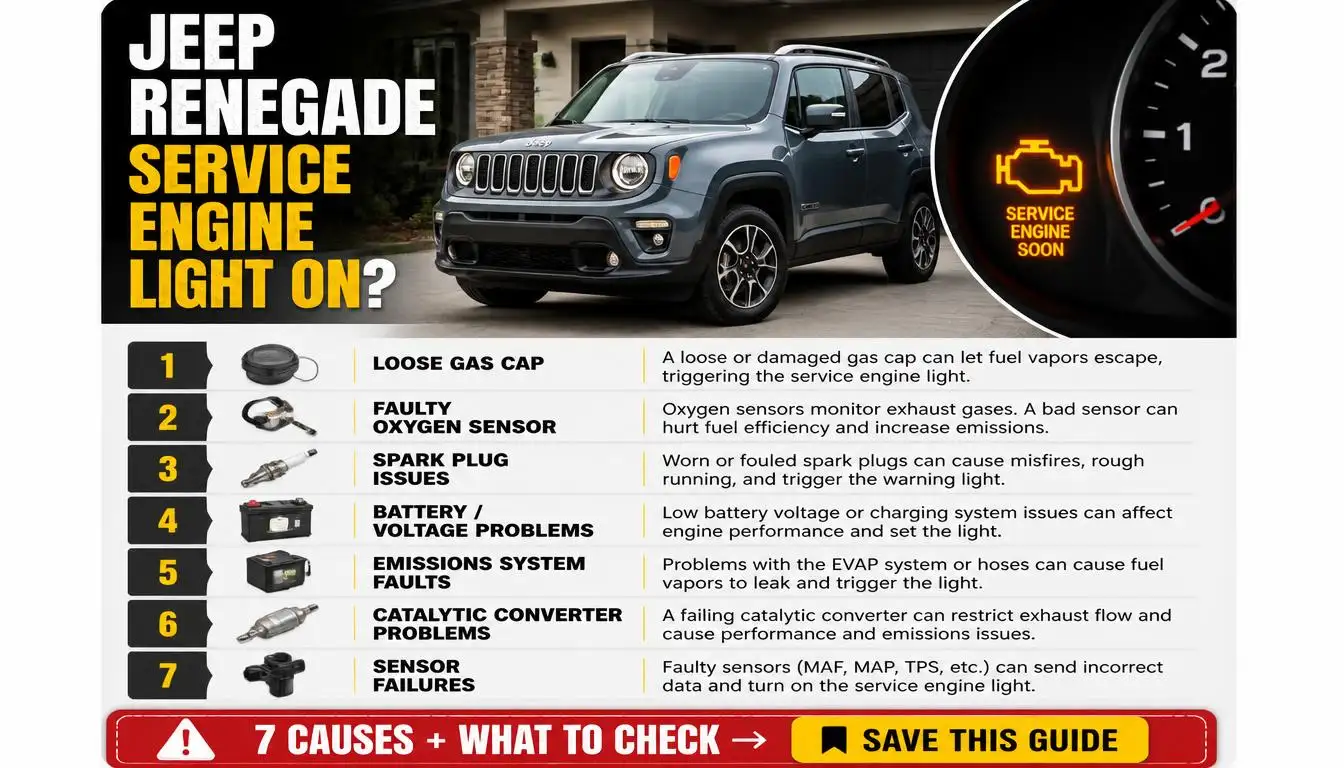
Why Is My Service Engine Light On Jeep Renegade 2? The short answer is that your OBD-II system detected a fault in the engine or emission controls. The light warns you to pay attention.
It does not always mean immediate danger. Sometimes it is a simple fix like a loose gas cap. Other times it signals a serious mechanical problem that needs urgent service.
Understanding the warning saves you time and money. A steady amber lamp lets you drive to a shop. A flashing lamp demands you pull over now.
Reading the diagnostic trouble code tells you exactly where to look. This guide walks you through what the light means, how to diagnose it, and when to tackle the repair yourself.
What the Service Engine Light Means on a Jeep Renegade
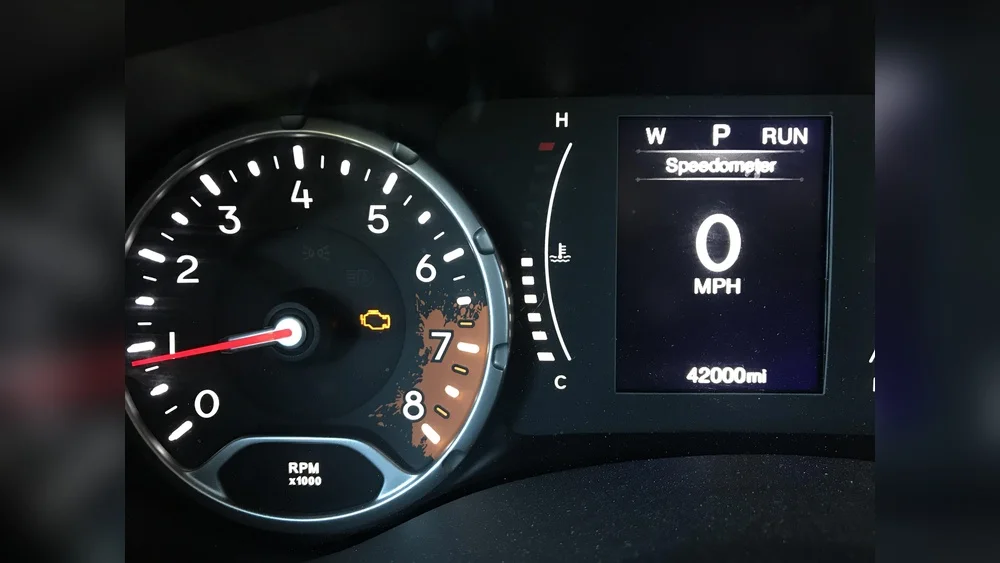
The amber lamp on your dash is the Malfunction Indicator Lamp, or MIL. It is the same light that appears when your vehicle's emission control system detects a fault. The MIL is not a generic warning icon.
It is a specific signal that the powertrain control module has recorded a trouble code. When the light is on, your Renegade may run normally. It may also experience reduced power, rough idle, or poor fuel economy.
The MIL is part of the federal OBD-II mandate. This requirement forces vehicles to monitor their own emissions-related components. If a sensor reads outside its programmed range, the module sets a code and turns on the light.
The system also stores freeze-frame data. This snapshot captures engine speed, load, and temperature at the moment the fault occurred. That data helps pinpoint the exact conditions that triggered the warning.
Other dashboard lights serve different purposes. The ABS indicator relates to your braking system. The traction control light relates to wheel slip.
The MIL specifically relates to the engine and emission systems. If you see a red oil-can symbol, that is a separate warning requiring immediate shutdown. For context on other dashboard warnings, reviewing what the part-time four-wheel-drive light means on a Jeep shows how different indicators map to distinct systems.
Quick Answer: Is It Safe to Keep Driving?
Why Is My Service Engine Light On Jeep Renegade 2? It means the OBD-II system detected a fault. A steady light allows continued driving.
A flashing light requires stopping soon. The flash can damage your catalytic converter. Retrieve codes to identify the exact issue.
How the OBD-II System Works on Your Renegade
Your Renegade uses an OBD-II port accessible under the dashboard on the driver's side. A scan tool plugs into this port and communicates with the engine control module. The module continuously monitors sensors such as the oxygen sensor, mass air flow sensor, throttle position sensor, and crankshaft position sensor.
When a reading falls outside the programmed limits, the module sets a diagnostic trouble code.
The OBD-II system also includes readiness monitors. These track whether each emission-related component has completed its self-test. If you clear codes without completing a drive cycle, some monitors stay incomplete.
This affects how your vehicle passes an emissions inspection. As of 2026, the OBD-II standard remains unchanged for your Renegade. Any compliant scan tool can read its codes.
Federal emission requirements are outlined by the Environmental Protection Agency (EPA).
Common Causes of the Service Engine Light on a Jeep Renegade
The light can trigger for many reasons. Some are trivial. Others are serious.
The most frequent culprits include:
| Cause | Typical Code | Severity |
|---|---|---|
| Loose or missing fuel cap | P0455 | Low |
| Failing oxygen sensor | P0135 | Medium |
| Ignition coil or spark plug failure | P0300–P0304 | High |
| Mass air flow sensor contamination | P0101 | Medium |
| Evaporative emission leak | P0456 | Low |
| Throttle body carbon buildup | P0121 | Medium |
| Camshaft or crankshaft position sensor fault | P0016 | High |
| Transmission communication loss | P0700 | Medium |
A loose gas cap is the easiest fix. It is also the first thing to check. If the cap is tight, the next step is reading the stored code.
The code points you toward the affected system. For routine maintenance that prevents many of these issues, knowing how to reset your Jeep Renegade oil change reminder after service keeps your maintenance schedule on track.
Solid vs Flashing Light: What Each Pattern Tells You
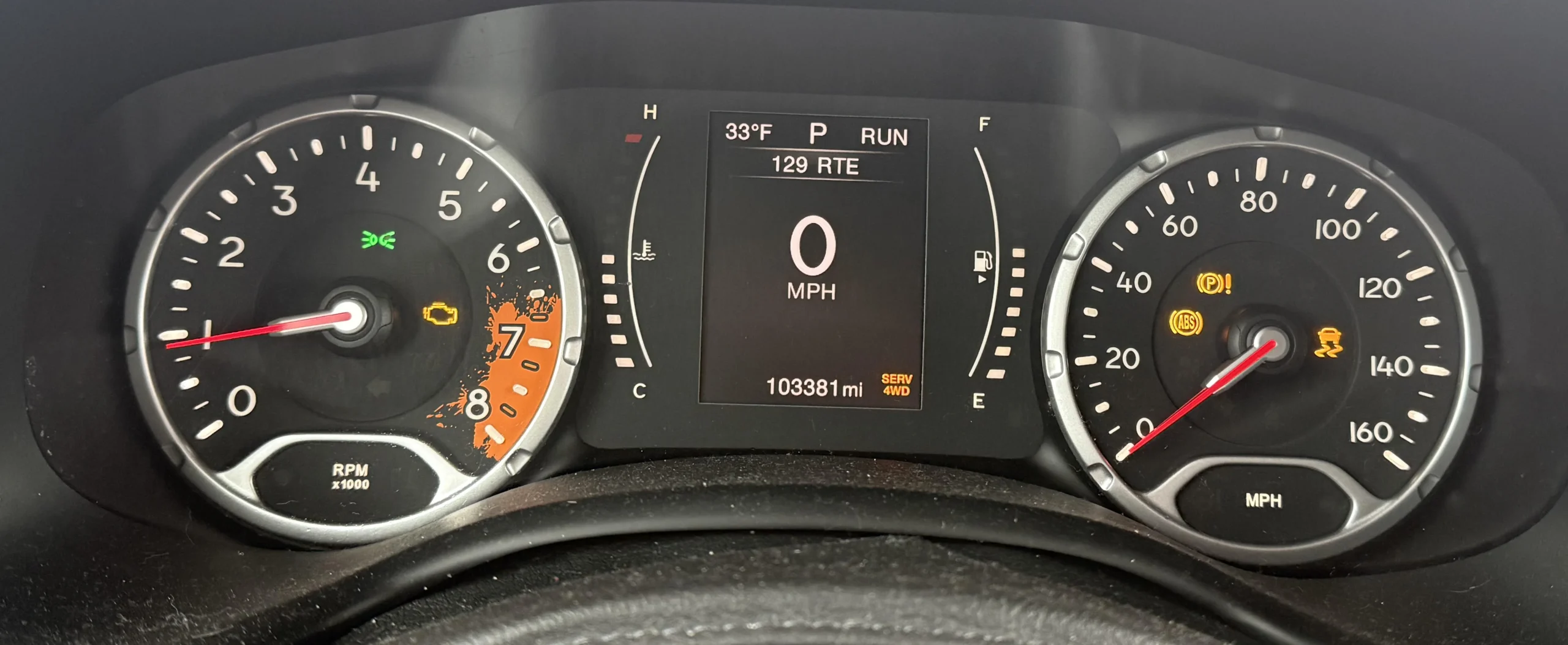
A solid MIL indicates that a fault has been detected. The engine is still running within safe parameters. You can usually drive the vehicle to a repair facility.
Avoid aggressive acceleration while doing so. A flashing MIL signals an active misfire or another condition that could quickly damage the catalytic converter. Reduce engine load immediately.
Seek service as soon as possible.
The blinking pattern also provides clues. Rapid blinking usually points to a severe misfire. Slow flashing may indicate a less urgent fault that still needs attention.
In both scenarios, connecting a scan tool to read pending and stored codes is the next step. This gives you actionable data instead of guesswork.
Step-by-Step: Pulling Codes and Reading Live Data
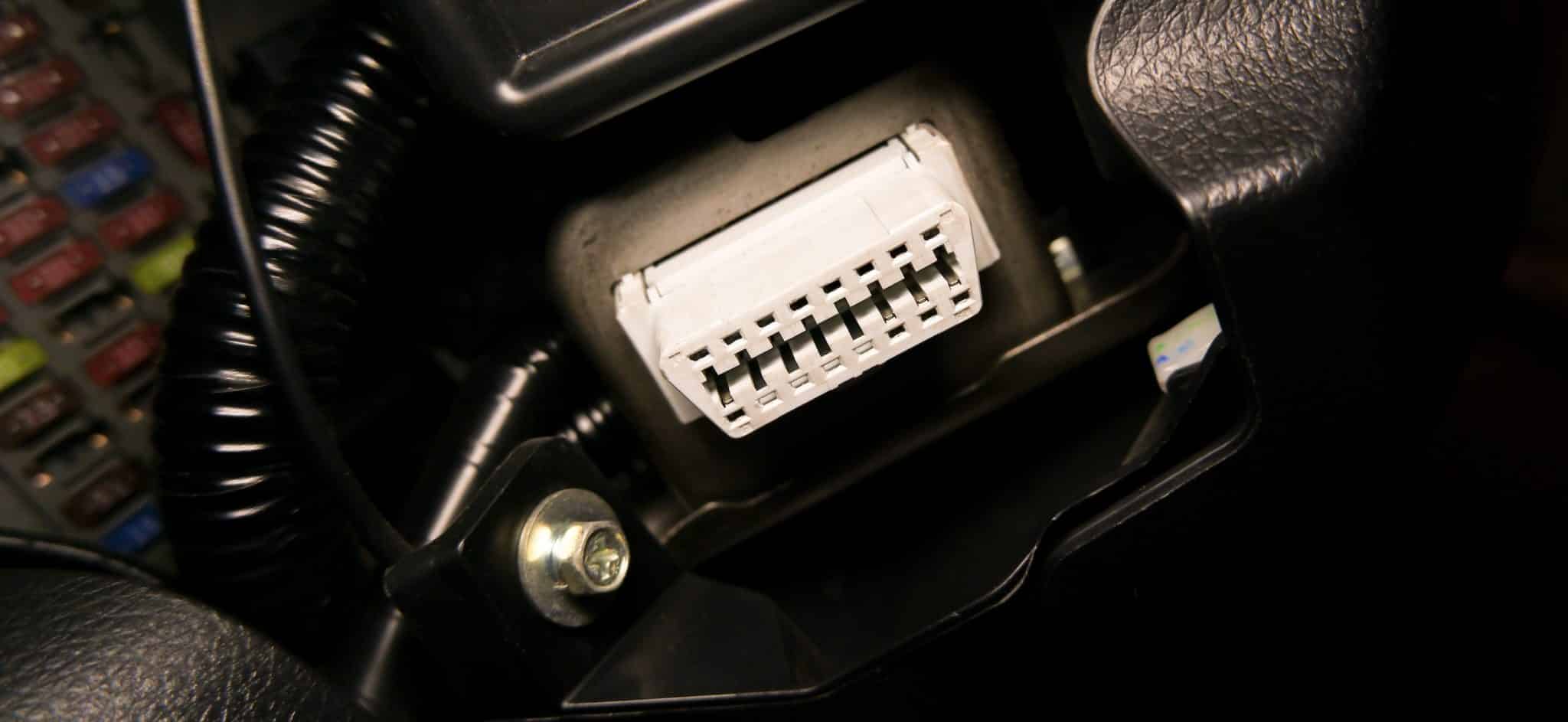
Pulling codes is straightforward once you locate the port. The OBD-II connector sits under the dashboard on the driver's side. It is a trapezoidal sixteen-pin connector.
Most people find it within arm's reach of the steering column. A basic code reader costs between twenty and fifty dollars. These tools display stored trouble codes and clear them after repairs.
More advanced scanners show live data streams. They also perform active tests on certain components.
Reading Stored and Pending Codes
Stored codes represent confirmed faults. They triggered the MIL during the current or previous drive cycle. Pending codes are single-event faults.
They have not yet met the criteria for a confirmed trigger. Always record both types when you first connect your scanner. This prevents you from missing intermittent problems.
Freeze-frame data appears alongside the code. This snapshot captures engine RPM, vehicle speed, coolant temperature, and fuel trim. It records the exact moment the fault occurred.
If the problem happens only under specific conditions, freeze-frame data becomes critical. Without it, you might chase a code that no longer presents itself.
Monitoring Live Data Streams
Live data lets you watch sensor values while the engine runs. Key parameters include short-term and long-term fuel trims. A fuel trim above plus ten percent indicates a lean condition.
A fuel trim below minus ten percent suggests a rich condition. The mass air flow sensor reading should scale smoothly with engine RPM. Deviations here often point to intake vacuum leaks or MAF contamination.
The oxygen sensor waveform matters as well. A healthy O2 sensor switches between roughly zero point one volts and zero point nine volts. A lazy or stuck sensor fails to switch quickly enough.
This behavior can set a code even when the sensor is still functional. Watching live data separates real faults from stale codes.
Clearing Codes and Verifying the Repair
Clearing the code is the final step. It is not the first step. Always address the root cause before erasing any codes.
After clearing, drive the vehicle through a complete drive cycle. This allows the readiness monitors to run their self-tests. If the MIL returns immediately, the problem persists.
If it returns after several drive cycles, you may be dealing with an intermittent fault.
Checking monitor readiness is essential before an emissions inspection. An incomplete monitor causes your Renegade to fail even if no current code exists. Most states require at least two monitors to be ready for a passing result.
Always verify readiness before heading to the inspection station.
If the Light Is Flashing – Immediate Actions
Flashing triggers an urgent condition. Do not ignore it. Treat it as a warning that needs immediate attention.
Stop Driving As Soon As Possible
A flashing MIL almost always indicates a severe misfire. Misfires send unburned fuel directly into the exhaust system. The catalytic converter tries to burn that extra fuel.
Temperatures inside the converter can exceed two thousand degrees Fahrenheit very quickly. This melts the internal substrate and destroys the component.
Catalytic converters for the Renegade are expensive. Replacement often runs between eight hundred and two thousand five hundred dollars depending on the source. Ignoring a flashing light can turn a simple ignition coil fix into a full powertrain overhaul.
Pull over safely when you see the flash. Turn off the engine. Call for roadside assistance or a tow to the nearest qualified shop.
Avoid Aggressive Driving Habits
If you must move the vehicle a short distance to reach safety, keep throttle input light. Do not accelerate hard. Do not climb steep grades.
Every rev that fires a misfiring cylinder adds heat to the exhaust stream. Even gentle driving under these conditions risks further damage. Minimize engine load until you reach a safe location.
Document What You Observed
Before the tow truck arrives, note any accompanying symptoms. Did the vehicle feel sluggish? Was there a popping sound from the exhaust?
Did the smell of raw fuel hit your nostrils? This information helps the technician prioritize which cylinders to inspect first. Saving those details reduces diagnostic time and keeps your repair bill lower.
If the Light Is Solid and the Vehicle Runs Normally
A steady light with normal operation means the issue is likely less urgent. Still, it deserves prompt attention. Driving with a steady MIL for extended periods can reduce fuel economy.
It can increase emissions. In some cases, it can lead to secondary damage.
Check the Fuel Cap First
A loose or damaged gas cap is a surprisingly common trigger. The evaporative emission system detects even a small leak. If the cap does not seal properly, the module sets a code and illuminates the lamp.
Tighten the cap until it clicks three times. Drive for a few days and see if the light goes out on its own. Many systems require two or three consecutive drive cycles without a fault before they turn off the MIL.
If tightening the cap does not resolve the issue, the problem lies elsewhere. Do not replace the cap preemptively. Let the code guide you.
Premature part swapping wastes money and rarely solves the problem.
Schedule a Diagnostic Appointment
Even if the car drives fine, book a service visit within the next week. Ask the shop to read and record all codes. Do not let them clear the codes without explanation.
A reputable technician will tell you what each code means. They should also explain whether it correlates with your driving experience. If a shop wants to replace parts without reading codes first, find another mechanic.
Code reading is free at most auto parts stores. It should be the starting point of any diagnosis.
If You Notice Rough Idle, Hesitation, or Power Loss
Symptoms combine with the light to narrow down the cause. Rough idle points toward ignition or vacuum issues. Hesitation during acceleration often signals a fuel delivery problem.
Loss of power usually means the ECU entered limp mode. Limp mode limits engine output to protect components from further damage.
| Symptom | Likely Systems Involved |
|---|---|
| Rough idle at stop | Spark plugs, coils, vacuum leak, idle air control |
| Hesitation on throttle tip-in | MAF sensor, fuel pump, fuel pressure regulator |
| Noticeable power loss | Catalytic converter restriction, turbo issue, transmission |
| Stalling after startup | Crankshaft position sensor, cam sensor, fuel cutoff |
Testing the Spark System
Ignition coil failure is frequent on the Renegade. A weak or dead coil causes a cylinder to misfire under load. You may feel a noticeable shake at highway speeds.
Scanning for P0300 through P0304 codes confirms which cylinder is affected. Swapping coils between cylinders helps isolate the faulty unit. If the misfire follows the coil to a different cylinder, the coil is bad.
If it stays in the original cylinder, check the spark plug or wiring harness next.
Spark plug condition also reveals a lot. Remove one plug and inspect the electrode. A clean tan plug is normal.
Black and sooty means rich mixture. White and blistered means lean condition or overheating. Replaced plugs at the recommended interval prevent many downstream problems.
The 1.4L MultiAir engine typically calls for plug replacement every thirty to forty thousand miles.
Checking for Vacuum Leaks
Vacuum leaks introduce unmetered air into the intake manifold. The oxygen sensor detects the extra oxygen. It reports a lean condition to the ECU.
The computer enriches the mixture to compensate. Over time, this upsets fuel trims and triggers codes like P0171 or P0174. Listen for a hissing sound near the intake manifold while the engine idles.
Spraying carb cleaner around vacuum lines and gaskets while the engine runs causes the RPM to change if you found a leak.
Carbon buildup on the throttle body is another common culprit on the MultiAir engines. Deposits restrict airflow and disrupt adaptive learning. Cleaning the throttle body restores proper air passage.
It also resets the adaptation values to factory baseline.
Common Mistakes When Diagnosing the Renegade
Mistakes in diagnosis waste time and money. The most frequent error is replacing parts based solely on a trouble code. Codes point to circuits and systems.
They do not pinpoint specific failed components. A code saying primary circuit malfunction could mean a bad coil, a broken wire, or a poor connector contact. Jumping straight to part replacement without verification leads to buyer remorse.
Other Frequent Errors
| Mistake | Consequence |
|---|---|
| Clearing codes before diagnosis | Loses freeze-frame data and pending codes |
| Ignoring pending codes | Misses intermittent faults that are harder to catch later |
| Using an unverified scan tool | Reads generic codes but misses manufacturer-specific data |
| Replacing the O2 sensor first | Often the most expensive part and rarely the real culprit |
| Neglecting battery voltage | Low voltage creates false codes across multiple systems |
| Skipping visual inspection | A disconnected hose is cheaper than a new throttle body |
| Not completing drive cycle after repair | Readiness monitors stay incomplete and fail inspection |
Choosing the Right Scan Tool Matters
Cheap Bluetooth adapters paired with phone apps work for basic code reading. They often cannot access transmission, ABS, or airbag modules. They also lack manufacturer-specific enhanced diagnostics.
The Renegade benefits from a scanner that supports Chrysler-specific functions. These include throttle body adaptation reset and module coding. Tools like Wi-Fi OBD-II adapters with dedicated software provide better coverage at a reasonable price.
Battery health directly affects diagnostic accuracy. A weak battery causes communication errors between modules. Voltage drops during cranking create phantom codes in unrelated systems.
Always verify battery voltage before relying heavily on a scan tool readout. If voltage falls below twelve point four volts at rest, charge or replace the battery first. Poor electrical health mimics sensor failures across the board.
DIY vs Professional: When to Do It Yourself
Some repairs suit garage work. Others demand specialized tools and training. Knowing where you draw the line saves money and prevents costly mistakes.
The decision depends on your comfort level, available equipment, and fault complexity.
Problems You Can Likely Handle Yourself
Simple issues like a loose gas cap, dirty mass air flow sensor, or worn spark plugs are manageable for most DIYers. These require basic hand tools and a scan tool to verify the repair. Replacing ignition coils is also straightforward on the Renegade.
Each coil bolts to the top of the engine with two small screws. No special procedures are needed beyond torquing them to spec.
Cleaning the throttle body is another affordable fix. You need throttle body cleaner and a soft brush. Remove the intake hose and gently scrape carbon deposits.
Never scrub the throttle plate with anything abrasive. Reinstall everything and perform a throttle adaptation reset if your scanner supports it.
Issues That Require a Professional
Timing chain failures demand full engine disassembly. The 1.4L MultiAir engine uses timing chains that can stretch or jump teeth under certain conditions. Repair involves removing the engine cover, timing covers, and sometimes the subframe.
This is not a weekend project. Attempting it without proper tools risks catastrophic engine damage.
Transmission code P0700 or related pressure codes need a specialist. The nine-speed automatic requires proprietary software for adapter coding and adaptation resets. A shop with the correct equipment can program new components and calibrate shift patterns.
Incorrect programming causes harsh shifts or premature wear. For related electrical diagnostics, understanding how to troubleshoot warning lights like the ABS indicator shows why specialized knowledge matters.
Hybrid or high-voltage system repairs are off-limits for anyone without certification. The Renegade does not offer a hybrid. Other Stellantis vehicles do.
Understanding where high voltage begins keeps you safe and compliant with manufacturer protocols.
| Task | DIY Friendly | Needs Professional |
|---|---|---|
| Gas cap replacement | Yes | No |
| Spark plug replacement | Yes | No |
| Ignition coil swap | Yes | No |
| Throttle body cleaning | Yes | No |
| Vacuum leak detection | Moderate | Yes for complex cases |
| Timing chain service | No | Yes |
| Transmission module repair | No | Yes |
| Catalytic converter replacement | No | Yes |
Costs and Tools You'll Need

Diagnostic costs vary widely depending on how much work you do yourself. A basic OBD-II scanner runs between twenty and fifty dollars. More capable bi-directional scanners start around one hundred fifty dollars and climb from there.
Professional grade tools exceed five hundred dollars. They are overkill for occasional use.
Repair costs depend entirely on the culprit. Here is a rough pricing guide for common Renegade fixes.
| Part or Service | Estimated Cost Range |
|---|---|
| Oxygen sensor replacement | $150–$350 parts and labor |
| Ignition coil replacement | $80–$150 per coil installed |
| Spark plug set | $60–$120 for aftermarket plugs |
| Throttle body cleaning | $0 DIY or $80–$150 professional |
| Catalytic converter replacement | $1,200–$2,500+ installed |
| Timing chain service | $1,500–$3,000+ |
| EVAP purge valve | $100–$200 installed |
| Mass air flow sensor | $120–$250 installed |
Essential Tools for Basic Diagnostics
A reliable scan tool is your primary investment. Look for one that reads engine, transmission, ABS, and airbag modules. Bluetooth adapters paired with apps like Torque Pro work for basic code reading.
Full desktop scanners provide live data graphs and component tests. A digital multimeter helps verify sensor voltages and wiring continuity. Basic hand tools including socket sets and screwdrivers cover most minor repairs.
Shop owners often absorb scanner costs into labor rates. One diagnostic hour typically runs eighty to one hundred fifty dollars. If you own your own scanner, you can skip that fee.
Many shops still charge a minimum labor charge even for code reading. Call ahead and ask about their policy before towing the vehicle in.
Safety and Legal Considerations
Working on your vehicle carries real risks. Exhaust fumes contain carbon monoxide. Park in a well-ventilated area whenever running the engine indoors.
Never drive a running vehicle inside a closed garage. Open both doors and use a fan to circulate fresh air.
Hot engines and exhaust components cause severe burns. Allow the vehicle to cool for at least thirty minutes before touching any underhood parts. Wear nitrile gloves when handling fluids.
Catch cans and rags should sit nearby for quick cleanup. Spilled fuel or coolant on hot metal creates fire hazards and toxic fumes.
Emissions Compliance Matters
Federal law requires all OBD-II equipped vehicles to pass emissions testing in participating states. Tampering with emission control systems is illegal under the Clean Air Act. Removing or disabling catalytic converters, oxygen sensors, or EVAP components violates federal regulations and state laws.
Penalties include fines up to seventy thousand dollars per violation for manufacturers. Individuals face significant but smaller penalties.
Your Renegade must complete its readiness monitors before inspection. Clearing codes without fixing the problem leaves monitors incomplete. An incomplete monitor results in an automatic fail.
This happens regardless of whether the vehicle passes the tailpipe test. Completing the drive cycle ensures your vehicle is ready for whatever inspection your state requires.
Warranty Protection
Newer Renegades may still be under factory powertrain warranty. Unauthorized repairs or using non-OEM parts could void coverage. Consult your owner manual for warranty terms before replacing major components.
Dealership repairs maintain warranty protection. Independent shops using Mopar Genuine Parts also preserve coverage under federal Magnuson-Moss Act provisions.
Keep receipts and documentation for every repair. Written records help prove that you maintained the vehicle according to manufacturer specifications. This documentation becomes critical if a warranty claim arises later.
Final Checklist: Before and After Repair
A structured checklist prevents skipped steps and forgotten details. Use this sequence to guide your diagnosis and repair process from start to finish.
Pre-Repair Verification
| Step | Action | Done? |
|---|---|---|
| 1 | Confirm MIL behavior: steady or flashing | |
| 2 | Note any drivability symptoms | |
| 3 | Check fuel cap tightness | |
| 4 | Verify battery voltage above twelve point four volts | |
| 5 | Connect scan tool and record all codes | |
| 6 | Capture freeze frame data for each code | |
| 7 | Inspect underhood for obvious damage or leaks | |
| 8 | Research TSBs for your model year and VIN |
Post-Repair Verification
| Step | Action | Done? |
|---|---|---|
| 1 | Clear all stored and pending codes | |
| 2 | Start engine and verify MIL stays off | |
| 3 | Monitor live data for normal sensor readings | |
| 4 | Perform test drive covering city and highway driving | |
| 5 | Reconnect scanner and check for returned codes | |
| 6 | Verify all readiness monitors show complete | |
| 7 | Confirm fuel economy returns to baseline | |
| 8 | Document repair details for your service records |
Long-Term Follow Up
Schedule a return visit if the light reappears within two weeks. Intermittent faults often take multiple drive cycles to retrigger. Bring your recorded data to the technician.
Detailed notes save diagnostic time and reduce your bill. Simple problems like carbon buildup resurface quickly if root causes are ignored. Regular maintenance intervals keep most warning lights from illuminating unexpectedly.
Staying on top of fluid changes and filter replacements reduces stress on sensors and actuators throughout the powertrain.
Frequently Asked Questions
Can I clear the service engine light myself?
Yes, you can clear the light with an OBD-II scanner. However, clearing the code without fixing the underlying problem is pointless. The light will return once the module reruns its tests and detects the fault again.
Always diagnose and repair first. Then clear the codes to verify the fix.
How many drive cycles does it take for the light to turn off?
Most manufacturers require three to five consecutive drive cycles without a recurring fault before the MIL extinguishes automatically. Each drive cycle must include cold start, warm up, and varied load conditions. If the fault was intermittent, waiting several days of normal driving may allow the system to self-resolve without any intervention.
Can a loose gas cap trigger the service engine light?
Absolutely. A loose or damaged fuel cap breaks the evaporative emission system seal. The OBD-II system detects the leak and illuminates the MIL.
Tighten the cap until it clicks three times. Then drive normally. The light should turn off after two or three drive cycles if no other fault exists.
Is it safe to drive with a solid service engine light?
Yes, driving is generally safe with a steady light. You should address the issue promptly though. Extended driving with certain faults can reduce fuel economy.
It can increase emissions and potentially cause secondary damage over time. Plan a diagnostic appointment within the next week for your peace of mind.
What is the cheapest way to read the codes?
Local auto parts stores often read codes free of charge. Most major chains like Advance Auto Parts, AutoZone, and NAPA offer this service with no purchase required. Their scanners display generic codes accurately.
You can then research the meaning and decide whether to DIY or seek professional help.
How often should I inspect my Renegade for warning lights?
Check your dashboard every time you start the engine. The bulbs should illuminate briefly during the startup self-test and then go out. If any warning light stays on after starting, investigate immediately.
Monthly visual inspections of underhood components also catch developing issues like cracked hoses or corroded connectors. Early detection prevents small problems from becoming expensive repairs.

“Cars aren’t just machines. They’re freedom, memory, and a little bit of grease under your fingernails.”
I’m Theodore Roosevelt—though my friends just call me “Ted” (and no, I’m not related to the president, though I do share his love for adventure). I grew up in Detroit in the 1970s, back when the city was still the heart of the American auto industry. My first love was a rusted-out 1967 Mustang my father and I rebuilt in our garage when I was fifteen. That project taught me that cars have souls. After spending twenty years as a mechanic and another ten writing for magazines, I started this blog to help everyday drivers and weekend wrenchers feel confident under the hood. Whether you’re restoring a classic or just trying to keep your daily driver alive for one more winter, I’m here to help you get there.