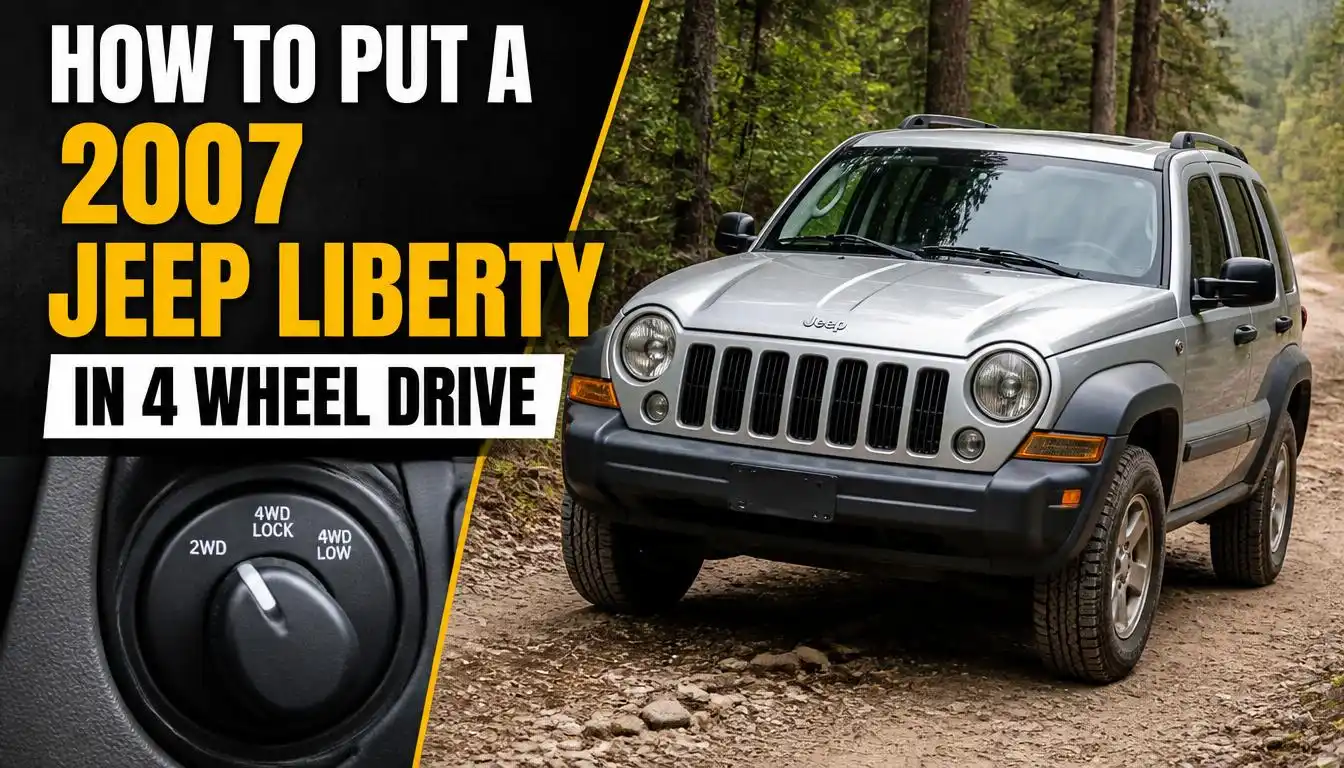
If you have a 2007 Jeep Liberty and are wondering how to put it in 4-wheel drive, the first thing to check is which 4WD system your Jeep has. The 2007 Liberty could be equipped with Command-Trac or Selec-Trac, and the available transfer-case positions are different.
For normal 4WD High operation, you can move from 2H or 2WD into 4H/4 PART TIME while stopped or while driving at up to 55 mph (88 km/h). For 4LO, slow to about 2–3 mph (3–5 km/h), put an automatic transmission in Neutral or depress the clutch on a manual transmission, then firmly move the transfer-case lever into low range. Do not exceed 25 mph (40 km/h) in 4LO.
The important part is choosing the right mode for the surface. Part-time 4WD is designed for loose or slippery conditions, not normal dry pavement.
Quick Answer: How to Put a 2007 Jeep Liberty in 4 Wheel Drive
For most slippery-road situations, putting a 2007 Jeep Liberty into 4WD is simple:
- Find the transfer-case lever next to the transmission shifter.
- If your Jeep is in 2H or 2WD, move the transfer-case lever firmly to 4H or 4 PART TIME.
- You can make this shift while stopped or while moving at up to 55 mph (88 km/h).
- Briefly easing off the accelerator after shifting can help the transfer case engage.
- Check the 4WD indicator on the instrument cluster.
- Use part-time 4WD only when the road is loose, snowy, icy, muddy, sandy, or otherwise slippery.
If you need 4LO, do not simply pull the lever into low range at normal road speed. Slow the Jeep to roughly 2–3 mph (3–5 km/h), place an automatic transmission in Neutral or press the clutch on a manual, and then shift the transfer case into 4LO.
Know Your 2007 Jeep Liberty 4WD System First
Before moving the transfer-case lever, look at the labels beside it. A 2007 Liberty may have either a Command-Trac or Selec-Trac system. The correct position depends on which one is installed.
Command-Trac Part-Time 4WD
Command-Trac has four basic positions:
- 2H – rear-wheel drive high range
- 4H – part-time four-wheel drive high range
- N – transfer-case Neutral
- 4L – part-time four-wheel drive low range
The 2007 owner’s information describes 2H as the normal mode for streets and highways with dry, hard surfaces. It describes 4H as a high-range four-wheel-drive mode intended to provide extra traction on loose or slippery surfaces.
Selec-Trac Full-Time and Part-Time 4WD
Selec-Trac adds another useful high-range option. Its positions include:
- 2WD
- 4 PART TIME
- 4 FULL TIME
- N
- 4LO
The big difference is 4 FULL TIME. The Selec-Trac transfer case uses an inter-axle differential in Full-Time mode, allowing the front and rear wheels to rotate at different speeds. That means Full-Time mode can be used on normal paved roads without the driveline binding associated with part-time 4WD.
How to Tell Which System Your Jeep Has
Look at the markings beside the transfer-case lever.
If you see:
2H – 4H – N – 4L, you have the basic part-time arrangement.
If you see:
2WD – 4 PART TIME – 4 FULL TIME – N – 4LO, your Jeep has the Selec-Trac-style layout described in the 2007 manual.
Do not assume another Liberty has the same system as yours just because it is also a 2007 model.
2007 Jeep Liberty vs Jeep Cherokee KJ
If you are in the UK, Australia, or another market outside North America, you may know this vehicle as the Jeep Cherokee KJ rather than the Liberty.
The first-generation Liberty carries the KJ model designation and was marketed as the Cherokee in markets outside North America. The KJ generation covers the 2002–2007 model years.
That means many 2007 Jeep Cherokee KJ owners will encounter the same transfer-case terminology discussed in this guide. However, always check the labels on your own vehicle because drivetrain equipment can vary by market and specification.
Understanding the Transfer Case Lever
The transmission gear selector and transfer-case lever do different jobs.
Your transmission controls normal forward and reverse gearing. The transfer case determines whether engine power is sent through the two-wheel-drive or four-wheel-drive arrangement and whether high or low range is selected.
What Does 2H Mean?
2H means two-wheel drive, high range.
On a Command-Trac-equipped Liberty, this is the normal setting for dry streets and highways.
Use 2H for ordinary commuting, highway travel, parking lots, and other high-traction paved surfaces.
What Does 4H or 4 PART TIME Mean?
4H or 4 PART TIME is four-wheel drive high range.
In this mode, the front and rear driveline are coupled for additional traction. It is intended for loose or slippery surfaces such as snow, mud, gravel, loose dirt, or similar conditions.
Do not confuse the word “PART TIME” with a system that automatically turns itself on and off. In this Jeep, it describes a locked-style four-wheel-drive operating mode intended only for appropriate surfaces.
What Does 4 FULL TIME Mean?
4 FULL TIME is available on the Selec-Trac system.
Unlike 4 PART TIME, it allows the front and rear wheels to rotate at different speeds through the transfer case. That makes it suitable for normal road surfaces where the tires need to follow slightly different paths during turns.
What Does N Mean?
N is transfer-case Neutral.
It disconnects the front and rear driveshafts from the powertrain and is primarily used for specified towing procedures.
Transfer-case Neutral is not the same thing as putting the transmission in Neutral. Do not leave the vehicle unattended with the transfer case in N without properly securing the vehicle.
What Does 4LO Mean?
4LO is four-wheel-drive low range.
It provides lower gearing for slow driving when extra pulling power and control are needed. Jeep recommends low range for demanding conditions such as difficult off-road terrain, deep mud, deep snow, sand, or steep sections where low-speed control is important.
It is not a mode for ordinary road driving.
How to Put a 2007 Jeep Liberty in 4H
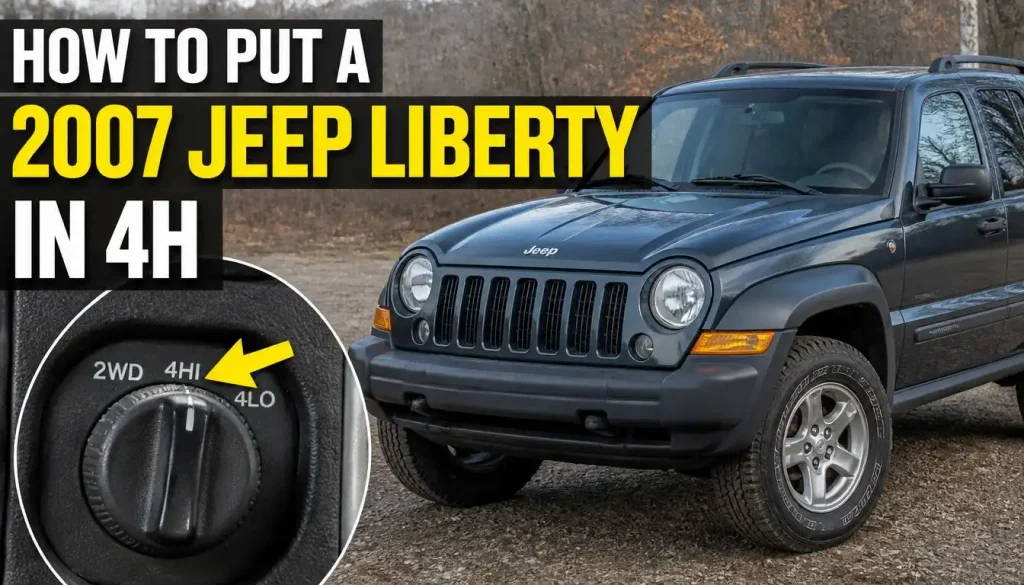
For snow, loose gravel, mud, or another low-traction surface, 4H is usually the first four-wheel-drive setting you will need.
Step 1: Check the Surface
Before engaging part-time 4WD, look at the road.
Good situations for 4H can include:
- Snow-covered roads
- Ice
- Loose gravel
- Mud
- Loose dirt
- Sand
- Slippery off-road trails
If the pavement is dry and providing strong traction, remain in 2H or use 4 FULL TIME only if your Selec-Trac-equipped Jeep provides that mode.
Step 2: Locate the Transfer-Case Lever
The transfer-case lever is separate from the transmission shifter.
Read the shift pattern beside the lever before moving it. You should know where 2H/2WD, 4H/4 PART TIME, N, and 4L/4LO are located.
Step 3: Shift From 2H to 4H
On Command-Trac, move the lever firmly from 2H toward 4H.
On Selec-Trac, move it from 2WD to 4 PART TIME when you need the locked high-range four-wheel-drive mode.
The 2007 manual allows these high-range shifts with the Jeep stopped or moving at up to 55 mph (88 km/h). A momentary release of the accelerator after the shift can help engagement occur more quickly.
You do not normally need to put the transmission in Neutral just to shift between 2H and 4H.
Step 4: Check the Dashboard Indicator
Watch the instrument cluster after moving the lever.
On a Selec-Trac system, the PART TIME indicator illuminates when the transfer case is in 4 PART TIME.
The indicator is useful, but you should also make sure the transfer-case lever has fully reached the intended position.
Step 5: Drive Smoothly
Having four-wheel drive does not mean you suddenly have unlimited grip.
Your Jeep may accelerate more confidently on a slippery surface, but braking and cornering still depend heavily on tire grip and road conditions.
Keep your speed appropriate for the surface.
Can You Shift a 2007 Jeep Liberty Into 4WD While Driving?
Yes. You can shift between 2H/2WD and the appropriate part-time high-range 4WD setting while the Jeep is moving.
For the 2007 Liberty, high-range shifts can be made at speeds up to 55 mph (88 km/h).
That does not mean you should wait until you are traveling 55 mph on a snowy road before deciding you need four-wheel drive.
Whenever possible, identify deteriorating conditions early, reduce your speed, and engage the appropriate mode before traction becomes a serious problem.
Also avoid shifting while the front or rear wheels are spinning aggressively. Reduce wheelspin first.
How to Put a 2007 Jeep Liberty in 4LO
4LO requires a different procedure from 4H.
Do not try to engage low range at normal driving speed.
When Should You Use 4LO?
4LO is useful when you need low-speed control and greater torque multiplication, such as:
- Deep mud
- Deep snow
- Loose sand
- Rocky trails
- Steep off-road climbs
- Steep descents
- Pulling through a difficult off-road section
- Crawling slowly over rough terrain
For normal snowy roads where you can travel comfortably at moderate speeds, 4H is usually more appropriate than 4LO.
How to Engage 4LO With an Automatic Transmission
The preferred procedure is:
- Reduce speed until the Jeep is rolling at about 2–3 mph (3–5 km/h).
- Shift the automatic transmission into N (Neutral).
- While the Jeep is slowly coasting, firmly move the transfer-case lever into 4L or 4LO.
- Do not intentionally pause with the transfer-case lever in N.
- Make sure the transfer case reaches the selected position.
- Shift the automatic transmission back into the appropriate driving gear.
- Continue at low speed.
The 2007 manual specifically recommends the slow 2–3 mph rolling method because shifting while completely stopped can sometimes make transfer-case gear teeth difficult to align.
How to Engage 4LO With a Manual Transmission
For a manual-transmission model:
- Slow to roughly 2–3 mph (3–5 km/h).
- Depress the clutch pedal.
- While coasting slowly, firmly move the transfer-case lever into 4L.
- Make sure it is fully engaged.
- Release the clutch appropriately and continue at low speed.
Again, do not attempt the low-range shift faster than approximately 2–3 mph.
Can You Shift Into 4LO While Completely Stopped?
It is possible, but you may find the lever refuses to engage completely because the internal teeth are not aligned.
The owner’s information says the preferred method is to shift while slowly rolling at 2–3 mph.
If the lever does not move into low range while stopped, do not solve the problem by forcing it aggressively.
How Fast Can You Drive in 4LO?
The 2007 Liberty owner’s information states that you should not exceed 25 mph (40 km/h) in 4LO.
In real off-road use, low range is commonly used well below that maximum because its main purpose is controlled, low-speed driving.
Does 4LO Give You More Traction?
Not exactly.
4LO changes the gearing so more torque is available at lower vehicle speeds. It can make it easier to crawl over obstacles, climb steep terrain, or move through difficult conditions.
But low gearing does not increase the basic friction between the tire and the ground.
Jeep’s own 4×4 guidance specifically notes that more torque does not automatically mean more traction. Too much throttle on snow, ice, or mud can still spin the tires and reduce grip.
4H vs 4LO: Which Should You Use?
| Driving Condition | Better Starting Choice |
|---|---|
| Normal dry pavement | 2H/2WD |
| Snow-covered road | 4H/4 PART TIME |
| Loose gravel | 4H/4 PART TIME |
| Light off-road trail | 4H |
| Deep mud | 4H or 4LO depending on severity |
| Deep sand | 4H or 4LO depending on conditions |
| Steep slow climb | 4LO |
| Rocky crawling | 4LO |
| Mixed paved conditions with Selec-Trac | 4 FULL TIME |
| Normal highway driving | 2H/2WD or suitable Full-Time mode if equipped |
The simple rule is this: use 4H when you need more traction but still need normal high-range driving, and use 4LO when the terrain requires slow speed, greater torque multiplication, and more control.
4 PART TIME vs 4 FULL TIME on a Jeep Liberty
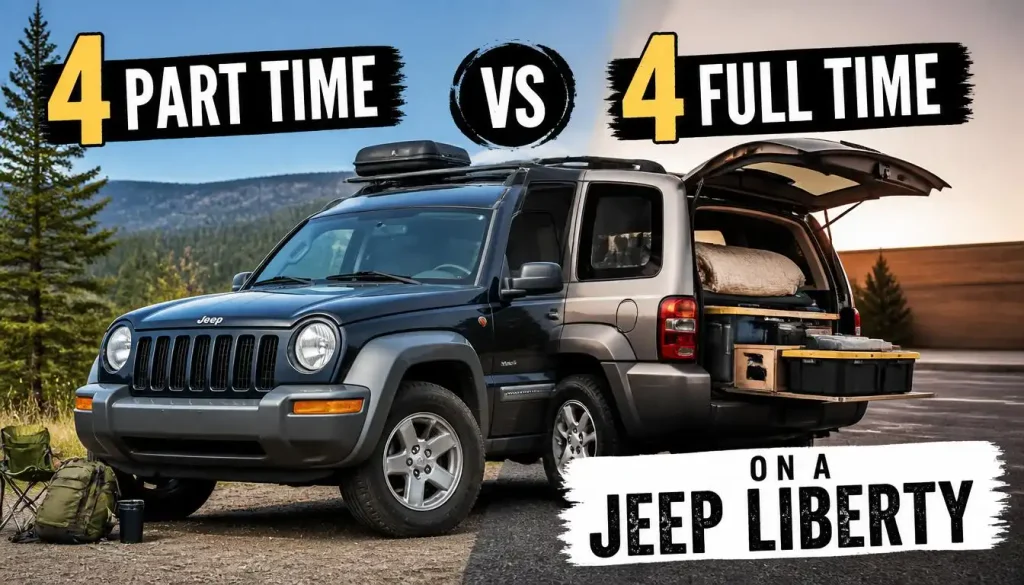
This is one of the most confusing parts of the older Liberty’s 4WD system.
4 PART TIME
4 PART TIME locks the front and rear driveline together for extra traction.
Use it on surfaces that allow some tire slip, such as loose gravel, snow, mud, sand, or similar slippery terrain.
4 FULL TIME
4 FULL TIME is available with Selec-Trac.
Its inter-axle differential allows the front and rear wheels to rotate at different speeds, so it can be used on ordinary paved roads as well as changing road conditions.
Why the Difference Matters
When you turn a vehicle, the front and rear tires do not all travel exactly the same distance.
A full-time system can accommodate those speed differences.
Part-time 4WD does not allow the same degree of front-to-rear speed difference. On a high-traction surface, that can create driveline wind-up or binding.
Jeep describes symptoms of this type of “crow hop” as possible shuddering, tire scuffing, or banging when basic part-time 4WD is used on dry pavement.
4WD vs AWD: Is a 2007 Jeep Liberty AWD?
The 2007 Liberty is normally described as a vehicle with selectable four-wheel-drive systems rather than a conventional modern crossover AWD setup.
Selec-Trac’s 4 FULL TIME mode can behave similarly to full-time four-wheel drive or AWD from the driver’s point of view because it can accommodate different front and rear wheel speeds on pavement.
However, the Liberty also provides part-time and low-range modes that are not found on many ordinary AWD vehicles.
Jeep notes that AWD and full-time 4WD are similar in their ability to operate on pavement, while low range is a feature that many AWD systems do not have.
Which 4WD Mode Should You Use?
The best mode depends on what is under your tires.
Dry Pavement
Use 2H or 2WD.
If you have Selec-Trac and specifically want full-time four-wheel drive, 4 FULL TIME can also be used on normal road surfaces.
Do not use 4 PART TIME simply because you want “more grip” on a dry highway.
Rain
Rain by itself does not automatically require part-time 4WD.
If the pavement still has good traction, use 2H/2WD or 4 FULL TIME if your Selec-Trac system has it.
If conditions become genuinely loose or slippery, choose the appropriate traction mode while keeping your speed conservative.
Snow and Ice
4H or 4 PART TIME is useful when the road is consistently snow-covered or slippery.
For severe, slow-speed conditions such as deep snow, 4LO may help, but ordinary winter road driving normally calls for high range rather than low range.
Gravel and Dirt
4H can work well on loose gravel and dirt because the surface allows enough tire slip to prevent the binding associated with dry pavement.
Mud
Start with 4H if you need additional traction while maintaining momentum.
For very deep mud or situations requiring slow, controlled pulling power, 4LO may be more suitable.
Sand
High range can work well when momentum is important. Low range may be useful in deeper or more difficult sand depending on the situation.
Avoid sudden steering inputs and unnecessary wheelspin.
Steep Hills
Low range is useful for slow, steep off-road climbs and descents because the lower gearing gives better control.
Do not attempt steep terrain sideways. Jeep’s off-road guidance warns against crossing very steep slopes at an angle because of vehicle instability.
Can You Drive a 2007 Jeep Liberty in 4WD on Dry Pavement?
It depends on the mode.
4 PART TIME or Command-Trac 4H: No, not for normal dry pavement.
Selec-Trac 4 FULL TIME: Yes.
The 2007 manual describes 4H/4 PART TIME as intended for loose or slippery road surfaces, while Selec-Trac’s 4 FULL TIME mode allows front and rear wheel-speed differences and can be used on ordinary road surfaces.
Driving a part-time system on high-traction pavement can cause driveline binding, tire scrubbing, steering resistance, shuddering, and unnecessary stress on drivetrain components.
How Fast Can You Drive a 2007 Jeep Liberty in 4WD?
Two different speed questions are often confused.
The first is how fast you can be traveling while shifting into 4H. The answer is up to 55 mph (88 km/h), according to the 2007 shifting procedure.
The second is how fast you should drive after 4H is engaged.
There is no reason to treat 55 mph as a target speed. Four-wheel drive does not make a snowy or muddy road safe at highway speeds. Jeep advises drivers not to go faster than road conditions permit.
For 4LO, the limit is clearer: do not exceed 25 mph (40 km/h).
How to Shift Back From 4WD to 2WD
If you are in 4H or 4 PART TIME and no longer need additional traction, return to two-wheel drive.
From 4H to 2H
Move the transfer-case lever from 4H to 2H.
This can be done while stopped or while moving at up to 55 mph (88 km/h). Briefly releasing the accelerator can help the transfer case disengage more quickly.
From 4LO Back to High Range
Use the same low-speed procedure used to enter low range:
- Slow to about 2–3 mph.
- Put an automatic transmission in Neutral or depress the clutch on a manual.
- Firmly shift the transfer case out of 4LO and into the appropriate high-range position.
- Make sure the new position is fully engaged.
- Then return to 2H/2WD when appropriate.
Do not try to pull the transfer-case lever out of low range while driving at normal road speed.
What Does the PART TIME Light Mean on a 2007 Jeep Liberty?
The PART TIME light normally means the transfer case has been selected into the part-time four-wheel-drive position.
On the Selec-Trac system described in the 2007 manual, the PART TIME indicator illuminates when the transfer case is shifted into 4 PART TIME.
Seeing “PART TIME” does not mean something is only partially working.
It identifies the type of 4WD mode.
Why Is the PART TIME Light Still On in 2WD?
If you have moved the lever back to 2H or 2WD but the PART TIME light remains on, first make sure the transfer case has actually completed the shift.
Try the normal disengagement procedure on an appropriate surface and briefly release the accelerator.
If the lever reaches 2WD but the indicator remains incorrect, the system may need inspection. Possible causes can include a transfer-case position switch, linkage problem, or another mechanical/electrical fault.
Do not diagnose the transfer case solely from the dashboard light.
2007 Jeep Liberty Won’t Go Into 4 Wheel Drive
If the transfer-case lever will not engage 4WD, do not force it.
Start with these checks:
Check Your Shifting Procedure
For 4H, make sure you are moving the lever firmly into the correct position.
For 4LO, use the proper 2–3 mph rolling procedure with the automatic transmission in Neutral or the clutch depressed on a manual. Low range can be harder to engage when completely stopped because the internal teeth may not line up.
Check the Shift Lever and Linkage
A worn, loose, disconnected, or damaged linkage can prevent movement at the transfer case even if the cabin lever appears to move.
Check the Indicator System
If 4WD seems mechanically engaged but the dashboard indication is wrong, the transfer-case position switch or related wiring may need diagnosis.
Check the Tires
Four-wheel-drive systems work best when all four tires are compatible in size and properly inflated.
Large differences in effective tire diameter can place unwanted stress on the drivetrain.
Check for Transfer-Case Problems
Grinding, repeated popping out of gear, inability to select a range, severe noise, or a lever that suddenly behaves differently can indicate a mechanical problem requiring inspection.
2007 Jeep Liberty Won’t Come Out of 4WD
If your Liberty stays in 4H after you move the lever toward 2H, avoid immediately forcing the lever.
On a loose or slippery surface:
- Drive slowly and straight.
- Move the transfer-case lever firmly toward 2H.
- Briefly ease off the accelerator.
- Allow the driveline to unload.
- Check whether the indicator changes.
If the vehicle has been driven in part-time 4WD on a high-traction surface, driveline wind-up may make shifting more difficult.
Move to an appropriate loose surface if safely possible rather than making repeated tight turns on dry pavement.
If it still will not disengage, inspect the linkage and transfer case.
What to Do if Your Jeep Liberty Is Stuck in 4LO
Start by using the correct low-range disengagement procedure.
Slow the Jeep to about 2–3 mph. With an automatic transmission, select Neutral. With a manual, depress the clutch. While coasting slowly, move the transfer-case lever firmly toward the high-range position.
If the Jeep is completely stopped and the lever will not move, the internal teeth may simply be poorly aligned. Moving slightly can sometimes allow alignment.
Stop trying if you hear severe grinding, the lever is physically jammed, the linkage appears loose, or the transfer case will not fully engage a range.
Common Mistakes When Using 4WD on a 2007 Jeep Liberty
Avoid these common mistakes:
- Using 4 PART TIME on normal dry pavement
- Confusing 4 FULL TIME with 4 PART TIME
- Trying to engage 4LO at road speed
- Forgetting to put an automatic transmission in Neutral for the low-range shift
- Forgetting to depress the clutch on a manual model
- Driving faster than 25 mph in 4LO
- Forcing the transfer-case lever when it will not move
- Assuming 4WD improves braking
- Using excessive throttle on snow or ice
- Ignoring abnormal grinding or banging noises
- Driving with significantly mismatched tires
- Relying only on a dashboard light to diagnose a mechanical problem
2007 Jeep Liberty 4WD Quick Reference
| Mode | Best Use | Dry Pavement? | Important Note |
|---|---|---|---|
| 2H/2WD | Normal roads and highways | Yes | Normal everyday mode |
| 4H/4 PART TIME | Snow, mud, gravel, loose surfaces | No | High-range locked 4WD |
| 4 FULL TIME | Normal or changing road conditions | Yes | Selec-Trac only |
| N | Specified towing procedures | No driving | Disconnects driveline |
| 4L/4LO | Severe slow off-road conditions | No | Maximum 25 mph |
Frequently Asked Questions
How do you put a 2007 Jeep Liberty into four-wheel drive?
For high-range 4WD, move the transfer-case lever from 2H/2WD into 4H or 4 PART TIME. The shift can be made while stopped or moving at up to 55 mph (88 km/h). Use part-time 4WD only on loose or slippery surfaces.
Do I need to stop to put a 2007 Jeep Liberty in 4WD?
Not for 4H. You can shift between 2H and 4H while moving at up to 55 mph.
4LO is different. The preferred method is to roll at only 2–3 mph, with an automatic transmission in Neutral or the clutch depressed on a manual.
How do I know if my Jeep Liberty is in 4WD?
Check the transfer-case lever position and the appropriate 4WD indicator in the instrument cluster. If the light and lever disagree or the vehicle does not behave normally, the linkage, position switch, or transfer case may need inspection.
What does PART TIME mean on a 2007 Jeep Liberty?
PART TIME identifies a four-wheel-drive mode that mechanically couples the front and rear driveline for increased traction. It is designed for loose or slippery surfaces rather than normal dry pavement.
What is the difference between 4 PART TIME and 4 FULL TIME?
4 PART TIME is intended for slippery or loose surfaces. 4 FULL TIME, available with Selec-Trac, allows the front and rear wheels to rotate at different speeds and can therefore be used on normal pavement.
Can I use 4H on dry pavement?
Not if you are using Command-Trac 4H or Selec-Trac 4 PART TIME. Those modes can cause driveline binding on high-traction surfaces.
Selec-Trac 4 FULL TIME is the pavement-safe four-wheel-drive option.
Should I use 4H or 4LO in snow?
Use 4H for most snow-covered road driving. Use 4LO only for severe, slow-speed situations such as deep snow, difficult terrain, or when greater low-speed control is needed.
Should I use 4WD in rain?
Ordinary rain does not automatically require part-time 4WD. Use 2H/2WD when traction remains good. If your Liberty has Selec-Trac, 4 FULL TIME can be used on paved roads when conditions vary.
How fast can I shift my Jeep Liberty into 4H?
The 2007 shifting procedure allows a 2H-to-4H or 2WD-to-4 PART TIME shift at up to 55 mph (88 km/h).
How fast can I drive in 4LO?
Do not exceed 25 mph (40 km/h) in 4LO. Low range is designed for slow driving and difficult terrain.
Why won’t my Jeep Liberty come out of 4WD?
Possible reasons include driveline wind-up, an incomplete shift, worn or damaged linkage, an indicator switch problem, or an internal transfer-case issue. First try the correct disengagement procedure without forcing the lever.
Is the 2007 Jeep Liberty the same as the Jeep Cherokee KJ?
The first-generation Liberty carries the KJ designation and was sold as the Jeep Cherokee in markets outside North America.
Final Thoughts
Putting a 2007 Jeep Liberty in 4-wheel drive is straightforward once you understand the transfer-case system in your vehicle.
For slippery roads and loose terrain, shift from 2H or 2WD into 4H/4 PART TIME. That high-range shift can be made while stopped or while moving at up to 55 mph. If you need 4LO, slow all the way down to about 2–3 mph, put an automatic transmission in Neutral or press the clutch on a manual, and then select low range. Keep your speed below 25 mph while 4LO is engaged.
Most importantly, do not treat every 4WD setting as interchangeable. Part-time 4WD belongs on loose or slippery surfaces. If your Liberty has Selec-Trac, 4 FULL TIME is the mode designed to accommodate normal paved-road driving.
Learning that distinction makes the system much easier to use—and helps you avoid unnecessary tire wear, driveline binding, and transfer-case stress.

“Cars aren’t just machines. They’re freedom, memory, and a little bit of grease under your fingernails.”
I’m Theodore Roosevelt—though my friends just call me “Ted” (and no, I’m not related to the president, though I do share his love for adventure). I grew up in Detroit in the 1970s, back when the city was still the heart of the American auto industry. My first love was a rusted-out 1967 Mustang my father and I rebuilt in our garage when I was fifteen. That project taught me that cars have souls. After spending twenty years as a mechanic and another ten writing for magazines, I started this blog to help everyday drivers and weekend wrenchers feel confident under the hood. Whether you’re restoring a classic or just trying to keep your daily driver alive for one more winter, I’m here to help you get there.