A Jeep is rarely bought just to get from one place to another. For many drivers, it represents the freedom to leave the pavement, explore rough trails, drive through changing weather, tow adventure gear, or simply feel more confident when the road ahead becomes unpredictable.
But capability alone is not enough.
Modern drivers also expect protection, stability, useful driver-assistance technology, and a vehicle that feels controlled in everyday traffic. That is where Jeep’s approach becomes interesting. Instead of treating safety and performance as two separate goals, many Jeep systems are designed so that better traction, visibility, vehicle control, and protection work together.
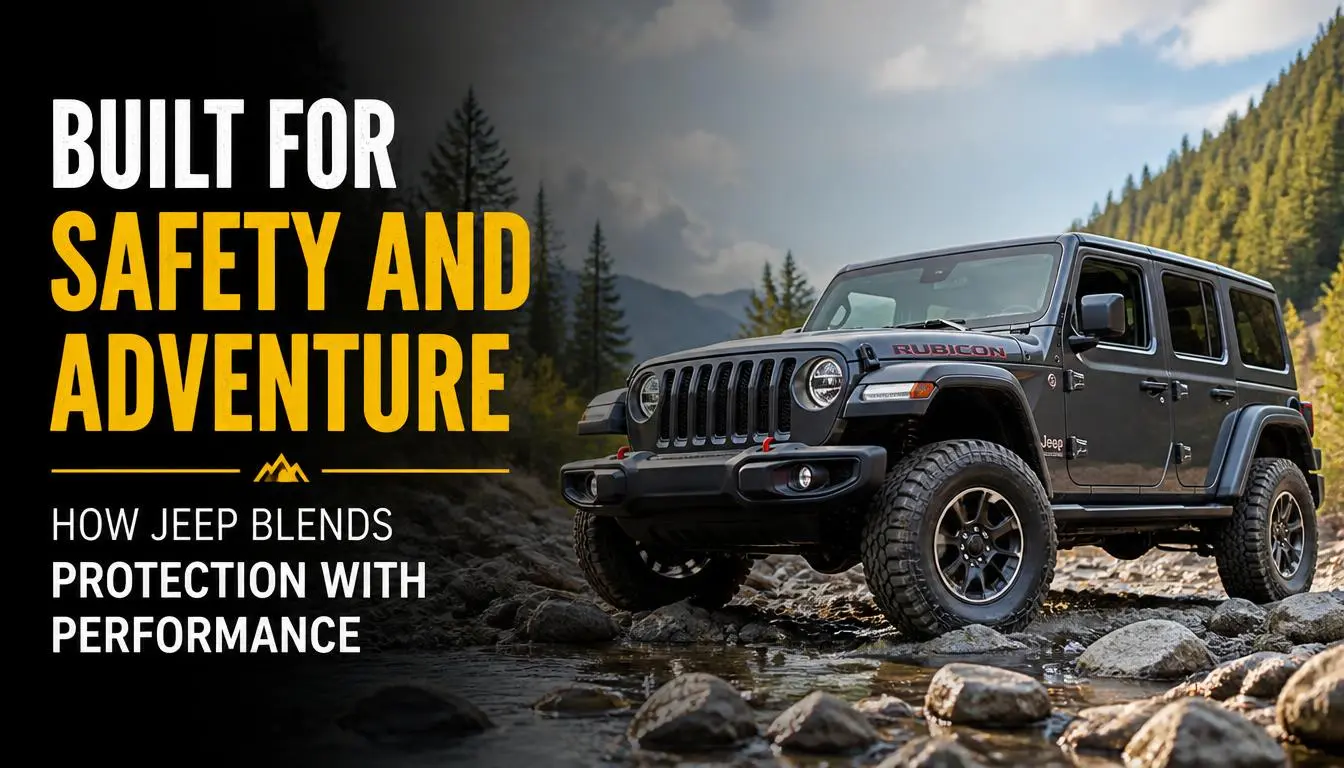
Understanding how Jeep blends protection with performance means looking beyond horsepower. The complete picture includes 4×4 systems, occupant protection, electronic safety aids, ground clearance, off-road geometry, underbody protection, suspension movement, tires, and responsible driving.
Here is how those pieces come together.
How Does Jeep Balance Safety and Adventure?
Jeep balances safety and adventure by combining traditional 4×4 capability with modern vehicle-control and safety technology. Depending on the model and trim, that can include advanced traction systems, low-range gearing, electronic stability control, driver-assistance features, protective underbody hardware, cameras, strong occupant restraints, and terrain-focused suspension systems.
The important point is that performance is not only about going faster.
On a trail, performance may mean crawling slowly over rocks without losing traction. In snow, it may mean sending power where grip is available. On a steep descent, it may mean maintaining predictable control. During highway driving, it may mean having assistance that alerts the driver to a potential hazard.
That broader definition of performance is one reason Jeep vehicles can appeal to both adventure-focused drivers and people who need an SUV for normal daily life.
Jeep Safety Features Designed to Protect Drivers and Passengers
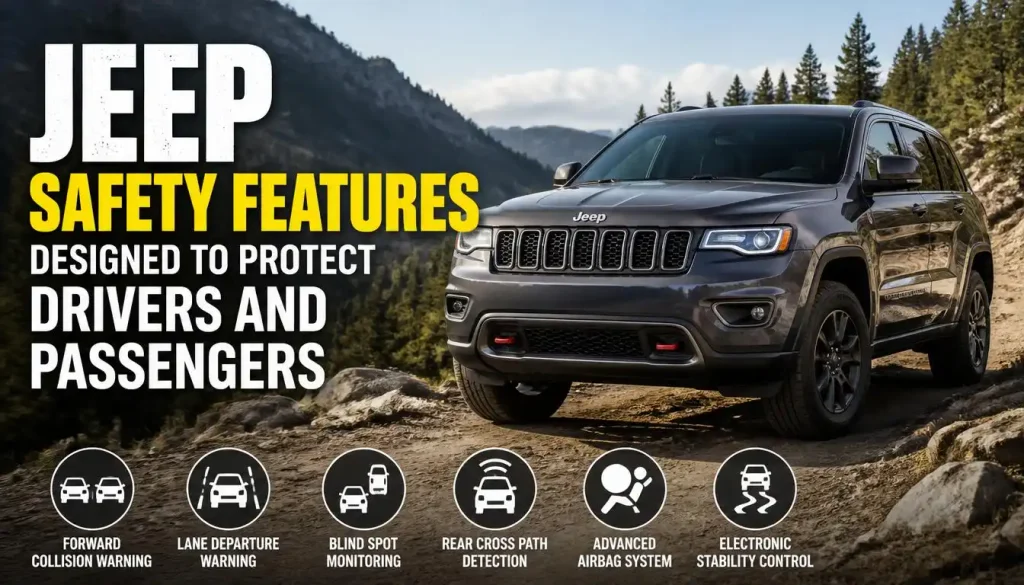
Jeep safety starts inside the vehicle.
Exact equipment varies considerably by model, trim, model year, and country, so buyers should always check the specification sheet for the exact vehicle they are considering. Still, modern Jeep models may offer a combination of active and passive safety technologies.
Driver-Assistance Technology
Depending on the vehicle, available safety and driver-assistance features can include:
- Forward collision warning
- Automatic emergency braking
- Blind-spot monitoring
- Rear cross-path detection
- Adaptive cruise control
- Parking sensors
- Reversing cameras
- Lane-related assistance on certain models
- Automatic high-beam assistance
- Surround-view or trail-view cameras on selected vehicles
These systems do not make a Jeep accident-proof. Their purpose is to provide additional information, warnings, or intervention when certain conditions are detected.
For a driver, that extra layer of awareness can be useful whether the vehicle is moving through city traffic or heading toward a remote trail.
Airbags, Seat Belts, and Occupant Protection
Passive safety becomes important when a collision cannot be avoided.
Modern Jeep vehicles use combinations of airbags, seat-belt restraints, structural engineering, and child-seat anchorage systems to help protect occupants. The exact configuration differs across models and years.
This is why shoppers should avoid assuming that every vehicle wearing a Jeep badge has identical safety equipment. Check the exact model year and trim, particularly when comparing used vehicles.
Stability and Traction Control
Electronic stability control and traction-control systems can play an important role when grip changes suddenly.
If wheels begin to slip or the vehicle starts moving away from the driver’s intended path, electronic systems may adjust braking or power delivery to help regain control.
These technologies can be valuable on wet roads, loose gravel, snow, mud, and other low-traction surfaces.
They still cannot overcome physics. Enter a corner too quickly, use unsuitable tires, or drive too fast on ice, and 4WD or electronic assistance cannot guarantee that the vehicle will remain under control.
Jeep 4×4 Systems Turn Performance Into Control
Four-wheel drive is one of the foundations of Jeep’s reputation, but its value goes beyond simply getting through mud.
When a vehicle can distribute torque across multiple wheels, it has more opportunities to find useful traction.
That matters when:
- One wheel is on a slippery surface
- The road is covered with snow
- Tires are moving across loose gravel
- A trail becomes muddy
- The vehicle is climbing a steep grade
- Wheels have different levels of grip on uneven terrain
For normal driving, that can mean greater confidence in difficult conditions. Off-road, it can mean the difference between maintaining controlled forward movement and simply spinning the tires.
Low-Range 4WD
Low-range gearing is particularly useful during technical off-road driving.
Instead of relying on speed or momentum, low-range gearing allows the vehicle to move slowly while delivering the torque needed for difficult terrain.
That makes it easier to control the Jeep while:
- Climbing rocks
- Crossing uneven ground
- Descending difficult sections
- Moving through deep mud
- Navigating steep trails
Slow, controlled progress is often safer than trying to power through an obstacle at speed.
Locking Differentials
On some off-road-focused Jeep configurations, locking differentials can help when traction becomes uneven.
A normal differential allows wheels to rotate at different speeds, which is useful during everyday cornering. In difficult off-road situations, however, a wheel with little grip can become a problem.
A locking differential can help distribute power more effectively across the axle, allowing the tire with useful traction to keep working.
The 2026 Wrangler Rubicon, for example, offers Jeep’s Tru-Lok electronic locking differentials along with its Rock-Trac 4×4 system. Jeep also lists a 4:1 low gear ratio and, in certain configurations, a crawl ratio of up to 100:1.
Suspension Articulation
Traction is easier to maintain when tires remain in useful contact with the ground.
That is where suspension articulation matters.
When one wheel rises over a rock while another drops into a hole, a flexible suspension can help the tires follow the terrain instead of leaving multiple wheels unloaded.
On Wrangler Rubicon models, Jeep’s electronic sway bar disconnect is designed to increase front suspension articulation during demanding off-road driving.
The result is not simply more dramatic off-road performance. Better tire contact can also make difficult terrain easier to negotiate at a controlled speed.
How Jeep Protects the Vehicle During Off-Road Adventures
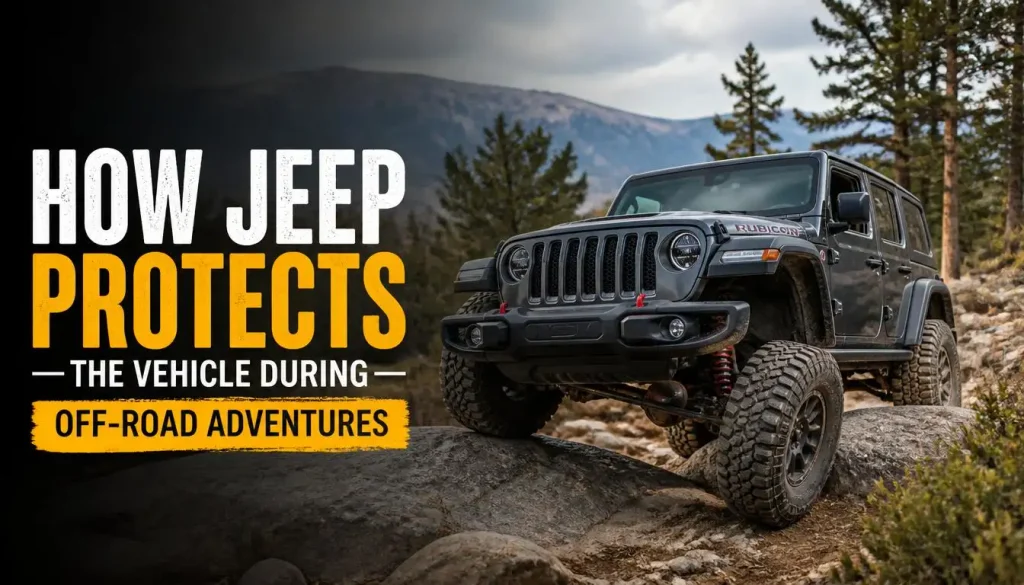
Protecting passengers is only part of off-road safety. The vehicle itself also needs protection from the terrain.
A sharp rock striking a vulnerable component underneath the vehicle can quickly turn an enjoyable trail trip into a recovery situation.
That is why off-road-focused Jeep models may use protective equipment such as:
- Skid plates
- Rock rails
- Tow hooks
- Protective bumpers
- Reinforced drivetrain components
- Off-road tires
The 2026 Wrangler capability package highlights steel skid plates, while Rubicon configurations include rock rails and can be equipped with winch-capable steel bumpers for additional protection on rocky ground.
Why Skid Plates Matter
Skid plates create a layer of protection between the trail and important components underneath the vehicle.
Depending on the vehicle, those vulnerable areas may include parts of the drivetrain, fuel system, transfer case, or other mechanical components.
They do not mean a driver can deliberately slam the vehicle onto rocks. Their job is to reduce the risk of serious damage when reasonable contact occurs during off-road travel.
Rock Rails and Bumpers
Rock rails help protect vulnerable lower body areas when a Jeep passes close to large rocks or crosses uneven obstacles.
Heavy-duty bumpers can also offer additional protection and may provide mounting or recovery options, depending on the configuration.
For serious trail users, these features can be as meaningful as extra engine power.
Ground Clearance and Off-Road Geometry Matter More Than Many Drivers Realize
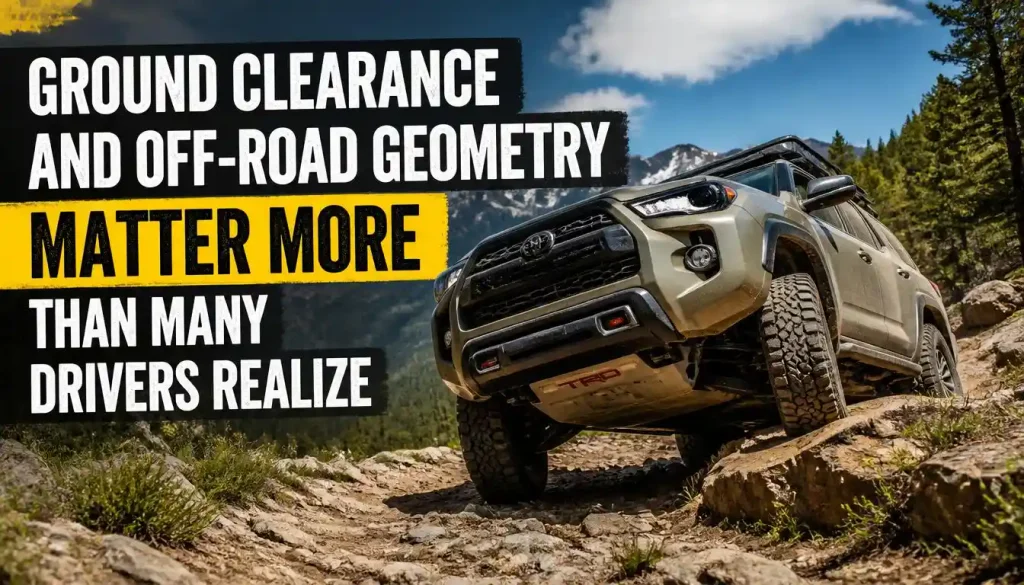
A powerful 4×4 can still become stuck or damaged if its body cannot physically clear an obstacle.
That is why ground clearance and off-road geometry are so important.
Ground Clearance
Ground clearance is the distance between the lowest vulnerable part of the vehicle and the terrain.
More usable clearance can help the vehicle travel over rocks, ruts, logs, and uneven surfaces without making contact underneath.
But ground clearance is only part of the equation.
Approach Angle
The approach angle describes how steep an obstacle the front of the vehicle can meet before the front overhang makes contact.
A better approach angle helps when climbing onto a steep trail section, rock, or ledge.
Breakover Angle
The breakover angle matters when the vehicle passes over the top of an obstacle.
If the breakover angle is insufficient, the middle of the vehicle can become grounded even when the front and rear wheels have enough traction.
Departure Angle
The departure angle works at the rear of the vehicle.
A useful departure angle reduces the chance of the rear bumper or body touching the ground when coming down from a steep obstacle.
Jeep includes ground clearance, approach, breakover, and departure considerations as important parts of Trail Rated capability.
For an adventure vehicle, those numbers can tell you more about real trail performance than a 0-to-60 time.
What Does Jeep Trail Rated Mean?
The Trail Rated badge is one of Jeep’s best-known off-road identifiers, but it is useful to understand what it actually represents.
Jeep evaluates Trail Rated 4×4 vehicles across five areas:
- Traction
- Water fording
- Maneuverability
- Articulation
- Ground clearance
Those categories focus on how a vehicle behaves in challenging off-road environments.
Traction
Traction is about keeping useful grip when surfaces become loose, slippery, or uneven.
It matters on rocks, dirt, mud, snow, and steep terrain.
Water Fording
Certain Jeep vehicles are engineered to travel through water within specific limits.
That does not mean any Jeep can safely drive through any flooded road or stream.
Water depth can be difficult to judge, currents can move a vehicle, and hidden obstacles can cause serious damage. Jeep specifically advises drivers not to attempt water fording unless the depth is known and within the vehicle’s stated limit in the owner’s manual.
Maneuverability
Trail driving often means navigating around rocks, trees, narrow paths, and tight turns.
Vehicle dimensions, steering, visibility, and turning behavior all affect how easily that can be done.
Articulation
Good articulation allows suspension movement to help the wheels follow uneven terrain.
Maintaining tire contact can improve both traction and control.
Ground Clearance
Clearance gives the underside of the vehicle more room to pass over obstacles.
The relationship between ground clearance and approach, breakover, and departure angles is especially important on rocky trails.
A Trail Rated badge should never be interpreted as permission to ignore trail conditions or driver skill. It indicates capability, not immunity from damage or accidents.
How Jeep Handles Snow, Rain, Mud, and Loose Surfaces
Adventure does not always mean rock crawling.
For drivers in Canada, the UK, parts of the USA, and colder regions of Australia, changing weather can create difficult driving conditions without ever leaving a paved road.
Driving a Jeep in Snow and Ice
A capable 4×4 system can help a Jeep get moving when snow reduces traction.
But this creates an important safety misunderstanding:
Four-wheel drive helps you accelerate; it does not magically shorten your stopping distance.
Every tire still has a limited amount of grip.
In winter conditions, appropriate tires, reduced speed, increased following distance, smooth steering, and gentle braking remain essential.
A 4WD Jeep on poor tires can easily have less usable grip than a less capable vehicle equipped with proper winter tires.
Rain and Wet Roads
Heavy rain reduces tire grip and visibility.
Stability systems and 4×4 traction may help the driver maintain control, but tire tread and speed remain critical.
Deep standing water should also be treated cautiously. Hydroplaning can occur before a vehicle reaches anything close to its advertised off-road water-fording ability.
Mud and Loose Dirt
Mud demands a different driving approach.
Too much throttle can turn useful traction into wheelspin. Depending on the terrain, selecting the correct 4WD mode, maintaining steady momentum, and using suitable tires can make the Jeep easier to control.
Again, performance is often about finesse rather than brute force.
Does 4WD Make a Jeep Safer?
Sometimes—but not in every situation.
Four-wheel drive can improve traction when power is being delivered to the wheels. That may help a Jeep move across snow, gravel, mud, steep grades, or uneven terrain with greater control.
What it does not automatically improve is:
- Emergency braking distance
- Tire grip during hard cornering
- Driver reaction time
- Visibility
- Protection from excessive speed
This distinction matters.
A driver can feel extremely confident because all four wheels are helping the vehicle move forward, then discover that stopping on the same slippery surface is much more difficult.
The safest approach is to treat 4WD as another useful tool, not as a substitute for appropriate tires and careful driving.
4WD vs AWD: What Is Better for Adventure?
Four-wheel drive and all-wheel drive are often discussed as if they mean exactly the same thing. In practice, the systems can be designed for different priorities.
AWD is commonly focused on automatically managing traction during normal road use. Traditional 4WD systems may provide more driver control and can include features such as low-range gearing for demanding terrain.
For serious off-road use, low range and additional traction hardware can be extremely valuable.
For everyday wet-road or winter driving, an automatic full-time system may be more convenient.
The better choice depends on the Jeep model, the system fitted to it, and what you actually plan to do with the vehicle.
Do not choose based on the 4WD or AWD label alone. Look at the system’s actual features.
How Jeep Combines Safety and Performance
Many of the technologies that improve Jeep capability can also support vehicle control.
| Jeep Feature | Safety or Protection Benefit | Performance Benefit |
|---|---|---|
| 4×4 system | Helps maintain control when grip is limited | Improves traction |
| Low-range gearing | Allows slower, more controlled progress | Provides torque for difficult terrain |
| Locking differentials | Helps avoid uncontrolled wheelspin in some situations | Sends usable power across the axle |
| Ground clearance | Reduces risk of underbody contact | Helps clear larger obstacles |
| Skid plates | Protect vulnerable components | Supports more demanding trail use |
| Rock rails | Help protect lower body areas | Make rocky terrain easier to tackle |
| Suspension articulation | Helps tires remain connected to uneven terrain | Improves off-road traction |
| Stability control | Helps correct certain loss-of-control situations | Improves confidence on changing surfaces |
| Cameras and sensors | Improve awareness around the vehicle | Help position the vehicle around obstacles |
This overlap explains why protection and performance do not have to compete with one another.
In many situations, better control is better performance.
On-Road Safety and Off-Road Capability Serve Different Needs
A Jeep may spend Saturday on a trail and Monday in rush-hour traffic.
Those environments demand different technologies.
On the Road
Everyday drivers are more likely to value:
- Collision-warning technology
- Automatic emergency braking where equipped
- Blind-spot monitoring
- Parking assistance
- Adaptive cruise control
- Good headlights
- Stable highway handling
- Convenient camera systems
Off the Road
Trail drivers are more likely to depend on:
- 4WD
- Low-range gearing
- Locking differentials
- Ground clearance
- Skid plates
- Rock rails
- Suspension articulation
- Recovery points
- All-terrain tires
- Suitable approach and departure angles
The best Jeep for a buyer is not necessarily the model with the most extreme off-road equipment. It is the model whose strengths match the driver’s actual lifestyle.
What Do Independent Jeep Safety Ratings Tell Us?
Independent testing is important because manufacturer feature lists and crash performance are not the same thing.
Safety results can also change by model year.
For example, the IIHS lists the 2026 four-door Jeep Wrangler with a Good rating in its updated moderate-overlap front test and updated side test. Its combined small-overlap front evaluation is Acceptable, while other categories vary. The organization also notes structural updates to certain 2026 Wrangler models built after October 2025.
The 2026 Jeep Grand Cherokee has Good IIHS ratings for the small-overlap front and updated side evaluations listed by the organization.
Those examples show why the question “Are Jeeps safe?” is too broad.
A better question is:
How did this exact Jeep model, model year, trim, and configuration perform?
Buyers in the USA
Check current results from organizations such as IIHS and NHTSA for the specific model year.
Buyers in Canada
Confirm Canadian-market specifications rather than assuming a US trim includes exactly the same standard equipment.
Buyers in the UK
Look at the safety specification and applicable independent European testing for the exact model and generation sold in the UK.
Buyers in Australia
Check current ANCAP information rather than relying on an old star rating. As of 2026, ANCAP lists Wrangler models from January 2026 onward as unrated, while its previous Wrangler rating applies to an older model period and expired in December 2025.
This is especially important when reading older reviews online. A safety score from several years ago may not describe the Jeep sitting in a showroom today.
Which Jeep Models Best Combine Safety and Adventure?
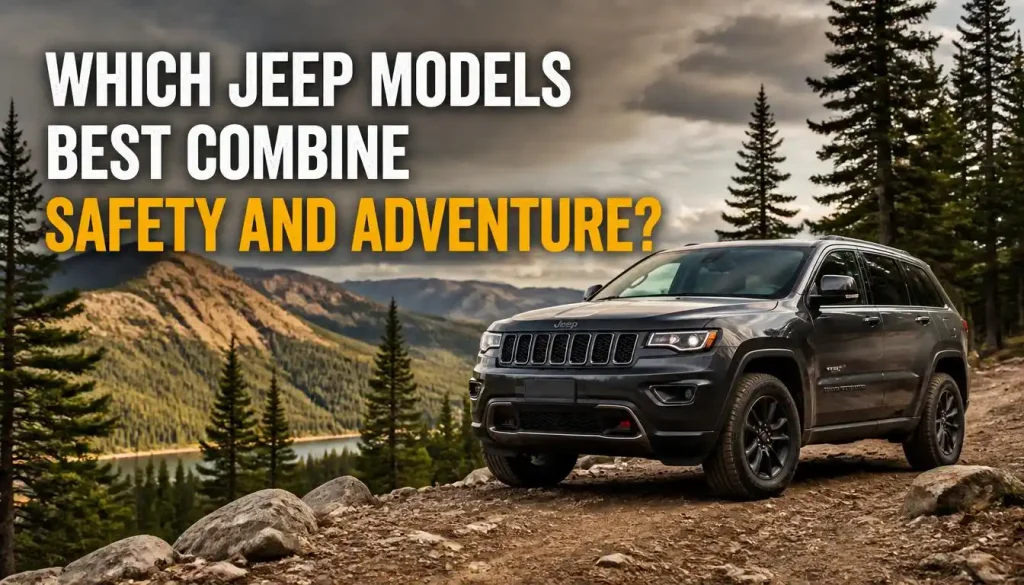
There is no single answer for every buyer.
Different Jeep models approach adventure from different directions.
Jeep Wrangler
The Wrangler is the obvious choice for drivers who place serious off-road capability near the top of their priority list.
Depending on configuration, it can offer specialized 4×4 hardware, low gearing, locking differentials, protective equipment, substantial ground clearance, and suspension systems intended for demanding trails.
The trade-off is that buyers should still compare its current independent safety results and everyday comfort against alternatives rather than choosing purely on reputation.
Jeep Grand Cherokee
The Grand Cherokee is better suited to buyers who want a more conventional everyday SUV experience while keeping meaningful capability for bad weather, travel, towing, or off-pavement driving.
For families who spend far more time on highways than rock trails, that balance may make more sense.
Jeep Gladiator
The Gladiator combines Jeep-style off-road capability with the practical advantage of a pickup bed.
It can suit drivers carrying camping equipment, bikes, tools, recovery gear, or other outdoor equipment.
Its longer dimensions can affect maneuverability and breakover behavior compared with a shorter off-roader, so trail type should be considered.
Jeep 4xe Models
Electrified Jeep models add another dimension to the performance discussion.
Electric assistance can provide strong low-speed torque, which can be useful during controlled driving. But owners should still follow the exact vehicle manual for off-road use, charging precautions, recovery procedures, and water-fording limits.
Technology changes the powertrain. It does not change the need for good judgment.
What Should You Check Before Taking a Jeep Off-Road?
A capable vehicle can still fail because of poor preparation.
Before entering a remote or difficult area, check the Jeep rather than assuming its equipment will handle everything automatically.
A useful pre-trip checklist includes:
- Check tire condition and pressure
- Confirm you have enough fuel or battery charge
- Inspect the spare tire
- Check important fluid levels
- Make sure recovery points are accessible
- Carry appropriate recovery equipment
- Bring a first-aid kit
- Carry drinking water
- Check weather conditions
- Study the trail before entering
- Confirm local access rules
- Know the vehicle’s ground clearance
- Understand the correct 4WD settings
- Know the vehicle’s water-fording limit
- Carry reliable navigation
- Tell someone where you are going
- Avoid travelling alone in very remote areas when possible
Most importantly, turn around when conditions exceed the ability of the driver or vehicle.
There is no prize for forcing a Jeep through an obstacle simply because it looks possible.
Are Jeeps Safe for Daily Driving and Family Use?
Many Jeep models are designed to spend most of their lives on normal roads, and they can serve as everyday family vehicles.
However, buyers should evaluate safety at the model level rather than the brand level.
If family use is your priority, compare:
- Independent crash-test results
- Standard safety equipment
- Rear-seat protection
- Child-seat anchor accessibility
- Blind-spot visibility
- Automatic emergency braking availability
- Headlight performance
- Parking cameras
- Tire choice
- Ride and handling
- Cargo requirements
A Wrangler selected for serious trail use and a Grand Cherokee selected for family travel may both be Jeeps, but they solve different problems.
How to Choose a Jeep for Safety and Adventure
Start by being realistic about where you drive.
If 95% of your journeys involve highways, school runs, and city roads, everyday safety technology and comfort deserve more attention than maximum rock-crawling ability.
If you regularly explore remote trails, then low-range gearing, underbody protection, suitable tires, ground clearance, and recovery equipment become more important.
Ask yourself five questions:
- How much serious off-roading will I actually do?
- Do I regularly drive in snow, mud, or poor weather?
- Will the Jeep carry children or other passengers every day?
- Do I need to tow or carry outdoor equipment?
- Which safety and capability features are standard on the exact trim I am buying?
Answer those first, and choosing the right Jeep becomes much easier.
Frequently Asked Questions About How Jeep Blends Protection With Performance
Are Jeeps safe vehicles?
Jeep safety varies by model, model year, trim, and equipment. Some models perform well in several independent crash tests, while results in other categories may be less strong. Check current IIHS, NHTSA, ANCAP, or relevant local safety information for the exact vehicle you plan to buy.
What safety features do Jeep vehicles have?
Depending on the model and trim, Jeep vehicles may include airbags, electronic stability control, traction control, blind-spot monitoring, automatic emergency braking, adaptive cruise control, parking sensors, and camera systems. Not every feature is standard on every Jeep.
Are Jeeps safe for off-road driving?
A properly equipped Jeep can provide excellent capability for off-road driving, but no vehicle makes off-roading risk-free. Terrain, tire condition, driver skill, weather, speed, and preparation all affect safety.
Does four-wheel drive make a Jeep safer?
4WD can improve traction when accelerating or moving through low-grip terrain. It does not automatically improve emergency braking distance or create more tire grip during every situation.
What does Trail Rated mean on a Jeep?
Trail Rated Jeep 4×4 vehicles are evaluated by Jeep in five capability areas: traction, water fording, maneuverability, articulation, and ground clearance. It indicates off-road capability, not that the vehicle can safely cross every obstacle.
Why are skid plates important on a Jeep?
Skid plates help shield vulnerable components underneath the vehicle from rocks and other trail obstacles. They are particularly useful when driving where underbody contact is possible.
What is the best Jeep for off-road adventure?
The Wrangler, especially off-road-focused configurations such as the Rubicon, is designed around serious trail capability. However, drivers who want more everyday comfort and family practicality may prefer a Grand Cherokee. The right answer depends on how the vehicle will actually be used.
Is a Jeep Wrangler safe for everyday driving?
A Wrangler can be used every day, but shoppers should compare the safety equipment and independent crash-test results for the exact model year and trim. Off-road ability should not be used as a substitute for evaluating normal road safety.
Can a Jeep drive safely through deep water?
Only within the limits specified for that exact vehicle and only when conditions are known. Never assume that a flooded road is safe because a Jeep has a published water-fording capability. Water can be deeper or faster-moving than it appears.
What should I check before taking my Jeep on a trail?
Check tires, fuel or battery charge, fluids, weather, navigation, recovery gear, spare tire, first-aid supplies, trail conditions, 4WD settings, vehicle clearance, and any applicable water-fording limits before leaving paved roads.
Final Thoughts
Jeep’s ability to combine protection and performance comes from more than a powerful engine or a 4×4 badge.
The real advantage appears when different systems work together.
Traction helps the vehicle find grip. Low-range gearing allows controlled movement. Locking differentials can help manage difficult terrain. Ground clearance and off-road geometry help avoid obstacles. Skid plates and rock rails protect vulnerable areas. Stability systems support vehicle control. Driver-assistance technology adds another layer of awareness during everyday driving.
That combination is what makes the idea of being built for safety and adventure meaningful.
At the same time, capability should never be confused with invincibility. Four-wheel drive cannot defeat ice, skid plates cannot protect against every impact, and driver-assistance technology cannot replace an attentive driver.
The smartest Jeep owner uses capability as a tool, understands the limits of the vehicle, prepares properly, and chooses the right equipment for the journey.
When those pieces come together, protection does not have to hold performance back. It can become part of what makes the adventure possible in the first place.

“Cars aren’t just machines. They’re freedom, memory, and a little bit of grease under your fingernails.”
I’m Theodore Roosevelt—though my friends just call me “Ted” (and no, I’m not related to the president, though I do share his love for adventure). I grew up in Detroit in the 1970s, back when the city was still the heart of the American auto industry. My first love was a rusted-out 1967 Mustang my father and I rebuilt in our garage when I was fifteen. That project taught me that cars have souls. After spending twenty years as a mechanic and another ten writing for magazines, I started this blog to help everyday drivers and weekend wrenchers feel confident under the hood. Whether you’re restoring a classic or just trying to keep your daily driver alive for one more winter, I’m here to help you get there.