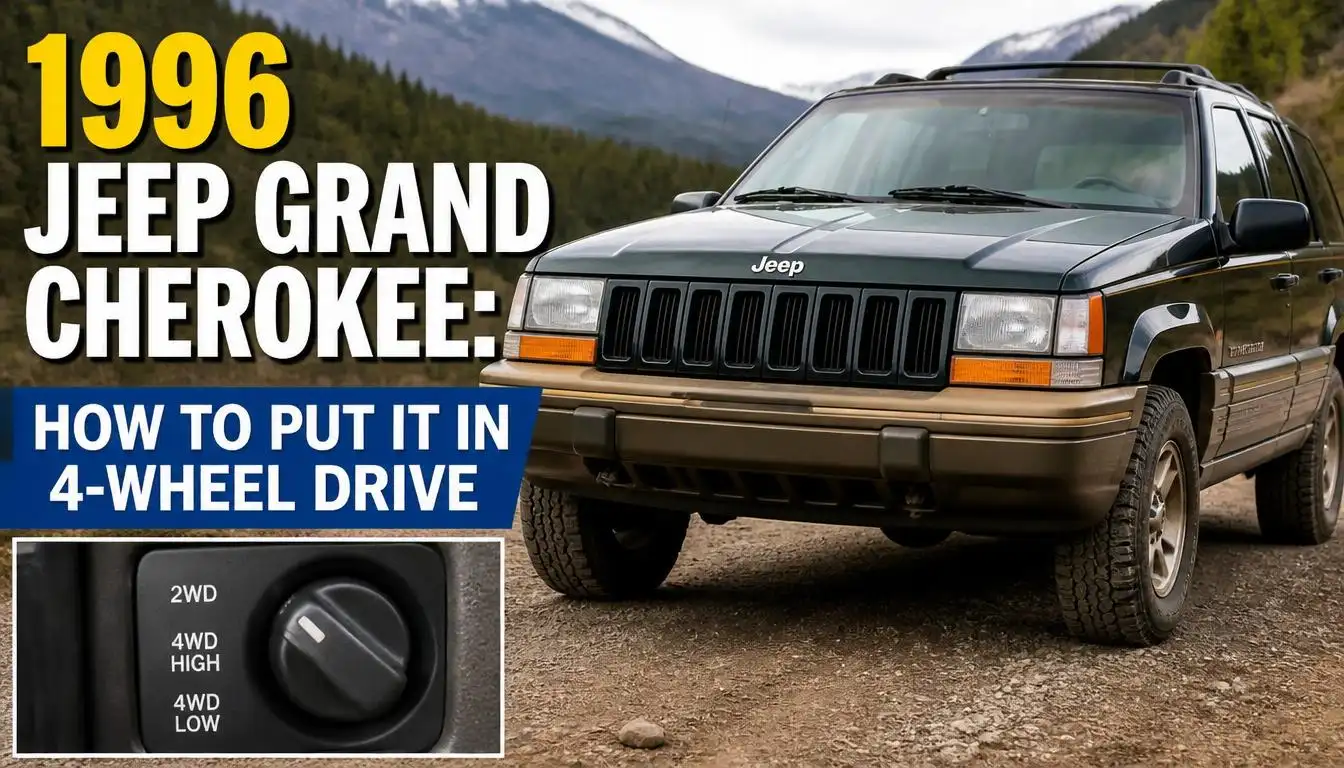
If you are trying to figure out how to put a 1996 Jeep Grand Cherokee in 4-wheel drive, the first thing you need to know is which 4WD system your Jeep has.
That matters because not every 1996 Grand Cherokee uses the same transfer case. A Jeep with Selec-Trac works differently from one with Quadra-Trac. With Selec-Trac, you can manually choose between 2WD and several 4WD modes. With Quadra-Trac, normal driving is already done in full-time four-wheel drive.
So before pulling the transfer-case lever, take a few seconds to identify the system in your Jeep. It can save you from selecting the wrong mode or putting unnecessary stress on the drivetrain.
Quick Answer: How to Put a 1996 Jeep Grand Cherokee in 4WD
If your 1996 Grand Cherokee has Selec-Trac, look at the transfer-case lever beside the transmission shifter. You will normally see:
2WD → 4 PART TIME → 4 FULL TIME → N → 4 LO
For everyday slippery or changing road conditions, move the lever from 2WD to 4 FULL TIME. For loose surfaces where the tires can slip, such as deep snow, mud, or gravel, 4 PART TIME may be more appropriate.
If your Jeep has Quadra-Trac, you may see:
4 ALL TIME → N → 4 LO
In that case, you do not need to switch on regular 4WD. Quadra-Trac operates as a full-time four-wheel-drive system during normal driving. You only need to manually select 4LO when low-range gearing is required.
Period information for the 1996 Grand Cherokee lists rear-wheel drive, Selec-Trac, and Quadra-Trac configurations, with Selec-Trac described as a shift-on-the-fly system and Quadra-Trac as permanent/full-time four-wheel drive.
Identify Your 1996 Jeep Grand Cherokee 4WD System First
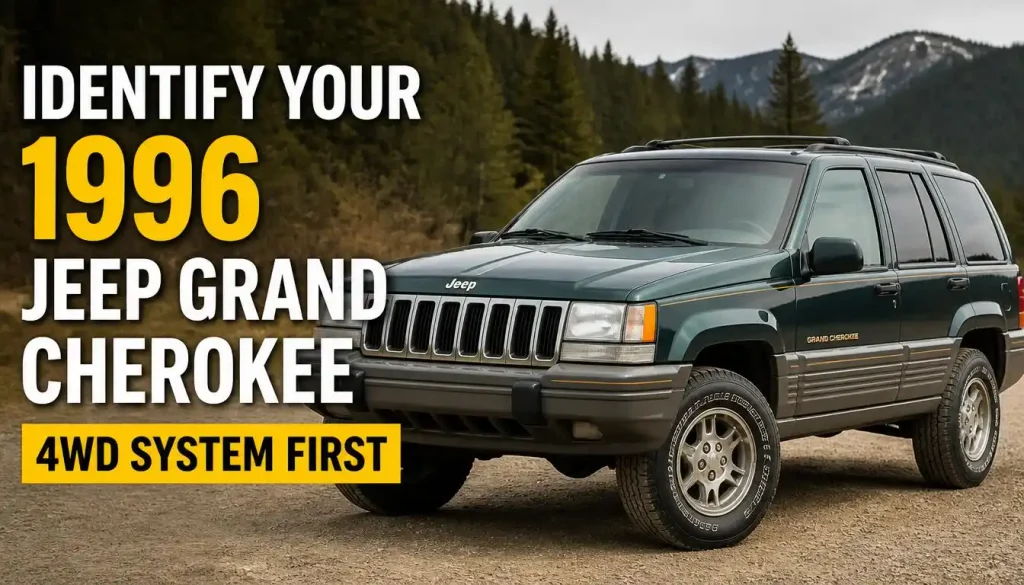
Do not assume that every 1996 Grand Cherokee uses the same 4WD setup.
These vehicles are now decades old. Some may also have had a transfer case replaced or swapped at some point. The safest approach is to look at the actual transfer-case selector and, if necessary, the identification tag on the transfer case.
Selec-Trac
Selec-Trac commonly uses a selector with these positions:
2WD
4 PART TIME
4 FULL TIME
N
4 LO
Selec-Trac lets you choose how the Jeep sends power to the axles. The 1996 factory service manual confirms that with Selec-Trac, the change from two-wheel drive to four-wheel drive takes place inside the transfer case.
If you have all of those positions on the console, the instructions in the Selec-Trac sections below are the ones you need.
Quadra-Trac
A Quadra-Trac Jeep normally has a much simpler selector:
4 ALL TIME
N
4 LO
If you look at your shifter and wonder, “Where is 2WD?” nothing is necessarily missing. Quadra-Trac is designed to operate in four-wheel drive during normal use.
You normally leave it in 4 ALL TIME and drive.
The 4 LO position is there for situations that require low-speed pulling power and additional traction.
What About Command-Trac?
Most U.S.-market information for the 1996 Grand Cherokee focuses on Selec-Trac and Quadra-Trac, and period model information notes that Command-Trac was removed from the regular U.S. Grand Cherokee options for 1996. Factory service information, however, still references Command-Trac-related configurations, and export or right-hand-drive vehicles can differ.
This matters for owners in the UK, Australia, and other export markets.
Instead of assuming the transfer case from the trim badge alone, check:
- The words printed next to the transfer-case lever
- The transfer-case identification tag
- Your original owner’s documentation
- The vehicle’s build information
The 1996 factory service manual also identifies separate VIN coding for 4×2, left-hand-drive 4×4, and right-hand-drive 4×4 Grand Cherokees.
What Do the 4WD Positions Mean?
Before moving the lever, it helps to understand what each position actually does.
| Mode | What It Does | Best Use |
|---|---|---|
| 2WD | Drives mainly through the rear wheels | Normal dry-road driving |
| 4 Full Time | Drives all four wheels while allowing front/rear speed differences | Rain, mixed roads, light snow, changing traction |
| 4 Part Time | Couples the front and rear more directly | Snow, mud, gravel, loose surfaces |
| N | Disconnects drive through the transfer case | Certain towing/service procedures |
| 4LO | Provides low-range gearing and high pulling force | Deep mud, steep terrain, rocks, difficult off-road driving |
The two modes most often confused are 4 Full Time and 4 Part Time.
Full Time can be used on normal paved roads because the system allows the front and rear driveline to accommodate speed differences while turning.
Part Time is intended for surfaces where the tires can slip. Using a locked part-time mode on dry, high-traction pavement can cause driveline binding.
How to Engage 4WD With Selec-Trac
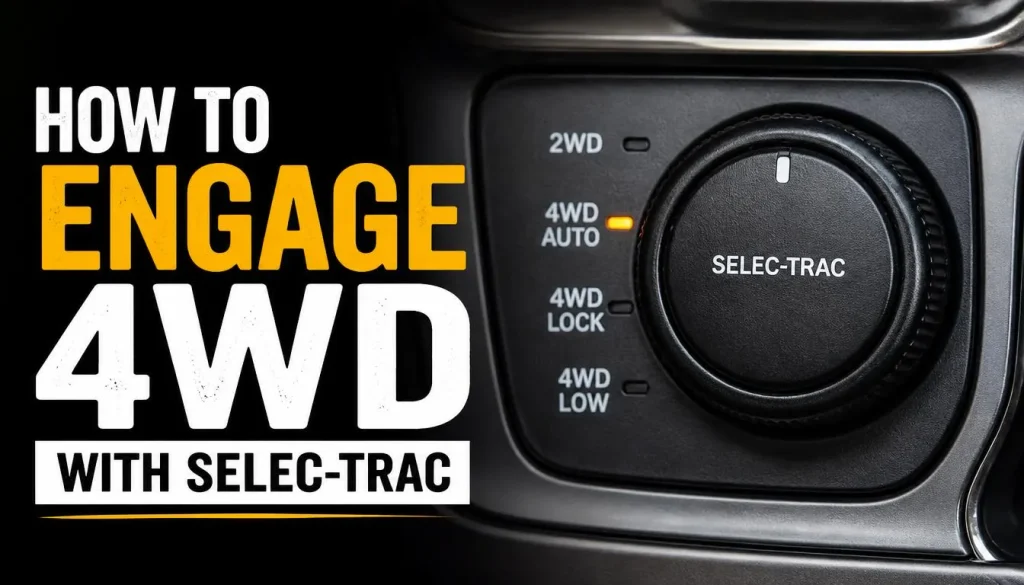
If your Jeep has Selec-Trac, regular high-range 4WD can be selected without going through the low-range procedure.
How to Shift From 2WD to 4 Full Time
For wet roads, patchy snow, changing winter conditions, or other situations where you want additional traction without locking the driveline:
- Keep the Jeep moving at a steady, controlled speed.
- Ease off heavy throttle.
- Move the transfer-case lever from 2WD toward 4 FULL TIME.
- Let the lever settle fully into the selected position.
- Check the 4WD indication on the dash or vehicle information display.
- Continue driving normally.
Selec-Trac was designed with shift-on-the-fly high-range operation, so you normally do not need to stop the Jeep just to move between 2WD and the high-range 4WD selections.
Even so, there is little benefit in making the change while accelerating hard or driving aggressively. A smooth, steady shift is easier on an older drivetrain.
How to Shift Into 4 Part Time
The procedure is similar:
- Reduce throttle input.
- Keep the Jeep moving smoothly.
- Move the transfer-case lever into 4 PART TIME.
- Make sure the lever fully reaches the selected position.
- Confirm the 4WD indicator.
Use 4 Part Time when the road or trail is slippery enough for the tires to release drivetrain tension.
Good examples include:
- Snow-covered roads
- Deep snow
- Mud
- Loose gravel
- Dirt trails
- Loose sand
Avoid using 4 Part Time for routine driving on clean, dry pavement.
Can You Shift Into 4WD While Driving?
Yes, with the Selec-Trac high-range modes, the system was designed to allow shifting while the vehicle is moving.
That does not apply to 4LO.
There is a major difference between moving from 2WD into a high-range 4WD setting and selecting low range. Low range requires a much slower and more deliberate procedure.
What Speed Should You Shift Into 4WD?
For high-range Selec-Trac operation, use a steady road speed and avoid shifting while the wheels are spinning or while you are applying heavy throttle.
Because a 1996 Grand Cherokee may have a replacement transfer case or different export-market equipment, check the instructions for the actual transfer case installed in your Jeep before relying on a maximum shift-speed number.
For 4LO, the procedure is much clearer: bring the Jeep down to roughly 2–3 mph (3–5 km/h) and put the transmission in Neutral before completing the low-range shift. Period 1996 Grand Cherokee road-test information describes the 4-low procedure as slowing to about 3 mph, selecting transmission Neutral, and then shifting into four-low.
How to Shift Back From 4WD to 2WD
With Selec-Trac:
- Drive at a steady speed.
- Ease off the accelerator.
- Move the transfer-case lever toward 2WD.
- Allow the drivetrain a moment to release any tension.
- Check that the indicator changes appropriately.
If the lever has moved but the Jeep seems reluctant to come out of Part Time, do not immediately force anything. Drivetrain tension can sometimes delay disengagement, especially after driving on a surface with more traction than expected.
How Quadra-Trac Works on a 1996 Grand Cherokee
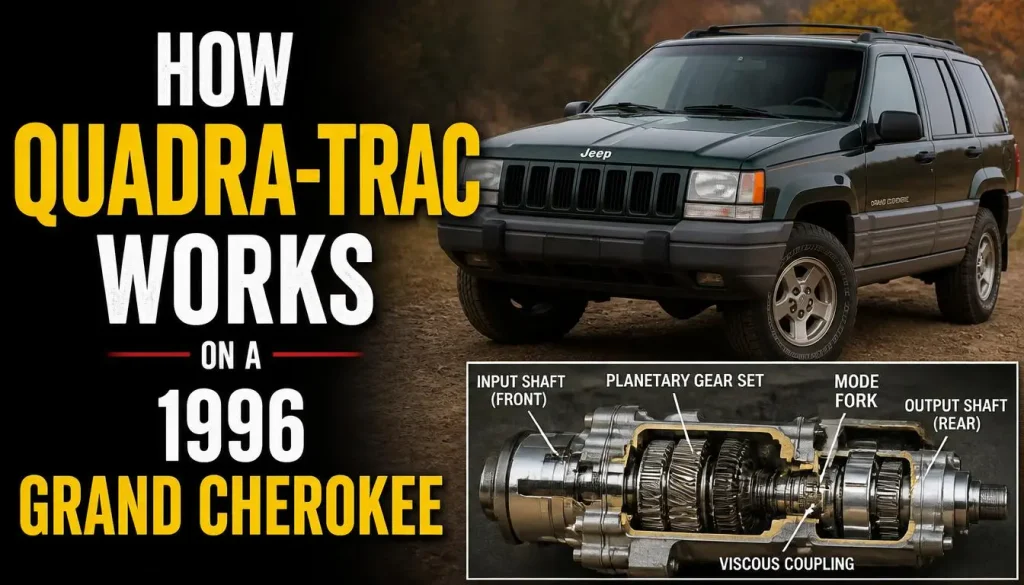
Quadra-Trac can confuse first-time owners because there is no normal 2WD position to select.
That is intentional.
In normal use, leave the transfer-case lever in 4 ALL TIME. The system handles regular four-wheel-drive operation without requiring you to engage 4HI every time the weather changes.
Is Quadra-Trac Always in 4WD?
During normal operation, yes—it is a full-time four-wheel-drive system.
That is why the selector does not work like the lever in a traditional part-time 4×4.
You do not need to stop when rain begins and manually “turn on” ordinary four-wheel drive. Your normal high-range driving position is already 4 ALL TIME.
Do You Need to Manually Engage Quadra-Trac?
Not for normal high-range four-wheel drive.
You manually operate the transfer-case lever mainly when you need:
- Transfer-case Neutral
- 4LO
If your selector says 4 ALL TIME – N – 4 LO, do not try to find a nonexistent 2WD or separate 4HI position.
How to Put a 1996 Jeep Grand Cherokee in 4LO
Four-wheel-drive low range is different from normal 4WD.
Do not simply pull the lever into 4LO at normal road speed.
A practical procedure is:
- Find a safe area where you can move very slowly.
- Slow the Jeep to approximately 2–3 mph (3–5 km/h).
- Keep the vehicle rolling slowly.
- Shift the automatic transmission into Neutral.
- Move the transfer-case lever firmly through its range into 4LO.
- Make sure the lever is fully seated in 4LO.
- Shift the transmission back into Drive or the appropriate forward gear.
- Accelerate gently.
The period procedure for the 1996 Grand Cherokee calls for slowing to about 3 mph and putting the transmission in Neutral before selecting four-low.
Do not casually force the lever if it refuses to move. A badly adjusted linkage, drivetrain tension, or a transfer-case problem may be preventing a clean shift.
How to Shift Out of 4LO
Use the same basic idea in reverse:
- Slow to a walking pace.
- Let the vehicle roll at roughly 2–3 mph.
- Put the transmission into Neutral.
- Move the transfer-case lever firmly out of 4LO and into the correct high-range position.
- Shift the transmission back into Drive.
- Confirm that low range has disengaged before returning to normal speed.
If it refuses to disengage, avoid trying to overpower the lever.
When Should You Use 4LO?
Use 4LO when you need controlled movement and high torque at low speed.
Examples include:
- Deep mud
- Deep snow
- Loose sand
- Rocky trails
- Steep off-road climbs
- Controlled descents
- Pulling through difficult low-speed terrain
4LO is not an “extra powerful highway 4WD mode.” It is low-range gearing intended for slow work.
When Should You Use Each 4WD Mode?
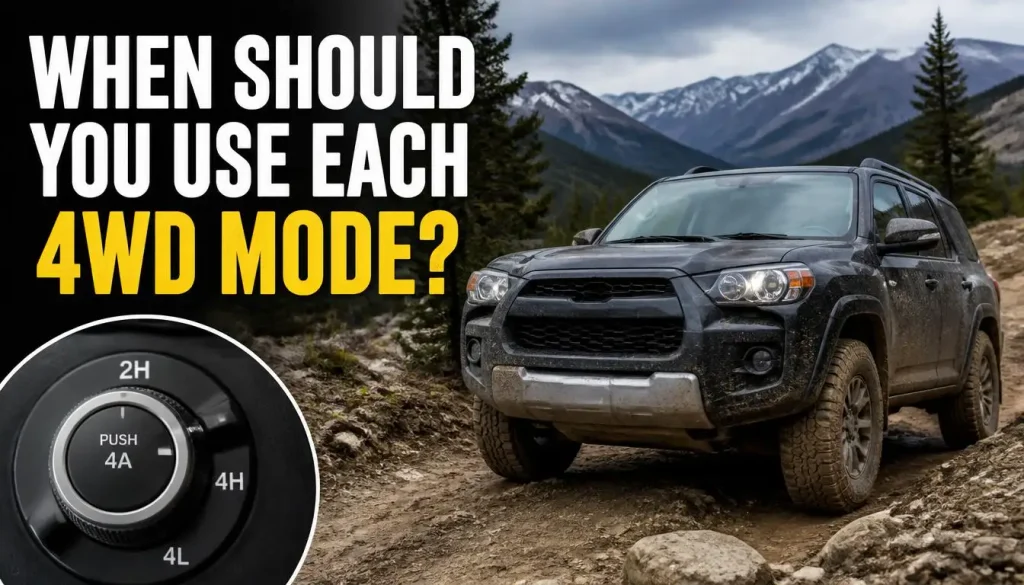
Choosing the correct mode matters more than simply putting the Jeep into four-wheel drive.
Snow and Ice
For Selec-Trac, 4 Full Time is useful when winter roads alternate between clear pavement and slippery sections.
If the road is consistently snow-covered and slippery enough to allow tire slip, 4 Part Time may provide a more locked-in 4WD setup.
Rain and Mixed Road Conditions
Use 4 Full Time with Selec-Trac.
There is normally no reason to use Part Time on ordinary wet pavement.
With Quadra-Trac, simply leave the Jeep in 4 ALL TIME.
Mud
Part Time may be useful for muddy trails where wheel slip is expected.
For deep mud that requires very slow movement and more torque, 4LO may be appropriate.
Sand
Loose sand can require four-wheel drive, but momentum, tire pressure, terrain, and experience all matter.
Use low range only when the conditions actually require low-speed pulling power.
Gravel and Loose Roads
4 Part Time can work well when the surface is loose enough to prevent driveline wind-up.
If the gravel road has frequent paved or high-traction sections, 4 Full Time is often the more convenient Selec-Trac choice.
Steep Hills and Off-Road Trails
4LO is especially useful when you need to move slowly without constantly using heavy throttle.
Low range can also improve control on steep descents by giving the driver more engine braking.
Can You Drive a 1996 Grand Cherokee in 4WD on Dry Pavement?
It depends on the mode.
4 Full Time: Yes. It is designed for normal road use.
Quadra-Trac 4 All Time: Yes. This is the normal driving position.
4 Part Time: Avoid using it on dry, high-traction pavement.
4LO: Do not use it for normal dry-road driving.
Why?
When a part-time or low-range mode mechanically ties the front and rear sides of the drivetrain together, the system needs some tire slip to release the difference in wheel speed that happens during turns.
On dry pavement, that slip may not occur. Instead, tension can build inside the drivetrain.
You may notice:
- Steering resistance
- Tire scrubbing
- Hopping
- Jerking during tight turns
- A feeling that the Jeep is fighting itself
If that happens, get onto an appropriate loose surface when safe and shift back to the correct mode.
How Fast Can You Drive in 4WD?
There is no single answer because “4WD” can mean several different modes.
4 Full Time is a normal high-range driving mode and can be used at normal appropriate road speeds.
Quadra-Trac 4 All Time is also the normal high-range driving setting.
4 Part Time should be used according to traction conditions rather than as an excuse to drive faster in snow or mud.
4LO is a low-speed mode. If the terrain allows normal road speed, you probably do not need low range anymore.
Remember that four-wheel drive can help the Jeep accelerate on slippery surfaces, but it does not magically shorten braking distance. Snow, ice, mud, worn tires, and excessive speed can still put you into a slide.
How to Know If 4WD Is Actually Engaged
Start with the transfer-case lever position and the dashboard display.
The 1996 factory service information shows that the vehicle information system receives transfer-case mode information and distinguishes Quadra-Trac from Command-Trac/Selec-Trac configurations.
If everything is working correctly, the indicator should correspond with the selected mode.
However, remember that an indicator only tells you what the electrical system sees. On an older vehicle, a faulty switch, linkage, or internal transfer-case problem can still cause the actual mechanical state to differ.
Do not test 4WD by flooring the accelerator on pavement.
If you genuinely need to confirm operation, inspect the system properly or have a technician diagnose it.
Why Won’t My 1996 Jeep Grand Cherokee Go Into 4WD?
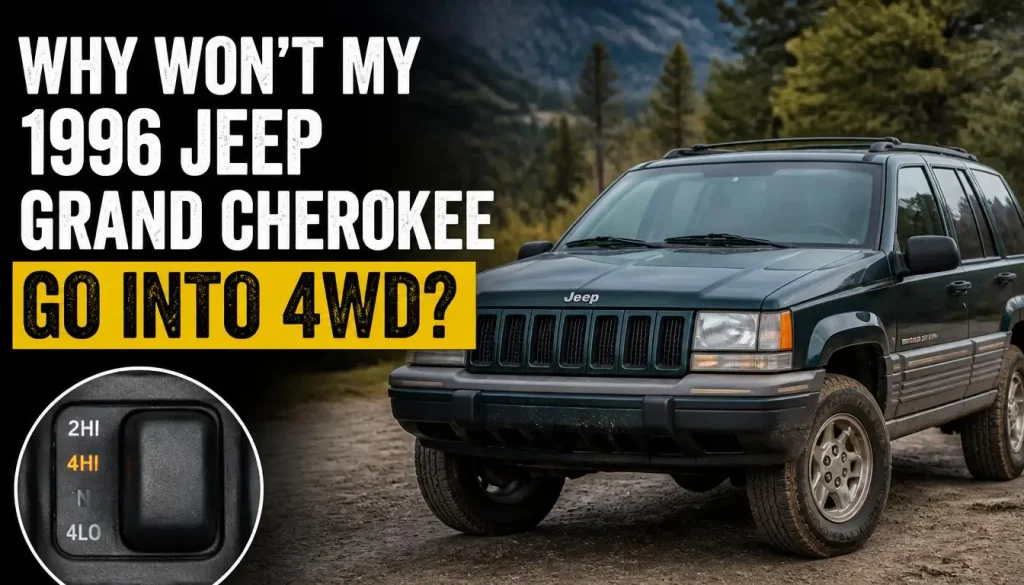
A 1996 Grand Cherokee is now an older vehicle, so problems are not always caused by driver technique.
Here are some of the more likely areas to check.
Transfer-Case Lever Won’t Move
Do not immediately pull harder.
Possible causes include:
- Shift linkage out of adjustment
- Corroded or seized linkage
- Drivetrain tension
- Internal transfer-case problems
Try following the correct shifting procedure on an appropriate surface first. If the lever still refuses to move, inspect the linkage.
Lever Moves but 4WD Doesn’t Engage
The lever position does not guarantee that the transfer case completed the shift.
Possible issues include:
- Loose linkage
- Incorrect linkage adjustment
- Damaged shift components
- Internal transfer-case wear
Have the system inspected if the Jeep remains in the same drive mode regardless of lever position.
The 4WD Light Doesn’t Come On
If the Jeep appears to shift normally but the dashboard does not show the correct mode, the problem may be electrical rather than mechanical.
Possible causes include:
- Transfer-case position switch
- Wiring
- Connector corrosion
- Display or indicator fault
Do not assume the entire 4WD system is broken just because a light fails to appear.
Jeep Won’t Shift Back Into 2WD
This can happen when the drivetrain is loaded or wound up.
Ease off the throttle and allow the Jeep to roll straight on a suitable surface. A small amount of movement may let the driveline release.
If the lever is physically jammed, stop trying to force it and check the linkage.
Jeep Is Stuck in 4LO
First make sure you are following the low-range disengagement procedure:
- Vehicle moving very slowly
- Transmission in Neutral
- Transfer-case lever moved firmly into high range
If it still will not shift, linkage adjustment or an internal transfer-case issue may need attention.
Grinding When Shifting Into 4LO
A grinding sound can occur when the input and output parts of the transfer case are rotating at incompatible speeds.
Make sure you have slowed to the proper crawl and placed the transmission in Neutral before moving the transfer-case lever.
If grinding happens repeatedly even with the correct procedure, stop forcing the shift and have the system inspected.
Jeep Hops or Binds During Turns
Binding or tire hopping is a classic sign that the drivetrain cannot release the difference between front and rear wheel speeds.
If you have Selec-Trac, first check whether you accidentally left it in 4 PART TIME rather than 4 FULL TIME.
If a Quadra-Trac Jeep binds badly during normal paved-road driving, the transfer case may need diagnosis rather than a different lever position.
Transfer-Case Shift Linkage Is Out of Adjustment
The shift lever operates the transfer case through mechanical linkage. With age, worn bushings or incorrect adjustment can prevent the lever from fully selecting a range.
If your shifter position and actual transfer-case position do not seem to match, inspect the linkage before assuming the entire transfer case has failed.
Common 4WD Mistakes to Avoid
A few simple mistakes cause a lot of confusion with these Jeeps.
- Do not assume every 1996 Grand Cherokee has the same transfer case.
- Do not treat 4 Full Time and 4 Part Time as the same mode.
- Do not use 4 Part Time for routine driving on dry pavement.
- Do not shift into 4LO at normal road speed.
- Do not use 4LO as a highway driving mode.
- Do not force a transfer-case lever that is clearly stuck.
- Do not ignore repeated grinding, hopping, or binding.
- Do not confuse transmission Neutral with transfer-case Neutral.
- Do not assume a dashboard light alone proves that the transfer case mechanically completed the shift.
- Do not forget that an older Jeep may no longer have its original transfer case.
When in doubt, look at the selector pattern and transfer-case identification before doing anything else.
Frequently Asked Questions
How do I put my 1996 Jeep Grand Cherokee in 4-wheel drive?
If it has Selec-Trac, move the transfer-case lever from 2WD into either 4 Full Time or 4 Part Time depending on road conditions. If it has Quadra-Trac and the selector says 4 All Time, normal four-wheel drive is already active.
Is a 1996 Jeep Grand Cherokee always in four-wheel drive?
Not every one is. Some 1996 Grand Cherokees were rear-wheel drive, while 4WD models could use systems such as Selec-Trac or Quadra-Trac. Quadra-Trac normally operates in full-time four-wheel drive.
How do I know if I have Selec-Trac or Quadra-Trac?
Look beside the transfer-case lever. Selec-Trac generally includes 2WD, 4 Part Time, 4 Full Time, Neutral, and 4LO. Quadra-Trac typically shows 4 All Time, Neutral, and 4LO.
If the vehicle has been modified, confirm the transfer-case ID itself.
Can I shift my 1996 Grand Cherokee into 4WD while driving?
With Selec-Trac, high-range four-wheel-drive selections are designed for shift-on-the-fly operation. Low range is different and should only be selected using the proper slow-speed Neutral procedure.
What speed should I use when shifting into 4LO?
Slow to roughly 2–3 mph (3–5 km/h), place the transmission in Neutral, and then complete the transfer-case shift into low range.
Can I use 4 Full Time on dry pavement?
Yes. That is one of the advantages of Selec-Trac’s Full Time mode. It allows the front and rear driveline to accommodate different rotational speeds during normal driving and turning.
What is the difference between 4 Full Time and 4 Part Time?
4 Full Time is suitable for normal paved roads as well as changing traction conditions.
4 Part Time couples the front and rear drivetrain more directly and is intended for surfaces such as snow, mud, dirt, or loose gravel where the tires can slip.
How do I put a 1996 Grand Cherokee into 4 Low?
Slow to about 2–3 mph, shift the transmission into Neutral, and move the transfer-case lever firmly into 4LO. Once it is fully engaged, return the transmission to Drive and proceed slowly.
Why won’t my Jeep come out of 4WD?
Drivetrain tension, a worn or misadjusted shift linkage, or an internal transfer-case problem can prevent clean disengagement. Do not force the lever. Allow the Jeep to roll straight on an appropriate surface and try the proper procedure again.
Why does my Jeep hop or bind when turning in 4WD?
If you have Selec-Trac, first check whether you are using 4 Part Time on a high-traction surface. If a Quadra-Trac Jeep binds during ordinary paved-road driving, the transfer case should be inspected for a possible mechanical problem.
Final Takeaway
Putting a 1996 Jeep Grand Cherokee in four-wheel drive is simple once you know which transfer case you have.
With Selec-Trac, choose 4 Full Time for normal or mixed road conditions and 4 Part Time for loose, slippery surfaces. With Quadra-Trac, normal high-range four-wheel drive is already active in 4 All Time.
Use 4LO only for slow, difficult terrain, and shift into it at roughly 2–3 mph with the transmission in Neutral.
Most importantly, check the selector in your actual Jeep before following any 4WD instructions. With a vehicle this old, identifying the transfer case is more reliable than assuming its setup from the trim badge alone.

“Cars aren’t just machines. They’re freedom, memory, and a little bit of grease under your fingernails.”
I’m Theodore Roosevelt—though my friends just call me “Ted” (and no, I’m not related to the president, though I do share his love for adventure). I grew up in Detroit in the 1970s, back when the city was still the heart of the American auto industry. My first love was a rusted-out 1967 Mustang my father and I rebuilt in our garage when I was fifteen. That project taught me that cars have souls. After spending twenty years as a mechanic and another ten writing for magazines, I started this blog to help everyday drivers and weekend wrenchers feel confident under the hood. Whether you’re restoring a classic or just trying to keep your daily driver alive for one more winter, I’m here to help you get there.